

6 Charge Carrier Dynamics in Polymer Solar Cells
125
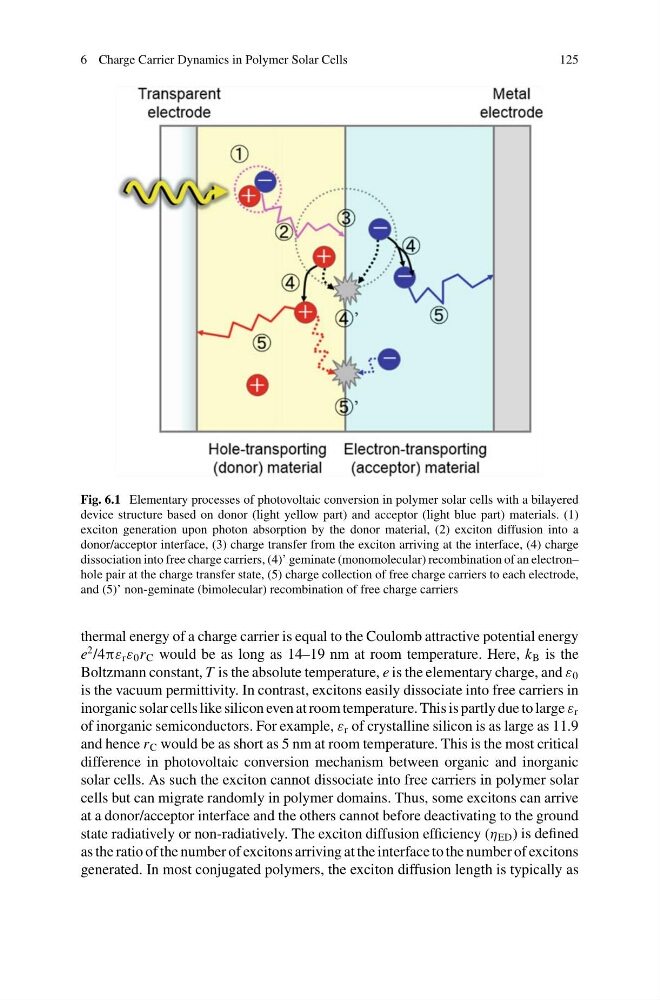
Fig. 6.1 Elementary processes of photovoltaic conversion in polymer solar cells with a bilayered
device structure based on donor (light yellow part) and acceptor (light blue part) materials. (1)
exciton generation upon photon absorption by the donor material, (2) exciton diffusion into a
donor/acceptor interface, (3) charge transfer from the exciton arriving at the interface, (4) charge
dissociation into free charge carriers, (4)’ geminate (monomolecular) recombination of an electron–
hole pair at the charge transfer state, (5) charge collection of free charge carriers to each electrode,
and (5)’ non-geminate (bimolecular) recombination of free charge carriers
thermal energy of a charge carrier is equal to the Coulomb attractive potential energy
e
2 /4πε r ε 0 r C would be as long as 14–19 nm at room temperature. Here, k B is the
Boltzmann constant, T is the absolute temperature, e is the elementary charge, and ε 0
is the vacuum permittivity. In contrast, excitons easily dissociate into free carriers in
inorganic solar cells like silicon even at room temperature. This is partly due to large ε r
of inorganic semiconductors. For example, ε r of crystalline silicon is as large as 11.9
and hence r C would be as short as 5 nm at room temperature. This is the most critical
difference in photovoltaic conversion mechanism between organic and inorganic
solar cells. As such the exciton cannot dissociate into free carriers in polymer solar
cells but can migrate randomly in polymer domains. Thus, some excitons can arrive
at a donor/acceptor interface and the others cannot before deactivating to the ground
state radiatively or non-radiatively. The exciton diffusion efficiency (η ED ) is defined
as the ratio of the number of excitons arriving at the interface to the number of excitons
generated. In most conjugated polymers, the exciton diffusion length is typically as
125
Fig. 6.1 Elementary processes of photovoltaic conversion in polymer solar cells with a bilayered
device structure based on donor (light yellow part) and acceptor (light blue part) materials. (1)
exciton generation upon photon absorption by the donor material, (2) exciton diffusion into a
donor/acceptor interface, (3) charge transfer from the exciton arriving at the interface, (4) charge
dissociation into free charge carriers, (4)’ geminate (monomolecular) recombination of an electron–
hole pair at the charge transfer state, (5) charge collection of free charge carriers to each electrode,
and (5)’ non-geminate (bimolecular) recombination of free charge carriers
thermal energy of a charge carrier is equal to the Coulomb attractive potential energy
e
2 /4πε r ε 0 r C would be as long as 14–19 nm at room temperature. Here, k B is the
Boltzmann constant, T is the absolute temperature, e is the elementary charge, and ε 0
is the vacuum permittivity. In contrast, excitons easily dissociate into free carriers in
inorganic solar cells like silicon even at room temperature. This is partly due to large ε r
of inorganic semiconductors. For example, ε r of crystalline silicon is as large as 11.9
and hence r C would be as short as 5 nm at room temperature. This is the most critical
difference in photovoltaic conversion mechanism between organic and inorganic
solar cells. As such the exciton cannot dissociate into free carriers in polymer solar
cells but can migrate randomly in polymer domains. Thus, some excitons can arrive
at a donor/acceptor interface and the others cannot before deactivating to the ground
state radiatively or non-radiatively. The exciton diffusion efficiency (η ED ) is defined
as the ratio of the number of excitons arriving at the interface to the number of excitons
generated. In most conjugated polymers, the exciton diffusion length is typically as