

5 Polymer Solar Cells: Development of π-Conjugated Polymers …
113
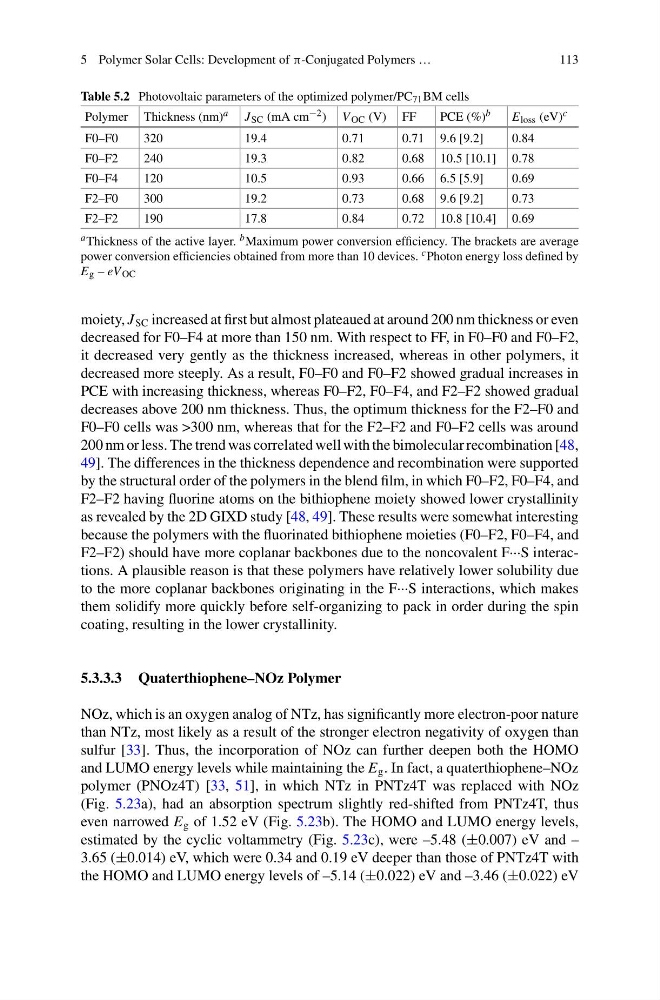
Table 5.2 Photovoltaic parameters of the optimized polymer/PC 71 BM cells
Polymer Thickness (nm) a J SC (mA cm −2 ) V OC (V) FF
PCE (%) b
E loss (eV) c
F0–F0
320
19.4
0.71
0.71 9.6 [9.2]
0.84
F0–F2
240
19.3
0.82
0.68 10.5 [10.1] 0.78
F0–F4
120
10.5
0.93
0.66 6.5 [5.9]
0.69
F2–F0
300
19.2
0.73
0.68 9.6 [9.2]
0.73
F2–F2
190
17.8
0.84
0.72 10.8 [10.4] 0.69
a Thickness of the active layer. b Maximum power conversion efficiency. The brackets are average
power conversion efficiencies obtained from more than 10 devices. c Photon energy loss defined by
E g – eV OC
moiety, J SC increased at first but almost plateaued at around 200 nm thickness or even
decreased for F0–F4 at more than 150 nm. With respect to FF, in F0–F0 and F0–F2,
it decreased very gently as the thickness increased, whereas in other polymers, it
decreased more steeply. As a result, F0–F0 and F0–F2 showed gradual increases in
PCE with increasing thickness, whereas F0–F2, F0–F4, and F2–F2 showed gradual
decreases above 200 nm thickness. Thus, the optimum thickness for the F2–F0 and
F0–F0 cells was >300 nm, whereas that for the F2–F2 and F0–F2 cells was around
200 nm or less. The trend was correlated well with the bimolecular recombination [48,
49]. The differences in the thickness dependence and recombination were supported
by the structural order of the polymers in the blend film, in which F0–F2, F0–F4, and
F2–F2 having fluorine atoms on the bithiophene moiety showed lower crystallinity
as revealed by the 2D GIXD study [48, 49]. These results were somewhat interesting
because the polymers with the fluorinated bithiophene moieties (F0–F2, F0–F4, and
F2–F2) should have more coplanar backbones due to the noncovalent F···S interactions. A plausible reason is that these polymers have relatively lower solubility due
to the more coplanar backbones originating in the F···S interactions, which makes
them solidify more quickly before self-organizing to pack in order during the spin
coating, resulting in the lower crystallinity.
5.3.3.3 Quaterthiophene–NOz Polymer
NOz, which is an oxygen analog of NTz, has significantly more electron-poor nature
than NTz, most likely as a result of the stronger electron negativity of oxygen than
sulfur [33]. Thus, the incorporation of NOz can further deepen both the HOMO
and LUMO energy levels while maintaining the E g . In fact, a quaterthiophene–NOz
polymer (PNOz4T) [33, 51], in which NTz in PNTz4T was replaced with NOz
(Fig. 5.23a), had an absorption spectrum slightly red-shifted from PNTz4T, thus
even narrowed E g of 1.52 eV (Fig. 5.23b). The HOMO and LUMO energy levels,
estimated by the cyclic voltammetry (Fig. 5.23c), were –5.48 (±0.007) eV and –
3.65 (±0.014) eV, which were 0.34 and 0.19 eV deeper than those of PNTz4T with
the HOMO and LUMO energy levels of –5.14 (±0.022) eV and –3.46 (±0.022) eV
113
Table 5.2 Photovoltaic parameters of the optimized polymer/PC 71 BM cells
Polymer Thickness (nm) a J SC (mA cm −2 ) V OC (V) FF
PCE (%) b
E loss (eV) c
F0–F0
320
19.4
0.71
0.71 9.6 [9.2]
0.84
F0–F2
240
19.3
0.82
0.68 10.5 [10.1] 0.78
F0–F4
120
10.5
0.93
0.66 6.5 [5.9]
0.69
F2–F0
300
19.2
0.73
0.68 9.6 [9.2]
0.73
F2–F2
190
17.8
0.84
0.72 10.8 [10.4] 0.69
a Thickness of the active layer. b Maximum power conversion efficiency. The brackets are average
power conversion efficiencies obtained from more than 10 devices. c Photon energy loss defined by
E g – eV OC
moiety, J SC increased at first but almost plateaued at around 200 nm thickness or even
decreased for F0–F4 at more than 150 nm. With respect to FF, in F0–F0 and F0–F2,
it decreased very gently as the thickness increased, whereas in other polymers, it
decreased more steeply. As a result, F0–F0 and F0–F2 showed gradual increases in
PCE with increasing thickness, whereas F0–F2, F0–F4, and F2–F2 showed gradual
decreases above 200 nm thickness. Thus, the optimum thickness for the F2–F0 and
F0–F0 cells was >300 nm, whereas that for the F2–F2 and F0–F2 cells was around
200 nm or less. The trend was correlated well with the bimolecular recombination [48,
49]. The differences in the thickness dependence and recombination were supported
by the structural order of the polymers in the blend film, in which F0–F2, F0–F4, and
F2–F2 having fluorine atoms on the bithiophene moiety showed lower crystallinity
as revealed by the 2D GIXD study [48, 49]. These results were somewhat interesting
because the polymers with the fluorinated bithiophene moieties (F0–F2, F0–F4, and
F2–F2) should have more coplanar backbones due to the noncovalent F···S interactions. A plausible reason is that these polymers have relatively lower solubility due
to the more coplanar backbones originating in the F···S interactions, which makes
them solidify more quickly before self-organizing to pack in order during the spin
coating, resulting in the lower crystallinity.
5.3.3.3 Quaterthiophene–NOz Polymer
NOz, which is an oxygen analog of NTz, has significantly more electron-poor nature
than NTz, most likely as a result of the stronger electron negativity of oxygen than
sulfur [33]. Thus, the incorporation of NOz can further deepen both the HOMO
and LUMO energy levels while maintaining the E g . In fact, a quaterthiophene–NOz
polymer (PNOz4T) [33, 51], in which NTz in PNTz4T was replaced with NOz
(Fig. 5.23a), had an absorption spectrum slightly red-shifted from PNTz4T, thus
even narrowed E g of 1.52 eV (Fig. 5.23b). The HOMO and LUMO energy levels,
estimated by the cyclic voltammetry (Fig. 5.23c), were –5.48 (±0.007) eV and –
3.65 (±0.014) eV, which were 0.34 and 0.19 eV deeper than those of PNTz4T with
the HOMO and LUMO energy levels of –5.14 (±0.022) eV and –3.46 (±0.022) eV