

5 Polymer Solar Cells: Development of π-Conjugated Polymers …
103
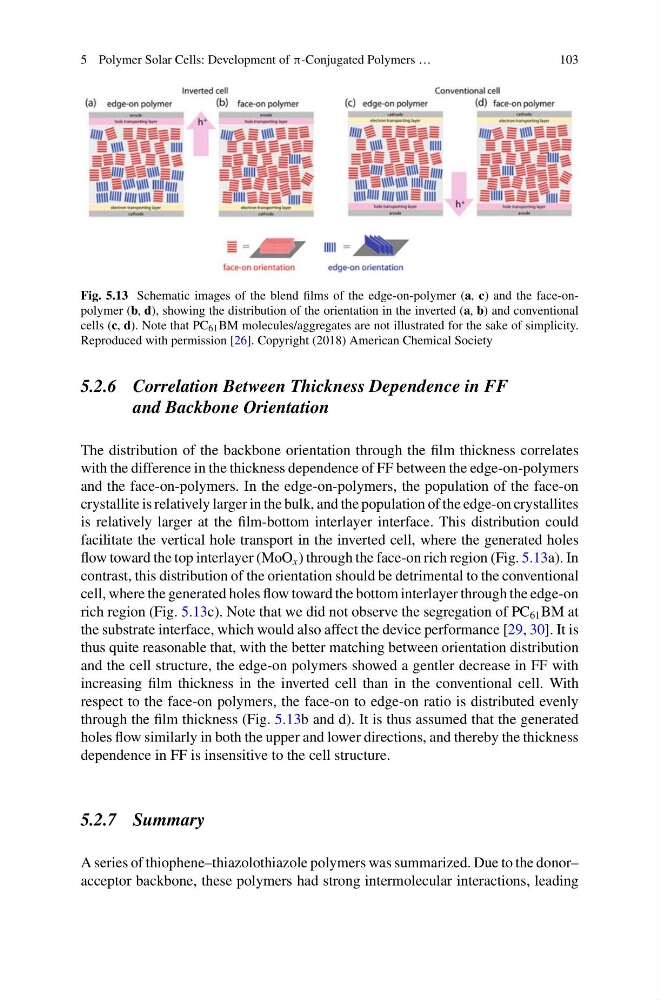
Fig. 5.13 Schematic images of the blend films of the edge-on-polymer (a, c) and the face-onpolymer (b, d), showing the distribution of the orientation in the inverted (a, b) and conventional
cells (c, d). Note that PC 61 BM molecules/aggregates are not illustrated for the sake of simplicity.
Reproduced with permission [26]. Copyright (2018) American Chemical Society
5.2.6 Correlation Between Thickness Dependence in FF
and Backbone Orientation
The distribution of the backbone orientation through the film thickness correlates
with the difference in the thickness dependence of FF between the edge-on-polymers
and the face-on-polymers. In the edge-on-polymers, the population of the face-on
crystallite is relatively larger in the bulk, and the population of the edge-on crystallites
is relatively larger at the film-bottom interlayer interface. This distribution could
facilitate the vertical hole transport in the inverted cell, where the generated holes
flow toward the top interlayer (MoO x ) through the face-on rich region (Fig. 5.13a). In
contrast, this distribution of the orientation should be detrimental to the conventional
cell, where the generated holes flow toward the bottom interlayer through the edge-on
rich region (Fig. 5.13c). Note that we did not observe the segregation of PC 61 BM at
the substrate interface, which would also affect the device performance [29, 30]. It is
thus quite reasonable that, with the better matching between orientation distribution
and the cell structure, the edge-on polymers showed a gentler decrease in FF with
increasing film thickness in the inverted cell than in the conventional cell. With
respect to the face-on polymers, the face-on to edge-on ratio is distributed evenly
through the film thickness (Fig. 5.13b and d). It is thus assumed that the generated
holes flow similarly in both the upper and lower directions, and thereby the thickness
dependence in FF is insensitive to the cell structure.
5.2.7 Summary
A series of thiophene–thiazolothiazole polymers was summarized. Due to the donor–
acceptor backbone, these polymers had strong intermolecular interactions, leading
103
Fig. 5.13 Schematic images of the blend films of the edge-on-polymer (a, c) and the face-onpolymer (b, d), showing the distribution of the orientation in the inverted (a, b) and conventional
cells (c, d). Note that PC 61 BM molecules/aggregates are not illustrated for the sake of simplicity.
Reproduced with permission [26]. Copyright (2018) American Chemical Society
5.2.6 Correlation Between Thickness Dependence in FF
and Backbone Orientation
The distribution of the backbone orientation through the film thickness correlates
with the difference in the thickness dependence of FF between the edge-on-polymers
and the face-on-polymers. In the edge-on-polymers, the population of the face-on
crystallite is relatively larger in the bulk, and the population of the edge-on crystallites
is relatively larger at the film-bottom interlayer interface. This distribution could
facilitate the vertical hole transport in the inverted cell, where the generated holes
flow toward the top interlayer (MoO x ) through the face-on rich region (Fig. 5.13a). In
contrast, this distribution of the orientation should be detrimental to the conventional
cell, where the generated holes flow toward the bottom interlayer through the edge-on
rich region (Fig. 5.13c). Note that we did not observe the segregation of PC 61 BM at
the substrate interface, which would also affect the device performance [29, 30]. It is
thus quite reasonable that, with the better matching between orientation distribution
and the cell structure, the edge-on polymers showed a gentler decrease in FF with
increasing film thickness in the inverted cell than in the conventional cell. With
respect to the face-on polymers, the face-on to edge-on ratio is distributed evenly
through the film thickness (Fig. 5.13b and d). It is thus assumed that the generated
holes flow similarly in both the upper and lower directions, and thereby the thickness
dependence in FF is insensitive to the cell structure.
5.2.7 Summary
A series of thiophene–thiazolothiazole polymers was summarized. Due to the donor–
acceptor backbone, these polymers had strong intermolecular interactions, leading