

102
I. Osaka
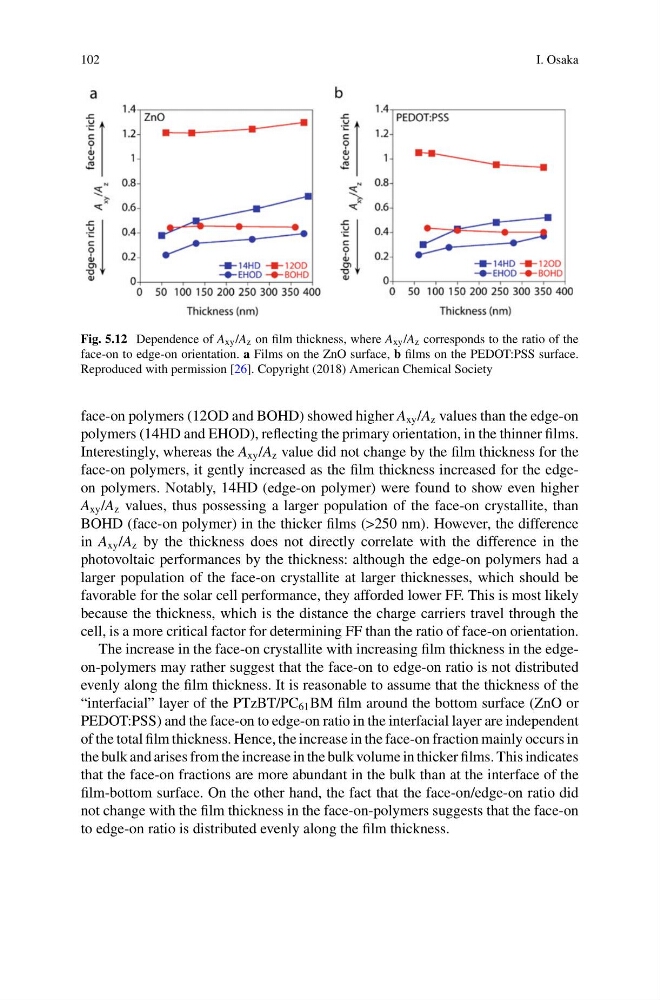
Fig. 5.12 Dependence of A xy /A z on film thickness, where A xy /A z corresponds to the ratio of the
face-on to edge-on orientation. a Films on the ZnO surface, b films on the PEDOT:PSS surface.
Reproduced with permission [26]. Copyright (2018) American Chemical Society
face-on polymers (12OD and BOHD) showed higher A xy /A z values than the edge-on
polymers (14HD and EHOD), reflecting the primary orientation, in the thinner films.
Interestingly, whereas the A xy /A z value did not change by the film thickness for the
face-on polymers, it gently increased as the film thickness increased for the edgeon polymers. Notably, 14HD (edge-on polymer) were found to show even higher
A xy /A z values, thus possessing a larger population of the face-on crystallite, than
BOHD (face-on polymer) in the thicker films (>250 nm). However, the difference
in A xy /A z by the thickness does not directly correlate with the difference in the
photovoltaic performances by the thickness: although the edge-on polymers had a
larger population of the face-on crystallite at larger thicknesses, which should be
favorable for the solar cell performance, they afforded lower FF. This is most likely
because the thickness, which is the distance the charge carriers travel through the
cell, is a more critical factor for determining FF than the ratio of face-on orientation.
The increase in the face-on crystallite with increasing film thickness in the edgeon-polymers may rather suggest that the face-on to edge-on ratio is not distributed
evenly along the film thickness. It is reasonable to assume that the thickness of the
“interfacial” layer of the PTzBT/PC 61 BM film around the bottom surface (ZnO or
PEDOT:PSS) and the face-on to edge-on ratio in the interfacial layer are independent
of the total film thickness. Hence, the increase in the face-on fraction mainly occurs in
the bulk and arises from the increase in the bulk volume in thicker films. This indicates
that the face-on fractions are more abundant in the bulk than at the interface of the
film-bottom surface. On the other hand, the fact that the face-on/edge-on ratio did
not change with the film thickness in the face-on-polymers suggests that the face-on
to edge-on ratio is distributed evenly along the film thickness.
I. Osaka
Fig. 5.12 Dependence of A xy /A z on film thickness, where A xy /A z corresponds to the ratio of the
face-on to edge-on orientation. a Films on the ZnO surface, b films on the PEDOT:PSS surface.
Reproduced with permission [26]. Copyright (2018) American Chemical Society
face-on polymers (12OD and BOHD) showed higher A xy /A z values than the edge-on
polymers (14HD and EHOD), reflecting the primary orientation, in the thinner films.
Interestingly, whereas the A xy /A z value did not change by the film thickness for the
face-on polymers, it gently increased as the film thickness increased for the edgeon polymers. Notably, 14HD (edge-on polymer) were found to show even higher
A xy /A z values, thus possessing a larger population of the face-on crystallite, than
BOHD (face-on polymer) in the thicker films (>250 nm). However, the difference
in A xy /A z by the thickness does not directly correlate with the difference in the
photovoltaic performances by the thickness: although the edge-on polymers had a
larger population of the face-on crystallite at larger thicknesses, which should be
favorable for the solar cell performance, they afforded lower FF. This is most likely
because the thickness, which is the distance the charge carriers travel through the
cell, is a more critical factor for determining FF than the ratio of face-on orientation.
The increase in the face-on crystallite with increasing film thickness in the edgeon-polymers may rather suggest that the face-on to edge-on ratio is not distributed
evenly along the film thickness. It is reasonable to assume that the thickness of the
“interfacial” layer of the PTzBT/PC 61 BM film around the bottom surface (ZnO or
PEDOT:PSS) and the face-on to edge-on ratio in the interfacial layer are independent
of the total film thickness. Hence, the increase in the face-on fraction mainly occurs in
the bulk and arises from the increase in the bulk volume in thicker films. This indicates
that the face-on fractions are more abundant in the bulk than at the interface of the
film-bottom surface. On the other hand, the fact that the face-on/edge-on ratio did
not change with the film thickness in the face-on-polymers suggests that the face-on
to edge-on ratio is distributed evenly along the film thickness.