

5 Polymer Solar Cells: Development of π-Conjugated Polymers …
95
0
0 . 5
1 . 0
1 . 5
2 . 0
qxy (Å -1 )
0
0 . 5
1 . 0
1 . 5
2 . 0
~qz (Å -1
)
0
0 . 5
1 . 0
1 . 5
2 . 0
~qz (Å -1
)
0
0 . 5
1 . 0
1 . 5
2 . 0
0
0 . 5
1 . 0
1 . 5
2 . 0
0
0 . 5
1 . 0
1 . 5
2 . 0
0
0.5
1.0
1.5
2.0
qxy (Å -1 )
0
0.5
1.0
1.5
2.0
qxy (Å -1 )
0
0 . 5
1 . 0
1 . 5
2 . 0
0
0 . 5
1 . 0
1 . 5
2 . 0
a
b
0
0.5
1.0
1.5
2.0
~qz
(Å -1
)
0
0.5
1.0
1.5
2.0
0
0 . 5
1 . 0
1 . 5
2 . 0
qxy (Å -1 )
0
0 . 5
1 . 0
1 . 5
2 . 0
~qz (Å -1
)
0
0 . 5
1 . 0
1 . 5
2 . 0
0
0 . 5
1 . 0
1 . 5
2 . 0
0
0.5
1.0
1.5
2.0
qxy (Å -1 )
0
0.5
1.0
1.5
2.0
0
0.5
1.0
1.5
2.0
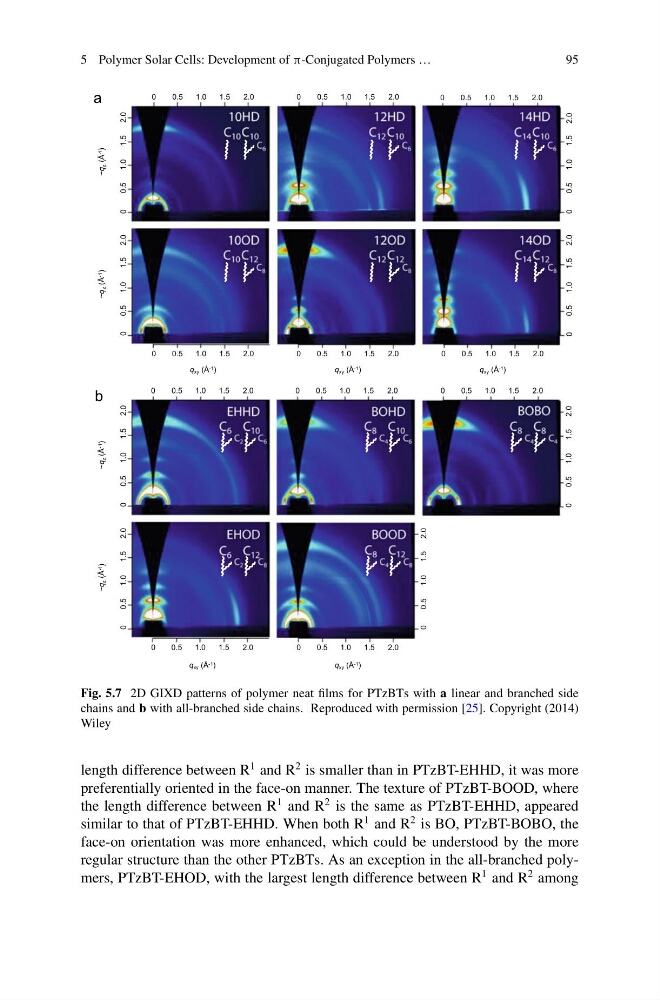
Fig. 5.7 2D GIXD patterns of polymer neat films for PTzBTs with a linear and branched side
chains and b with all-branched side chains. Reproduced with permission [25]. Copyright (2014)
Wiley
length difference between R
1 and R
2 is smaller than in PTzBT-EHHD, it was more
preferentially oriented in the face-on manner. The texture of PTzBT-BOOD, where
the length difference between R
1 and R
2 is the same as PTzBT-EHHD, appeared
similar to that of PTzBT-EHHD. When both R
1 and R
2 is BO, PTzBT-BOBO, the
face-on orientation was more enhanced, which could be understood by the more
regular structure than the other PTzBTs. As an exception in the all-branched polymers, PTzBT-EHOD, with the largest length difference between R
1 and R
2 among
95
0
0 . 5
1 . 0
1 . 5
2 . 0
qxy (Å -1 )
0
0 . 5
1 . 0
1 . 5
2 . 0
~qz (Å -1
)
0
0 . 5
1 . 0
1 . 5
2 . 0
~qz (Å -1
)
0
0 . 5
1 . 0
1 . 5
2 . 0
0
0 . 5
1 . 0
1 . 5
2 . 0
0
0 . 5
1 . 0
1 . 5
2 . 0
0
0.5
1.0
1.5
2.0
qxy (Å -1 )
0
0.5
1.0
1.5
2.0
qxy (Å -1 )
0
0 . 5
1 . 0
1 . 5
2 . 0
0
0 . 5
1 . 0
1 . 5
2 . 0
a
b
0
0.5
1.0
1.5
2.0
~qz
(Å -1
)
0
0.5
1.0
1.5
2.0
0
0 . 5
1 . 0
1 . 5
2 . 0
qxy (Å -1 )
0
0 . 5
1 . 0
1 . 5
2 . 0
~qz (Å -1
)
0
0 . 5
1 . 0
1 . 5
2 . 0
0
0 . 5
1 . 0
1 . 5
2 . 0
0
0.5
1.0
1.5
2.0
qxy (Å -1 )
0
0.5
1.0
1.5
2.0
0
0.5
1.0
1.5
2.0
Fig. 5.7 2D GIXD patterns of polymer neat films for PTzBTs with a linear and branched side
chains and b with all-branched side chains. Reproduced with permission [25]. Copyright (2014)
Wiley
length difference between R
1 and R
2 is smaller than in PTzBT-EHHD, it was more
preferentially oriented in the face-on manner. The texture of PTzBT-BOOD, where
the length difference between R
1 and R
2 is the same as PTzBT-EHHD, appeared
similar to that of PTzBT-EHHD. When both R
1 and R
2 is BO, PTzBT-BOBO, the
face-on orientation was more enhanced, which could be understood by the more
regular structure than the other PTzBTs. As an exception in the all-branched polymers, PTzBT-EHOD, with the largest length difference between R
1 and R
2 among