

2 JAPAN’S ENERGY POLICY AND COMMUNITY POWER …
41
Japan’s nuclear supporters, including METI and the EPCOs, are afraid
of, and have attempted to limit, renewable energy capacity. A typical
example of this is the 2003 New Energy Act. The FIT (feed-in-tariff)
system was finally enacted in July 2012, after the Fukushima Daiichi
accident, under the DPJ Kan cabinet, following a multi-year dispute
between environmental NGOs, METI, and the EPCOs. This led to a
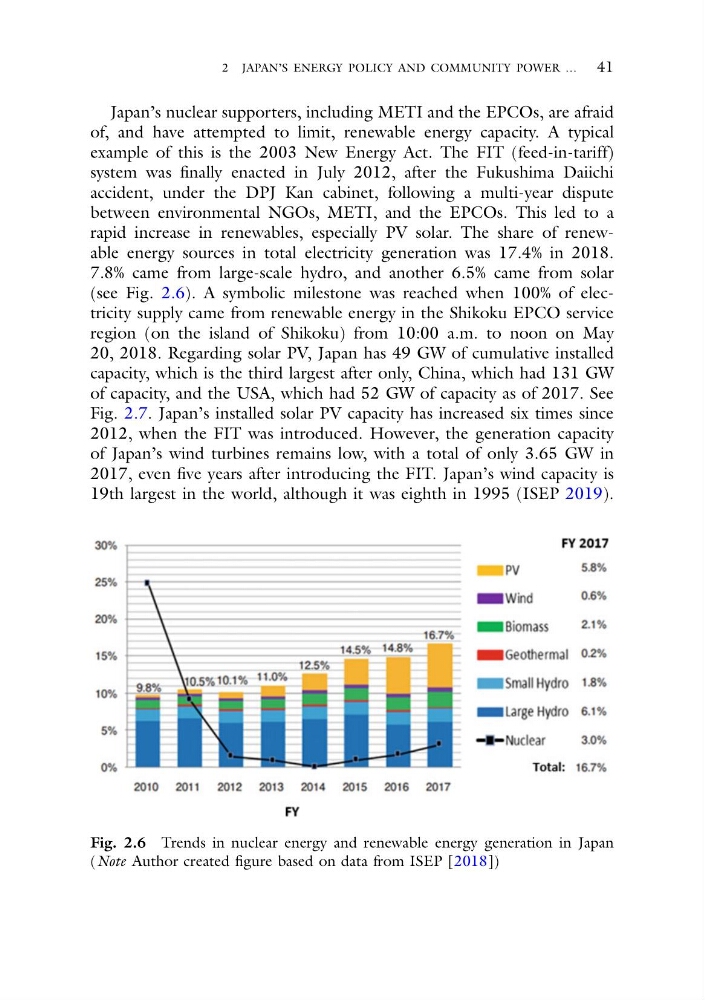
rapid increase in renewables, especially PV solar. The share of renewable energy sources in total electricity generation was 17.4% in 2018.
7.8% came from large-scale hydro, and another 6.5% came from solar
(see Fig. 2.6). A symbolic milestone was reached when 100% of electricity supply came from renewable energy in the Shikoku EPCO service
region (on the island of Shikoku) from 10:00 a.m. to noon on May
20, 2018. Regarding solar PV, Japan has 49 GW of cumulative installed
capacity, which is the third largest after only, China, which had 131 GW
of capacity, and the USA, which had 52 GW of capacity as of 2017. See
Fig. 2.7. Japan’s installed solar PV capacity has increased six times since
2012, when the FIT was introduced. However, the generation capacity
of Japan’s wind turbines remains low, with a total of only 3.65 GW in
2017, even five years after introducing the FIT. Japan’s wind capacity is
19th largest in the world, although it was eighth in 1995 (ISEP 2019).
Fig. 2.6 Trends in nuclear energy and renewable energy generation in Japan
(Note Author created figure based on data from ISEP [2018])
41
Japan’s nuclear supporters, including METI and the EPCOs, are afraid
of, and have attempted to limit, renewable energy capacity. A typical
example of this is the 2003 New Energy Act. The FIT (feed-in-tariff)
system was finally enacted in July 2012, after the Fukushima Daiichi
accident, under the DPJ Kan cabinet, following a multi-year dispute
between environmental NGOs, METI, and the EPCOs. This led to a
rapid increase in renewables, especially PV solar. The share of renewable energy sources in total electricity generation was 17.4% in 2018.
7.8% came from large-scale hydro, and another 6.5% came from solar
(see Fig. 2.6). A symbolic milestone was reached when 100% of electricity supply came from renewable energy in the Shikoku EPCO service
region (on the island of Shikoku) from 10:00 a.m. to noon on May
20, 2018. Regarding solar PV, Japan has 49 GW of cumulative installed
capacity, which is the third largest after only, China, which had 131 GW
of capacity, and the USA, which had 52 GW of capacity as of 2017. See
Fig. 2.7. Japan’s installed solar PV capacity has increased six times since
2012, when the FIT was introduced. However, the generation capacity
of Japan’s wind turbines remains low, with a total of only 3.65 GW in
2017, even five years after introducing the FIT. Japan’s wind capacity is
19th largest in the world, although it was eighth in 1995 (ISEP 2019).
Fig. 2.6 Trends in nuclear energy and renewable energy generation in Japan
(Note Author created figure based on data from ISEP [2018])