

40 K. HASEGAWA
The Tough Challenge of Promoting
Wind Turbines in Japan
Worldwide, since right after the Fukushima accident, wind and solar
power have dramatically increased. About 26.5% of electricity came from
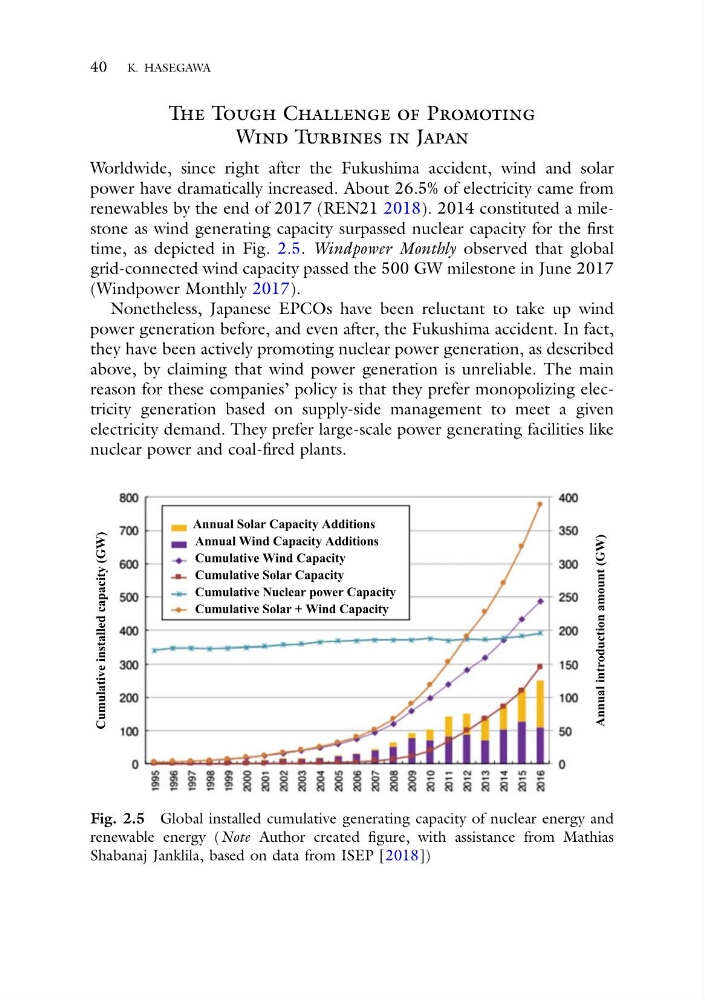
renewables by the end of 2017 (REN21 2018). 2014 constituted a milestone as wind generating capacity surpassed nuclear capacity for the first
time, as depicted in Fig. 2.5. Windpower Monthly observed that global
grid-connected wind capacity passed the 500 GW milestone in June 2017
(Windpower Monthly 2017).
Nonetheless, Japanese EPCOs have been reluctant to take up wind
power generation before, and even after, the Fukushima accident. In fact,
they have been actively promoting nuclear power generation, as described
above, by claiming that wind power generation is unreliable. The main
reason for these companies’ policy is that they prefer monopolizing electricity generation based on supply-side management to meet a given
electricity demand. They prefer large-scale power generating facilities like
nuclear power and coal-fired plants.
Cumulative installed capacity (GW)
Annual introduction amount (GW)
Annual Solar Capacity Additions
Annual Wind Capacity Additions
Cumulative Wind Capacity
Cumulative Solar Capacity
Cumulative Nuclear power Capacity
Cumulative Solar + Wind Capacity
Fig. 2.5 Global installed cumulative generating capacity of nuclear energy and
renewable energy (Note Author created figure, with assistance from Mathias
Shabanaj Janklila, based on data from ISEP [2018])
The Tough Challenge of Promoting
Wind Turbines in Japan
Worldwide, since right after the Fukushima accident, wind and solar
power have dramatically increased. About 26.5% of electricity came from
renewables by the end of 2017 (REN21 2018). 2014 constituted a milestone as wind generating capacity surpassed nuclear capacity for the first
time, as depicted in Fig. 2.5. Windpower Monthly observed that global
grid-connected wind capacity passed the 500 GW milestone in June 2017
(Windpower Monthly 2017).
Nonetheless, Japanese EPCOs have been reluctant to take up wind
power generation before, and even after, the Fukushima accident. In fact,
they have been actively promoting nuclear power generation, as described
above, by claiming that wind power generation is unreliable. The main
reason for these companies’ policy is that they prefer monopolizing electricity generation based on supply-side management to meet a given
electricity demand. They prefer large-scale power generating facilities like
nuclear power and coal-fired plants.
Cumulative installed capacity (GW)
Annual introduction amount (GW)
Annual Solar Capacity Additions
Annual Wind Capacity Additions
Cumulative Wind Capacity
Cumulative Solar Capacity
Cumulative Nuclear power Capacity
Cumulative Solar + Wind Capacity
Fig. 2.5 Global installed cumulative generating capacity of nuclear energy and
renewable energy (Note Author created figure, with assistance from Mathias
Shabanaj Janklila, based on data from ISEP [2018])