

13 BEYOND WIND: NEW CHALLENGES TO THE EXPANSION …
331
plug-in hybrid, battery electric, and fuel-cell vehicles (Danish Council on
Climate Change 2018).
Nevertheless, relative to other comparable countries, existing policies
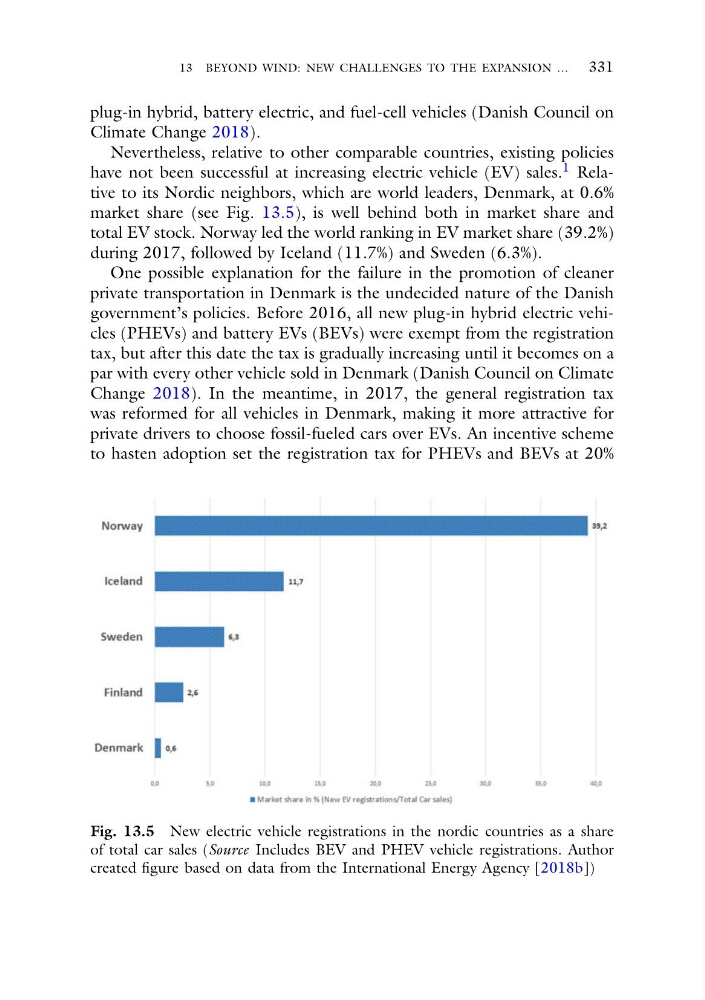
have not been successful at increasing electric vehicle (EV) sales. 1 Relative to its Nordic neighbors, which are world leaders, Denmark, at 0.6%
market share (see Fig. 13.5), is well behind both in market share and
total EV stock. Norway led the world ranking in EV market share (39.2%)
during 2017, followed by Iceland (11.7%) and Sweden (6.3%).
One possible explanation for the failure in the promotion of cleaner
private transportation in Denmark is the undecided nature of the Danish
government’s policies. Before 2016, all new plug-in hybrid electric vehicles (PHEVs) and battery EVs (BEVs) were exempt from the registration
tax, but after this date the tax is gradually increasing until it becomes on a
par with every other vehicle sold in Denmark (Danish Council on Climate
Change 2018). In the meantime, in 2017, the general registration tax
was reformed for all vehicles in Denmark, making it more attractive for
private drivers to choose fossil-fueled cars over EVs. An incentive scheme
to hasten adoption set the registration tax for PHEVs and BEVs at 20%
Fig. 13.5 New electric vehicle registrations in the nordic countries as a share
of total car sales (Source Includes BEV and PHEV vehicle registrations. Author
created figure based on data from the International Energy Agency [2018b])
331
plug-in hybrid, battery electric, and fuel-cell vehicles (Danish Council on
Climate Change 2018).
Nevertheless, relative to other comparable countries, existing policies
have not been successful at increasing electric vehicle (EV) sales. 1 Relative to its Nordic neighbors, which are world leaders, Denmark, at 0.6%
market share (see Fig. 13.5), is well behind both in market share and
total EV stock. Norway led the world ranking in EV market share (39.2%)
during 2017, followed by Iceland (11.7%) and Sweden (6.3%).
One possible explanation for the failure in the promotion of cleaner
private transportation in Denmark is the undecided nature of the Danish
government’s policies. Before 2016, all new plug-in hybrid electric vehicles (PHEVs) and battery EVs (BEVs) were exempt from the registration
tax, but after this date the tax is gradually increasing until it becomes on a
par with every other vehicle sold in Denmark (Danish Council on Climate
Change 2018). In the meantime, in 2017, the general registration tax
was reformed for all vehicles in Denmark, making it more attractive for
private drivers to choose fossil-fueled cars over EVs. An incentive scheme
to hasten adoption set the registration tax for PHEVs and BEVs at 20%
Fig. 13.5 New electric vehicle registrations in the nordic countries as a share
of total car sales (Source Includes BEV and PHEV vehicle registrations. Author
created figure based on data from the International Energy Agency [2018b])