

270 N. H. NGUYEN ET AL.
units that produce or purchase electricity and the electricity end users
who produce electricity by themselves must acquire a share of electricity
from renewable sources (excluding hydropower sources with capacity
exceeding 30 MW): at least 5% by 2020, 10% by 2030, and 20% by
2050. However, detailed guidelines and policies for RPS have not yet
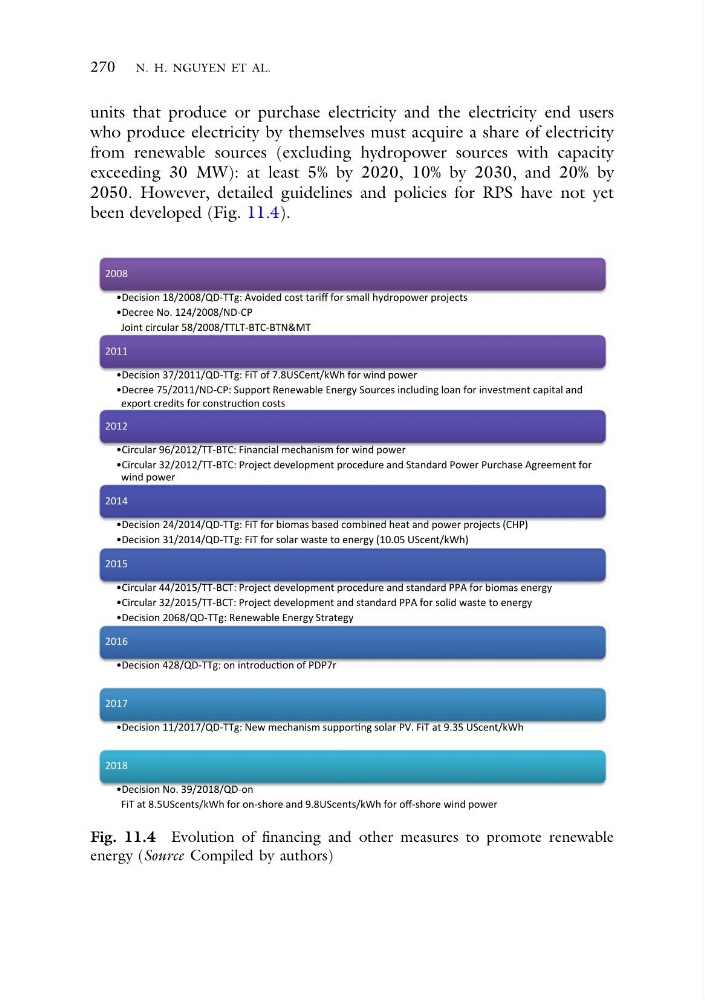
been developed (Fig. 11.4).
2008
•Decision 18/2008/QD-TTg: Avoided cost tariff for small hydropower projects
•Decree No. 124/2008/ND-CP
Joint circular 58/2008/TTLT-BTC-BTN&MT
2011
•Decision 37/2011/QD-TTg: FiT of 7.8USCent/kWh for wind power
•Decree 75/2011/ND-CP: Support Renewable Energy Sources including loan for investment capital and
export credits for construccon costs
2012
•Circular 96/2012/TT-BTC: Financial mechanism for wind power
•Circular 32/2012/TT-BTC: Project development procedure and Standard Power Purchase Agreement for
wind power
2014
•Decision 24/2014/QD-TTg: FiT for biomas based combined heat and power projects (CHP)
•Decision 31/2014/QD-TTg: FiT for solar waste to energy (10.05 UScent/kWh)
2015
•Circular 44/2015/TT-BCT: Project development procedure and standard PPA for biomas energy
•Circular 32/2015/TT-BCT: Project development and standard PPA for solid waste to energy
•Decision 2068/QD-TTg: Renewable Energy Strategy
2016
•Decision 428/QD-TTg: on introduccon of PDP7r
2017
•Decision 11/2017/QD-TTg: New mechanism supporrng solar PV. FiT at 9.35 UScent/kWh
2018
•Decision No. 39/2018/QD-on
FiT at 8.5UScents/kWh for on-shore and 9.8UScents/kWh for off-shore wind power
Fig. 11.4 Evolution of financing and other measures to promote renewable
energy (Source Compiled by authors)
units that produce or purchase electricity and the electricity end users
who produce electricity by themselves must acquire a share of electricity
from renewable sources (excluding hydropower sources with capacity
exceeding 30 MW): at least 5% by 2020, 10% by 2030, and 20% by
2050. However, detailed guidelines and policies for RPS have not yet
been developed (Fig. 11.4).
2008
•Decision 18/2008/QD-TTg: Avoided cost tariff for small hydropower projects
•Decree No. 124/2008/ND-CP
Joint circular 58/2008/TTLT-BTC-BTN&MT
2011
•Decision 37/2011/QD-TTg: FiT of 7.8USCent/kWh for wind power
•Decree 75/2011/ND-CP: Support Renewable Energy Sources including loan for investment capital and
export credits for construccon costs
2012
•Circular 96/2012/TT-BTC: Financial mechanism for wind power
•Circular 32/2012/TT-BTC: Project development procedure and Standard Power Purchase Agreement for
wind power
2014
•Decision 24/2014/QD-TTg: FiT for biomas based combined heat and power projects (CHP)
•Decision 31/2014/QD-TTg: FiT for solar waste to energy (10.05 UScent/kWh)
2015
•Circular 44/2015/TT-BCT: Project development procedure and standard PPA for biomas energy
•Circular 32/2015/TT-BCT: Project development and standard PPA for solid waste to energy
•Decision 2068/QD-TTg: Renewable Energy Strategy
2016
•Decision 428/QD-TTg: on introduccon of PDP7r
2017
•Decision 11/2017/QD-TTg: New mechanism supporrng solar PV. FiT at 9.35 UScent/kWh
2018
•Decision No. 39/2018/QD-on
FiT at 8.5UScents/kWh for on-shore and 9.8UScents/kWh for off-shore wind power
Fig. 11.4 Evolution of financing and other measures to promote renewable
energy (Source Compiled by authors)