

216 G. CHEN
renewable energy industrial (manufacturing) policy (Zhang et al. 2013,
pp. 342–353).
Over the past decade, the gravity of solar PV production has shifted
from the United States, to Japan, to Europe and to Asia, especially China,
which quadrupled its poly-silicon solar panel manufacturing capacity
between 2009 and 2011. China’s existing production capacity of solar
panels is about 150% of the global real demand, and in just four
years between 2009 and 2012, the international price of solar panels
had been cut by more than 75% largely due to an aggressive capacity
built-up in China. To alleviate this overcapacity problem, the Chinese
government thus has been redirecting energy subsidies in favor of PV
power generation in order to breed a domestic renewable power market
of sufficient scale to absorb manufacture oversupply that has encountered overseas boycott (Interviews with policy makers and researchers in
NDRC’s Energy Research Institute, Beijing, March 2012).
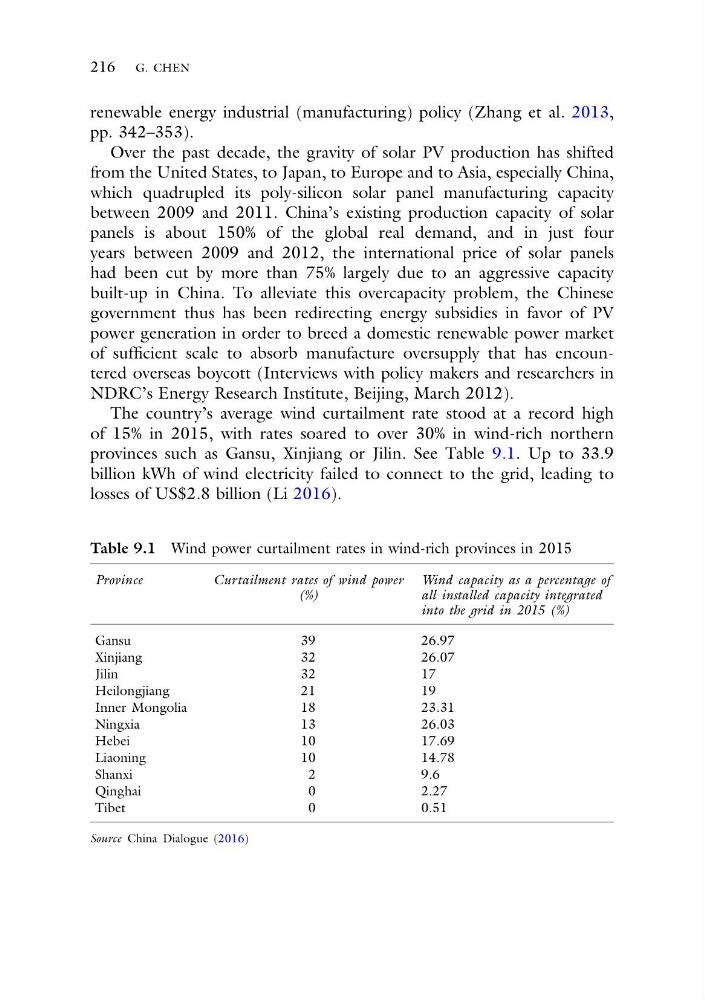
The country’s average wind curtailment rate stood at a record high
of 15% in 2015, with rates soared to over 30% in wind-rich northern
provinces such as Gansu, Xinjiang or Jilin. See Table 9.1. Up to 33.9
billion kWh of wind electricity failed to connect to the grid, leading to
losses of US$2.8 billion (Li 2016).
Table 9.1 Wind power curtailment rates in wind-rich provinces in 2015
Province
Curtailment rates of wind power
(%)
Wind capacity as a percentage of
all installed capacity integrated
into the grid in 2015 (%)
Gansu
39
26.97
Xinjiang
32
26.07
Jilin
32
17
Heilongjiang
21
19
Inner Mongolia
18
23.31
Ningxia
13
26.03
Hebei
10
17.69
Liaoning
10
14.78
Shanxi
2
9.6
Qinghai
0
2.27
Tibet
0
0.51
Source China Dialogue (2016)
renewable energy industrial (manufacturing) policy (Zhang et al. 2013,
pp. 342–353).
Over the past decade, the gravity of solar PV production has shifted
from the United States, to Japan, to Europe and to Asia, especially China,
which quadrupled its poly-silicon solar panel manufacturing capacity
between 2009 and 2011. China’s existing production capacity of solar
panels is about 150% of the global real demand, and in just four
years between 2009 and 2012, the international price of solar panels
had been cut by more than 75% largely due to an aggressive capacity
built-up in China. To alleviate this overcapacity problem, the Chinese
government thus has been redirecting energy subsidies in favor of PV
power generation in order to breed a domestic renewable power market
of sufficient scale to absorb manufacture oversupply that has encountered overseas boycott (Interviews with policy makers and researchers in
NDRC’s Energy Research Institute, Beijing, March 2012).
The country’s average wind curtailment rate stood at a record high
of 15% in 2015, with rates soared to over 30% in wind-rich northern
provinces such as Gansu, Xinjiang or Jilin. See Table 9.1. Up to 33.9
billion kWh of wind electricity failed to connect to the grid, leading to
losses of US$2.8 billion (Li 2016).
Table 9.1 Wind power curtailment rates in wind-rich provinces in 2015
Province
Curtailment rates of wind power
(%)
Wind capacity as a percentage of
all installed capacity integrated
into the grid in 2015 (%)
Gansu
39
26.97
Xinjiang
32
26.07
Jilin
32
17
Heilongjiang
21
19
Inner Mongolia
18
23.31
Ningxia
13
26.03
Hebei
10
17.69
Liaoning
10
14.78
Shanxi
2
9.6
Qinghai
0
2.27
Tibet
0
0.51
Source China Dialogue (2016)