

184 S. Y. KIM AND I. SUN
among the world’s top five importers of liquefied natural gas (2nd), coal
(4th), and crude oil (5th).
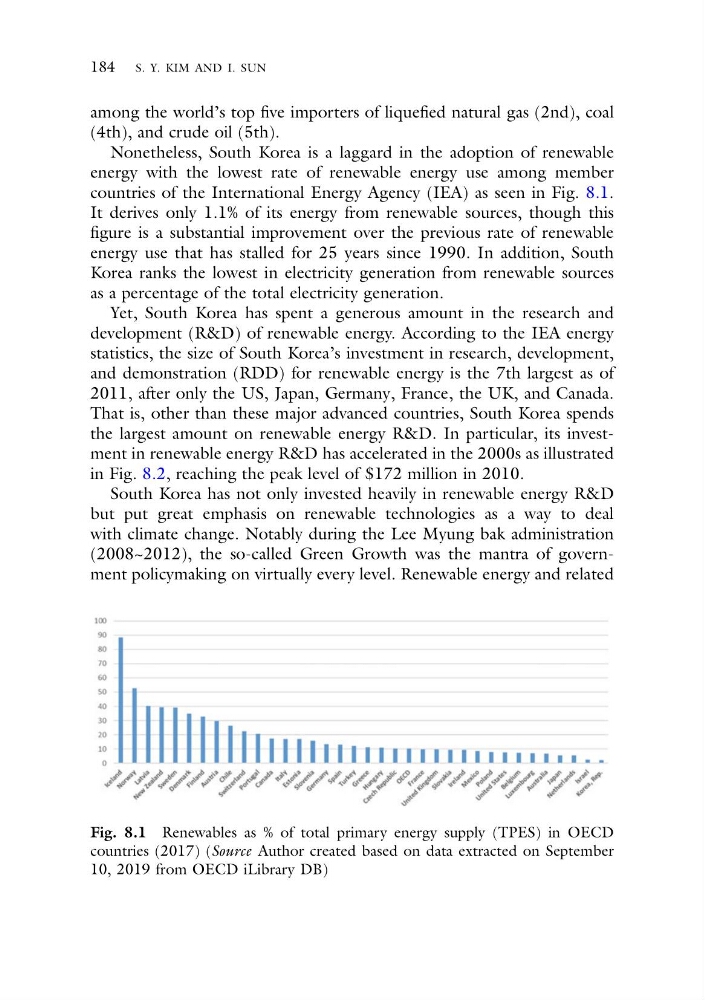
Nonetheless, South Korea is a laggard in the adoption of renewable
energy with the lowest rate of renewable energy use among member
countries of the International Energy Agency (IEA) as seen in Fig. 8.1.
It derives only 1.1% of its energy from renewable sources, though this
figure is a substantial improvement over the previous rate of renewable
energy use that has stalled for 25 years since 1990. In addition, South
Korea ranks the lowest in electricity generation from renewable sources
as a percentage of the total electricity generation.
Yet, South Korea has spent a generous amount in the research and
development (R&D) of renewable energy. According to the IEA energy
statistics, the size of South Korea’s investment in research, development,
and demonstration (RDD) for renewable energy is the 7th largest as of
2011, after only the US, Japan, Germany, France, the UK, and Canada.
That is, other than these major advanced countries, South Korea spends
the largest amount on renewable energy R&D. In particular, its investment in renewable energy R&D has accelerated in the 2000s as illustrated
in Fig. 8.2, reaching the peak level of $172 million in 2010.
South Korea has not only invested heavily in renewable energy R&D
but put great emphasis on renewable technologies as a way to deal
with climate change. Notably during the Lee Myung bak administration
(2008~2012), the so-called Green Growth was the mantra of government policymaking on virtually every level. Renewable energy and related
Fig. 8.1 Renewables as % of total primary energy supply (TPES) in OECD
countries (2017) (Source Author created based on data extracted on September
10, 2019 from OECD iLibrary DB)
among the world’s top five importers of liquefied natural gas (2nd), coal
(4th), and crude oil (5th).
Nonetheless, South Korea is a laggard in the adoption of renewable
energy with the lowest rate of renewable energy use among member
countries of the International Energy Agency (IEA) as seen in Fig. 8.1.
It derives only 1.1% of its energy from renewable sources, though this
figure is a substantial improvement over the previous rate of renewable
energy use that has stalled for 25 years since 1990. In addition, South
Korea ranks the lowest in electricity generation from renewable sources
as a percentage of the total electricity generation.
Yet, South Korea has spent a generous amount in the research and
development (R&D) of renewable energy. According to the IEA energy
statistics, the size of South Korea’s investment in research, development,
and demonstration (RDD) for renewable energy is the 7th largest as of
2011, after only the US, Japan, Germany, France, the UK, and Canada.
That is, other than these major advanced countries, South Korea spends
the largest amount on renewable energy R&D. In particular, its investment in renewable energy R&D has accelerated in the 2000s as illustrated
in Fig. 8.2, reaching the peak level of $172 million in 2010.
South Korea has not only invested heavily in renewable energy R&D
but put great emphasis on renewable technologies as a way to deal
with climate change. Notably during the Lee Myung bak administration
(2008~2012), the so-called Green Growth was the mantra of government policymaking on virtually every level. Renewable energy and related
Fig. 8.1 Renewables as % of total primary energy supply (TPES) in OECD
countries (2017) (Source Author created based on data extracted on September
10, 2019 from OECD iLibrary DB)