

158 R. M. URIU
mentioned in an official document, METI’s Strategic Energy Plan (METI
2014). The key policy pronouncement was the June 23, 2014 unveiling
of the “Hydrogen and Fuel Cell Strategic Road Map.”
However, while the 3/11 crisis elevated the visibility of the industry,
it is important to note that actual industrial policies did not change very
much. That is, the government and industry actors remained the same,
and the problems facing the industry were also unchanged—how to lower
costs and resolve the many technological bottlenecks that still existed. The
only difference was the industry’s new prominence.
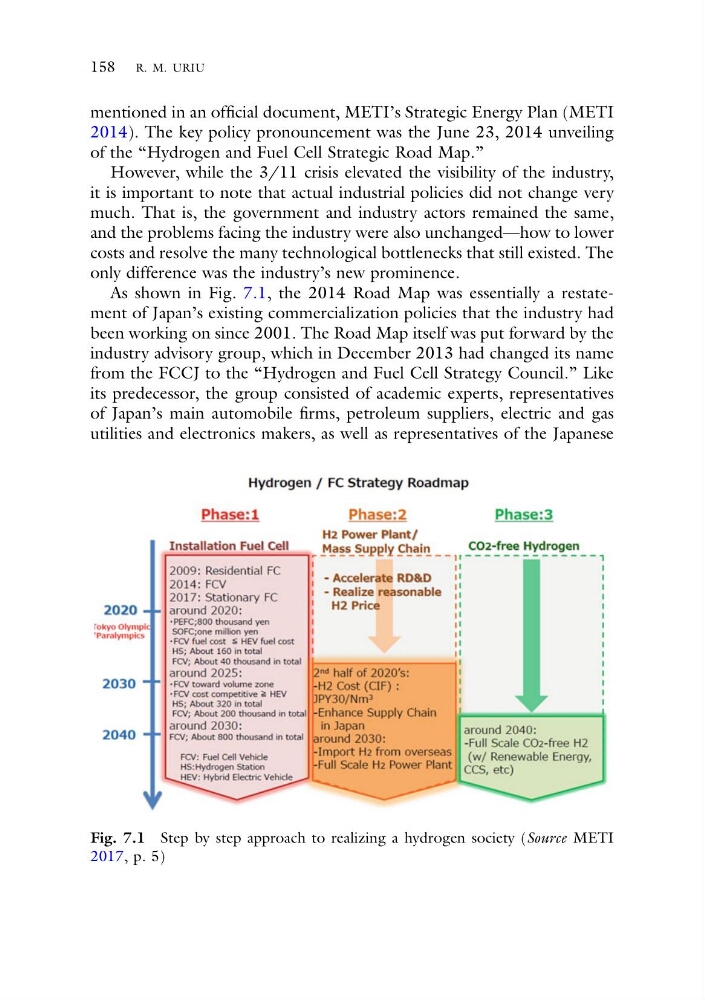
As shown in Fig. 7.1, the 2014 Road Map was essentially a restatement of Japan’s existing commercialization policies that the industry had
been working on since 2001. The Road Map itself was put forward by the
industry advisory group, which in December 2013 had changed its name
from the FCCJ to the “Hydrogen and Fuel Cell Strategy Council.” Like
its predecessor, the group consisted of academic experts, representatives
of Japan’s main automobile firms, petroleum suppliers, electric and gas
utilities and electronics makers, as well as representatives of the Japanese
Fig. 7.1 Step by step approach to realizing a hydrogen society (Source METI
2017, p. 5)
mentioned in an official document, METI’s Strategic Energy Plan (METI
2014). The key policy pronouncement was the June 23, 2014 unveiling
of the “Hydrogen and Fuel Cell Strategic Road Map.”
However, while the 3/11 crisis elevated the visibility of the industry,
it is important to note that actual industrial policies did not change very
much. That is, the government and industry actors remained the same,
and the problems facing the industry were also unchanged—how to lower
costs and resolve the many technological bottlenecks that still existed. The
only difference was the industry’s new prominence.
As shown in Fig. 7.1, the 2014 Road Map was essentially a restatement of Japan’s existing commercialization policies that the industry had
been working on since 2001. The Road Map itself was put forward by the
industry advisory group, which in December 2013 had changed its name
from the FCCJ to the “Hydrogen and Fuel Cell Strategy Council.” Like
its predecessor, the group consisted of academic experts, representatives
of Japan’s main automobile firms, petroleum suppliers, electric and gas
utilities and electronics makers, as well as representatives of the Japanese
Fig. 7.1 Step by step approach to realizing a hydrogen society (Source METI
2017, p. 5)