

118 P. MIDFORD
the incumbent EPCOs; by October 2017 over 450 new market participants were supplying 12% of the market (Movellan 2016; METI 2018,
pp. 82–83). Although most market participants, including new entrants,
have been competing based on lower prices (including bundling electricity
service with other services, such as cell phone and cable TV) (Nagata
2016), some new entrants compete on the type of power they provide.
Among these companies, all offer to maximize renewable electricity
supply, none promise to maximize nuclear power (even in the future),
a fact that appears to reflect a lack of demand for nuclear power. Electricity liberalization thus gives consumers the ability to directly influence
Japan’s future energy mix by choosing between fossil-and-nuclear-fueled
generation versus renewable energy generation.
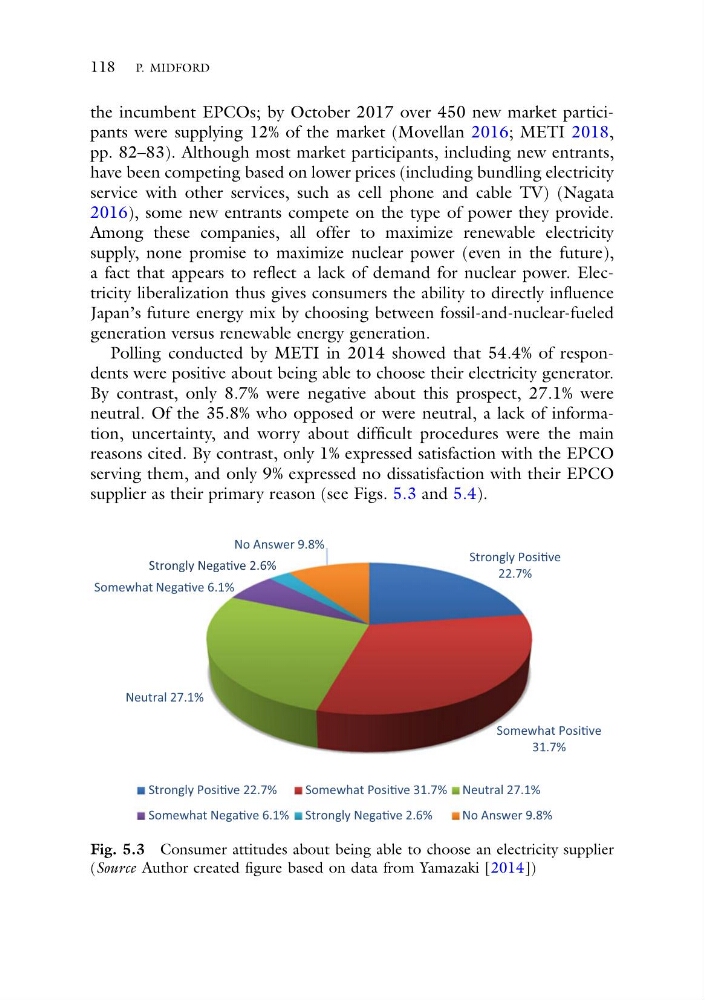
Polling conducted by METI in 2014 showed that 54.4% of respondents were positive about being able to choose their electricity generator.
By contrast, only 8.7% were negative about this prospect, 27.1% were
neutral. Of the 35.8% who opposed or were neutral, a lack of information, uncertainty, and worry about difficult procedures were the main
reasons cited. By contrast, only 1% expressed satisfaction with the EPCO
serving them, and only 9% expressed no dissatisfaction with their EPCO
supplier as their primary reason (see Figs. 5.3 and 5.4).
Strongly PosiƟve
22.7%
Somewhat PosiƟve
31.7%
Neutral 27.1%
Somewhat NegaƟve 6.1%
Strongly NegaƟve 2.6%
No Answer 9.8%
Strongly PosiƟve 22.7%
Somewhat PosiƟve 31.7% Neutral 27.1%
Somewhat NegaƟve 6.1% Strongly NegaƟve 2.6%
No Answer 9.8%
Fig. 5.3 Consumer attitudes about being able to choose an electricity supplier
(Source Author created figure based on data from Yamazaki [2014])
the incumbent EPCOs; by October 2017 over 450 new market participants were supplying 12% of the market (Movellan 2016; METI 2018,
pp. 82–83). Although most market participants, including new entrants,
have been competing based on lower prices (including bundling electricity
service with other services, such as cell phone and cable TV) (Nagata
2016), some new entrants compete on the type of power they provide.
Among these companies, all offer to maximize renewable electricity
supply, none promise to maximize nuclear power (even in the future),
a fact that appears to reflect a lack of demand for nuclear power. Electricity liberalization thus gives consumers the ability to directly influence
Japan’s future energy mix by choosing between fossil-and-nuclear-fueled
generation versus renewable energy generation.
Polling conducted by METI in 2014 showed that 54.4% of respondents were positive about being able to choose their electricity generator.
By contrast, only 8.7% were negative about this prospect, 27.1% were
neutral. Of the 35.8% who opposed or were neutral, a lack of information, uncertainty, and worry about difficult procedures were the main
reasons cited. By contrast, only 1% expressed satisfaction with the EPCO
serving them, and only 9% expressed no dissatisfaction with their EPCO
supplier as their primary reason (see Figs. 5.3 and 5.4).
Strongly PosiƟve
22.7%
Somewhat PosiƟve
31.7%
Neutral 27.1%
Somewhat NegaƟve 6.1%
Strongly NegaƟve 2.6%
No Answer 9.8%
Strongly PosiƟve 22.7%
Somewhat PosiƟve 31.7% Neutral 27.1%
Somewhat NegaƟve 6.1% Strongly NegaƟve 2.6%
No Answer 9.8%
Fig. 5.3 Consumer attitudes about being able to choose an electricity supplier
(Source Author created figure based on data from Yamazaki [2014])