

5 THE POLITICS OF NUCLEAR POWER PLANT RESTARTS …
111
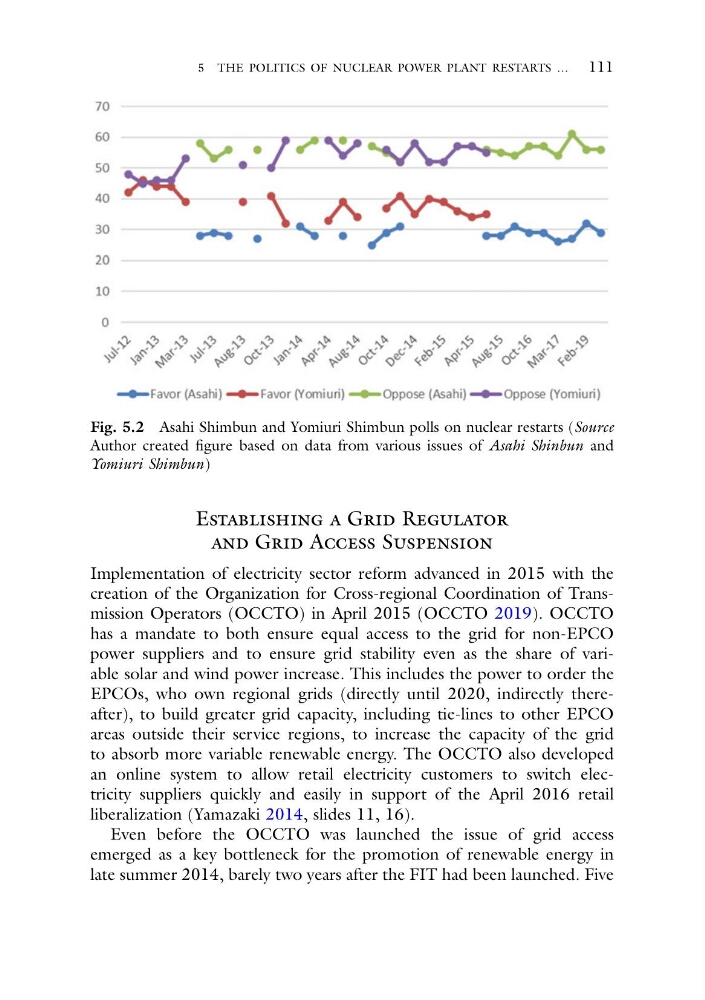
Fig. 5.2 Asahi Shimbun and Yomiuri Shimbun polls on nuclear restarts (Source
Author created figure based on data from various issues of Asahi Shinbun and
Yomiuri Shimbun)
Establishing a Grid Regulator
and Grid Access Suspension
Implementation of electricity sector reform advanced in 2015 with the
creation of the Organization for Cross-regional Coordination of Transmission Operators (OCCTO) in April 2015 (OCCTO 2019). OCCTO
has a mandate to both ensure equal access to the grid for non-EPCO
power suppliers and to ensure grid stability even as the share of variable solar and wind power increase. This includes the power to order the
EPCOs, who own regional grids (directly until 2020, indirectly thereafter), to build greater grid capacity, including tie-lines to other EPCO
areas outside their service regions, to increase the capacity of the grid
to absorb more variable renewable energy. The OCCTO also developed
an online system to allow retail electricity customers to switch electricity suppliers quickly and easily in support of the April 2016 retail
liberalization (Yamazaki 2014, slides 11, 16).
Even before the OCCTO was launched the issue of grid access
emerged as a key bottleneck for the promotion of renewable energy in
late summer 2014, barely two years after the FIT had been launched. Five
111
Fig. 5.2 Asahi Shimbun and Yomiuri Shimbun polls on nuclear restarts (Source
Author created figure based on data from various issues of Asahi Shinbun and
Yomiuri Shimbun)
Establishing a Grid Regulator
and Grid Access Suspension
Implementation of electricity sector reform advanced in 2015 with the
creation of the Organization for Cross-regional Coordination of Transmission Operators (OCCTO) in April 2015 (OCCTO 2019). OCCTO
has a mandate to both ensure equal access to the grid for non-EPCO
power suppliers and to ensure grid stability even as the share of variable solar and wind power increase. This includes the power to order the
EPCOs, who own regional grids (directly until 2020, indirectly thereafter), to build greater grid capacity, including tie-lines to other EPCO
areas outside their service regions, to increase the capacity of the grid
to absorb more variable renewable energy. The OCCTO also developed
an online system to allow retail electricity customers to switch electricity suppliers quickly and easily in support of the April 2016 retail
liberalization (Yamazaki 2014, slides 11, 16).
Even before the OCCTO was launched the issue of grid access
emerged as a key bottleneck for the promotion of renewable energy in
late summer 2014, barely two years after the FIT had been launched. Five