

74
5.2.2.1 Iniferter Polymerization
Iniferters are compounds that promote initiation, transfer and termination (ini-tiator,
trans-fer agent, ter-minator) in radical polymerizations. Since the bimolecular termination and other transfer reactions are insignificant, they allow the introduction
of monomers in the iniferter bond, obtaining polymers with two iniferter fragments
at the chain ends (Otsu 2000). The concept of iniferter was first proposed by Otsu
et al. (1982) to allow the controlled synthesis and molecular design of polymers
through radical polymerization (Otsu and Matsumoto 1998). They described the
synthesis of styrene and methyl methacrylate using phenylazotriphenylmethane and
benzyl-N,N-diethyldithiocarbamate as thermal and photochemical iniferters,
respectively (Tasdelen and Yagci 2013).
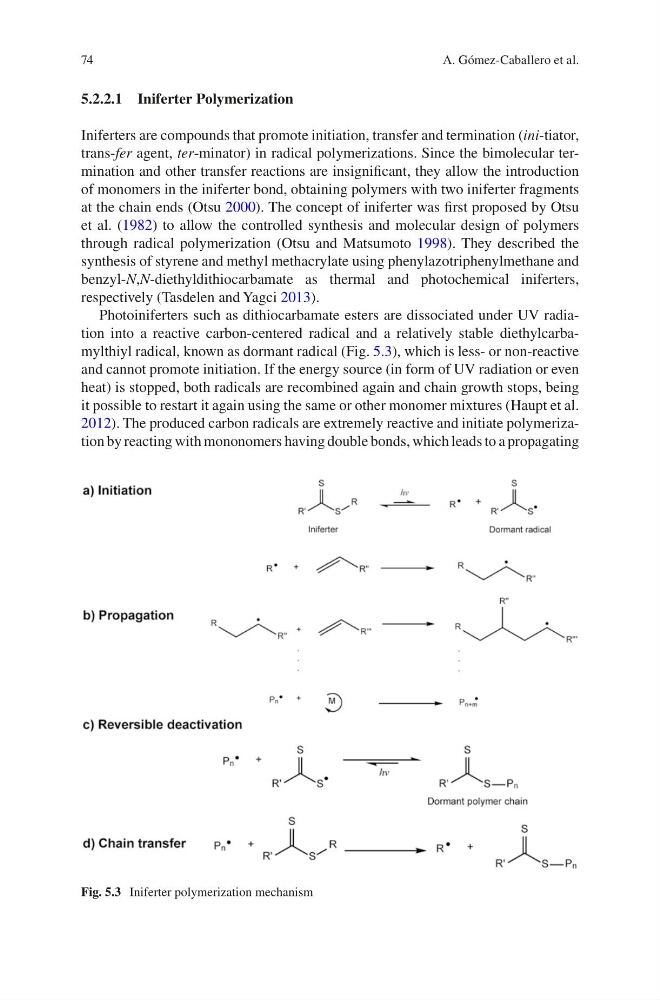
Photoiniferters such as dithiocarbamate esters are dissociated under UV radiation into a reactive carbon-centered radical and a relatively stable diethylcarbamylthiyl radical, known as dormant radical (Fig. 5.3), which is less- or non-reactive
and cannot promote initiation. If the energy source (in form of UV radiation or even
heat) is stopped, both radicals are recombined again and chain growth stops, being
it possible to restart it again using the same or other monomer mixtures (Haupt et al.
2012). The produced carbon radicals are extremely reactive and initiate polymerization by reacting with mononomers having double bonds, which leads to a propagating
Fig. 5.3 Iniferter polymerization mechanism
A. Gómez-Caballero et al.
5.2.2.1 Iniferter Polymerization
Iniferters are compounds that promote initiation, transfer and termination (ini-tiator,
trans-fer agent, ter-minator) in radical polymerizations. Since the bimolecular termination and other transfer reactions are insignificant, they allow the introduction
of monomers in the iniferter bond, obtaining polymers with two iniferter fragments
at the chain ends (Otsu 2000). The concept of iniferter was first proposed by Otsu
et al. (1982) to allow the controlled synthesis and molecular design of polymers
through radical polymerization (Otsu and Matsumoto 1998). They described the
synthesis of styrene and methyl methacrylate using phenylazotriphenylmethane and
benzyl-N,N-diethyldithiocarbamate as thermal and photochemical iniferters,
respectively (Tasdelen and Yagci 2013).
Photoiniferters such as dithiocarbamate esters are dissociated under UV radiation into a reactive carbon-centered radical and a relatively stable diethylcarbamylthiyl radical, known as dormant radical (Fig. 5.3), which is less- or non-reactive
and cannot promote initiation. If the energy source (in form of UV radiation or even
heat) is stopped, both radicals are recombined again and chain growth stops, being
it possible to restart it again using the same or other monomer mixtures (Haupt et al.
2012). The produced carbon radicals are extremely reactive and initiate polymerization by reacting with mononomers having double bonds, which leads to a propagating
Fig. 5.3 Iniferter polymerization mechanism
A. Gómez-Caballero et al.