

73
lifetime of the growing chains from about 1 s in FRP to more than 1 h in RDRP
allowing controlled propagation where all polymer chains grow at almost the same
rate (Braunecker and Matyjaszewski 2007). RDRP is often slower than FRP, which
favors the generation of much more homogeneous imprinted polymers, more likely
to have a homogeneous distribution of the binding site. This makes MIP resemble
to monoclonal antibodies, which have (pseudo) monoclonal binding properties
(Canfarotta et al. 2016a) and less cross-reactivity than the imprinted polymers
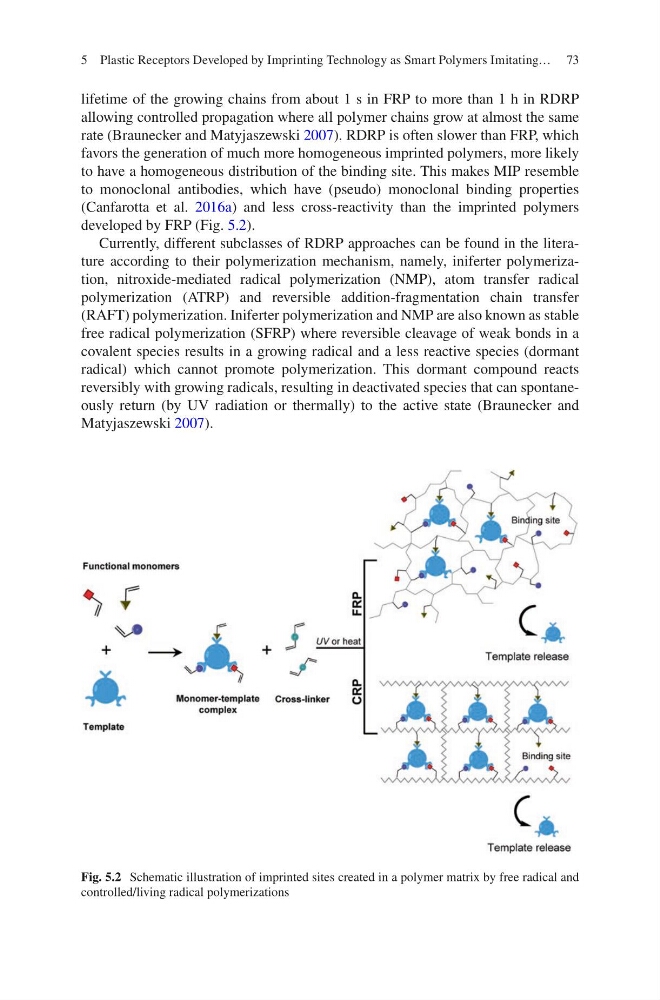
developed by FRP (Fig. 5.2).
Currently, different subclasses of RDRP approaches can be found in the literature according to their polymerization mechanism, namely, iniferter polymerization, nitroxide-mediated radical polymerization (NMP), atom transfer radical
polymerization (ATRP) and reversible addition-fragmentation chain transfer
(RAFT) polymerization. Iniferter polymerization and NMP are also known as stable
free radical polymerization (SFRP) where reversible cleavage of weak bonds in a
covalent species results in a growing radical and a less reactive species (dormant
radical) which cannot promote polymerization. This dormant compound reacts
reversibly with growing radicals, resulting in deactivated species that can spontaneously return (by UV radiation or thermally) to the active state (Braunecker and
Matyjaszewski 2007).
Fig. 5.2 Schematic illustration of imprinted sites created in a polymer matrix by free radical and
controlled/living radical polymerizations
5 Plastic Receptors Developed by Imprinting Technology as Smart Polymers Imitating…
lifetime of the growing chains from about 1 s in FRP to more than 1 h in RDRP
allowing controlled propagation where all polymer chains grow at almost the same
rate (Braunecker and Matyjaszewski 2007). RDRP is often slower than FRP, which
favors the generation of much more homogeneous imprinted polymers, more likely
to have a homogeneous distribution of the binding site. This makes MIP resemble
to monoclonal antibodies, which have (pseudo) monoclonal binding properties
(Canfarotta et al. 2016a) and less cross-reactivity than the imprinted polymers
developed by FRP (Fig. 5.2).
Currently, different subclasses of RDRP approaches can be found in the literature according to their polymerization mechanism, namely, iniferter polymerization, nitroxide-mediated radical polymerization (NMP), atom transfer radical
polymerization (ATRP) and reversible addition-fragmentation chain transfer
(RAFT) polymerization. Iniferter polymerization and NMP are also known as stable
free radical polymerization (SFRP) where reversible cleavage of weak bonds in a
covalent species results in a growing radical and a less reactive species (dormant
radical) which cannot promote polymerization. This dormant compound reacts
reversibly with growing radicals, resulting in deactivated species that can spontaneously return (by UV radiation or thermally) to the active state (Braunecker and
Matyjaszewski 2007).
Fig. 5.2 Schematic illustration of imprinted sites created in a polymer matrix by free radical and
controlled/living radical polymerizations
5 Plastic Receptors Developed by Imprinting Technology as Smart Polymers Imitating…