

185
thermal degradation of PA6.6 may lead to the generation of cyclic compounds such
as cyclopentanone from chain ends depending on the type of PA (Fig. 8.7), with the
exception for PA6.6 in which the residue remained from the thermogravimetric
analysis (TGA) was very limited. Various side reactions taking place in the course
of thermal or thermo-oxidative decomposition can assist in the crosslinking of
PA. The C=C double bonds that participate in the polymerization reactions are the
reason for the high char content from PA6.6 among this family of polymers.
According to Levchik et al. (1995), PA6 was subjected to the first degradation step
once impurities and/or low molecular weight oligomers were born in the system
(Fig. 8.7). The second degradation step was obviously in the range of 300–450 °C,
probably because almost all the material was volatilized to form a crosslinked structure due to the polymerization of the unsaturated alkylamide bond scission. The
formation of a thermally stable structure prevented from weight loss up to
450 °C. Eventually, ca. 5% increase in char content was evidenced.
Chemically modified PA has been used and studied because of their flame retardant properties (Yao et al. 1992). For example, Efros et al. (1983) grafted 2-methyl5-vinyl pyridine onto PA in order to improve LOI values after incorporation of
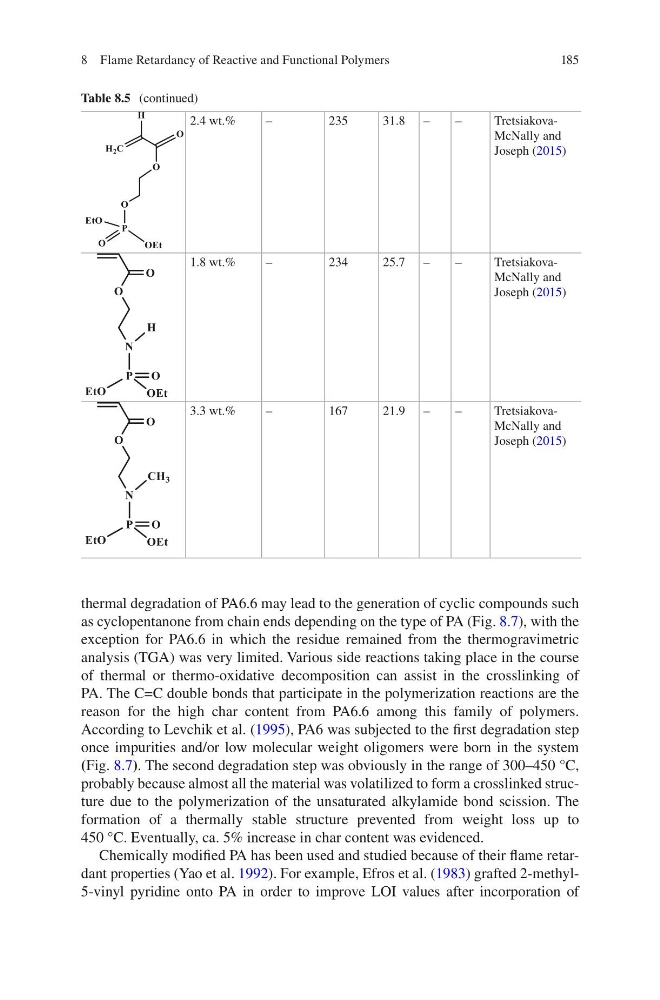
Table 8.5 (continued)
2.4 wt.%
–
235
31.8 –
–
TretsiakovaMcNally and
Joseph (2015)
1.8 wt.%
–
234
25.7 –
–
TretsiakovaMcNally and
Joseph (2015)
3.3 wt.%
–
167
21.9 –
–
TretsiakovaMcNally and
Joseph (2015)
8 Flame Retardancy of Reactive and Functional Polymers
thermal degradation of PA6.6 may lead to the generation of cyclic compounds such
as cyclopentanone from chain ends depending on the type of PA (Fig. 8.7), with the
exception for PA6.6 in which the residue remained from the thermogravimetric
analysis (TGA) was very limited. Various side reactions taking place in the course
of thermal or thermo-oxidative decomposition can assist in the crosslinking of
PA. The C=C double bonds that participate in the polymerization reactions are the
reason for the high char content from PA6.6 among this family of polymers.
According to Levchik et al. (1995), PA6 was subjected to the first degradation step
once impurities and/or low molecular weight oligomers were born in the system
(Fig. 8.7). The second degradation step was obviously in the range of 300–450 °C,
probably because almost all the material was volatilized to form a crosslinked structure due to the polymerization of the unsaturated alkylamide bond scission. The
formation of a thermally stable structure prevented from weight loss up to
450 °C. Eventually, ca. 5% increase in char content was evidenced.
Chemically modified PA has been used and studied because of their flame retardant properties (Yao et al. 1992). For example, Efros et al. (1983) grafted 2-methyl5-vinyl pyridine onto PA in order to improve LOI values after incorporation of
Table 8.5 (continued)
2.4 wt.%
–
235
31.8 –
–
TretsiakovaMcNally and
Joseph (2015)
1.8 wt.%
–
234
25.7 –
–
TretsiakovaMcNally and
Joseph (2015)
3.3 wt.%
–
167
21.9 –
–
TretsiakovaMcNally and
Joseph (2015)
8 Flame Retardancy of Reactive and Functional Polymers