

179
soybean oil with phosphoric which was reacted with polymeric diphenylmethane
diisocyanate to obtain PU. The LOI value of obtained PU containing 0.86 wt.%
phosphorus reached 21.8, while the LOI of pure PU (without phosphorus)
was 18.7.
8.3 Thermoplastics
8.3.1 Poly(Methyl Methacrylate) (PMMA)
PMMA is a transparent thermoplastic polymer with high flammability properties.
The flame retardance of PMMA has been widely investigated via chemical methods
and by the addition of flame-retardant elements onto macromolecular chains using
copolymerization methods or chemical modification of their side chains (Vahabi
et al. 2012a, b). The incorporation of additive has led to the loss of transparency of
PMMA, and therefore, chemical methods are more interesting. Price and Ebdon
from University of Bolton are the pioneers of the chemical modification of PMMA
for improving its flame retardancy. Ebdon et al. (2000a) studied the fire behavior of
three copolymers obtained by radical copolymerization of methyl methacrylate
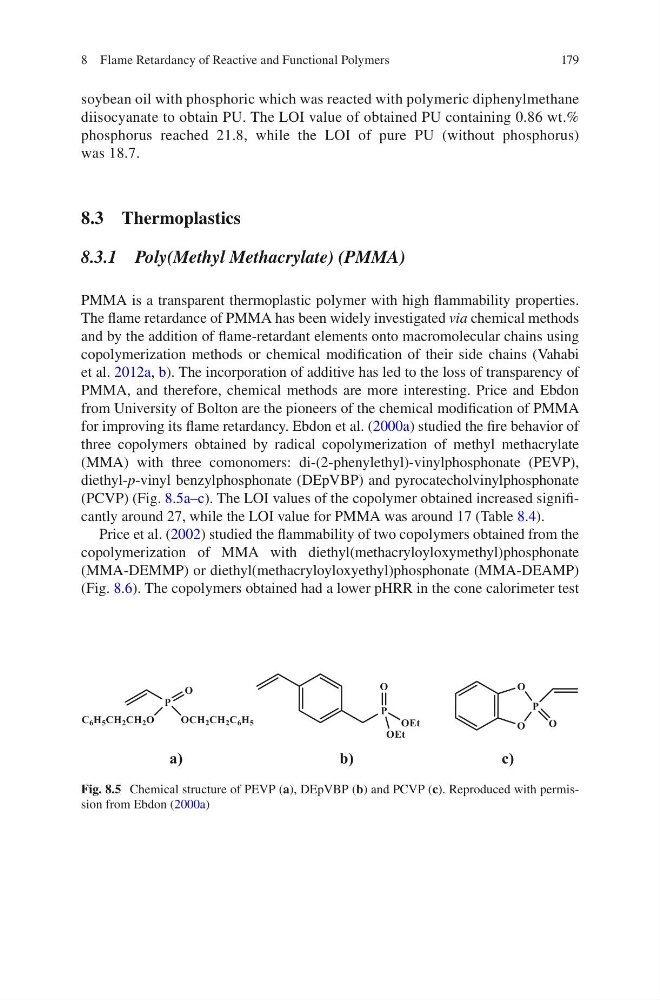
(MMA) with three comonomers: di-(2-phenylethyl)-vinylphosphonate (PEVP),
diethyl-p-vinyl benzylphosphonate (DEpVBP) and pyrocatecholvinylphosphonate
(PCVP) (Fig. 8.5a–c). The LOI values of the copolymer obtained increased significantly around 27, while the LOI value for PMMA was around 17 (Table 8.4).
Price et al. (2002) studied the flammability of two copolymers obtained from the
copolymerization of MMA with diethyl(methacryloyloxymethyl)phosphonate
(MMA-DEMMP) or diethyl(methacryloyloxyethyl)phosphonate (MMA-DEAMP)
(Fig. 8.6). The copolymers obtained had a lower pHRR in the cone calorimeter test
Fig. 8.5 Chemical structure of PEVP (a), DEpVBP (b) and PCVP (c). Reproduced with permission from Ebdon (2000a)
8 Flame Retardancy of Reactive and Functional Polymers
soybean oil with phosphoric which was reacted with polymeric diphenylmethane
diisocyanate to obtain PU. The LOI value of obtained PU containing 0.86 wt.%
phosphorus reached 21.8, while the LOI of pure PU (without phosphorus)
was 18.7.
8.3 Thermoplastics
8.3.1 Poly(Methyl Methacrylate) (PMMA)
PMMA is a transparent thermoplastic polymer with high flammability properties.
The flame retardance of PMMA has been widely investigated via chemical methods
and by the addition of flame-retardant elements onto macromolecular chains using
copolymerization methods or chemical modification of their side chains (Vahabi
et al. 2012a, b). The incorporation of additive has led to the loss of transparency of
PMMA, and therefore, chemical methods are more interesting. Price and Ebdon
from University of Bolton are the pioneers of the chemical modification of PMMA
for improving its flame retardancy. Ebdon et al. (2000a) studied the fire behavior of
three copolymers obtained by radical copolymerization of methyl methacrylate
(MMA) with three comonomers: di-(2-phenylethyl)-vinylphosphonate (PEVP),
diethyl-p-vinyl benzylphosphonate (DEpVBP) and pyrocatecholvinylphosphonate
(PCVP) (Fig. 8.5a–c). The LOI values of the copolymer obtained increased significantly around 27, while the LOI value for PMMA was around 17 (Table 8.4).
Price et al. (2002) studied the flammability of two copolymers obtained from the
copolymerization of MMA with diethyl(methacryloyloxymethyl)phosphonate
(MMA-DEMMP) or diethyl(methacryloyloxyethyl)phosphonate (MMA-DEAMP)
(Fig. 8.6). The copolymers obtained had a lower pHRR in the cone calorimeter test
Fig. 8.5 Chemical structure of PEVP (a), DEpVBP (b) and PCVP (c). Reproduced with permission from Ebdon (2000a)
8 Flame Retardancy of Reactive and Functional Polymers