

146
The accuracy (precision and trueness) of 3D printed dental parts is mandatory
when they are intended for temporary or permanent fixed restorations or when they
are designed to make removable prostheses. Three main phases are given during
polymer processing by 3D printing: (1) preparatory phase in which the build orientation is selected, the STL file is sliced and the support structure is generated, (2) the
actual build of the object and (3) removal of the support structure, post-curing of the
fabricated structure, finishing and polishing. Such phases could significantly
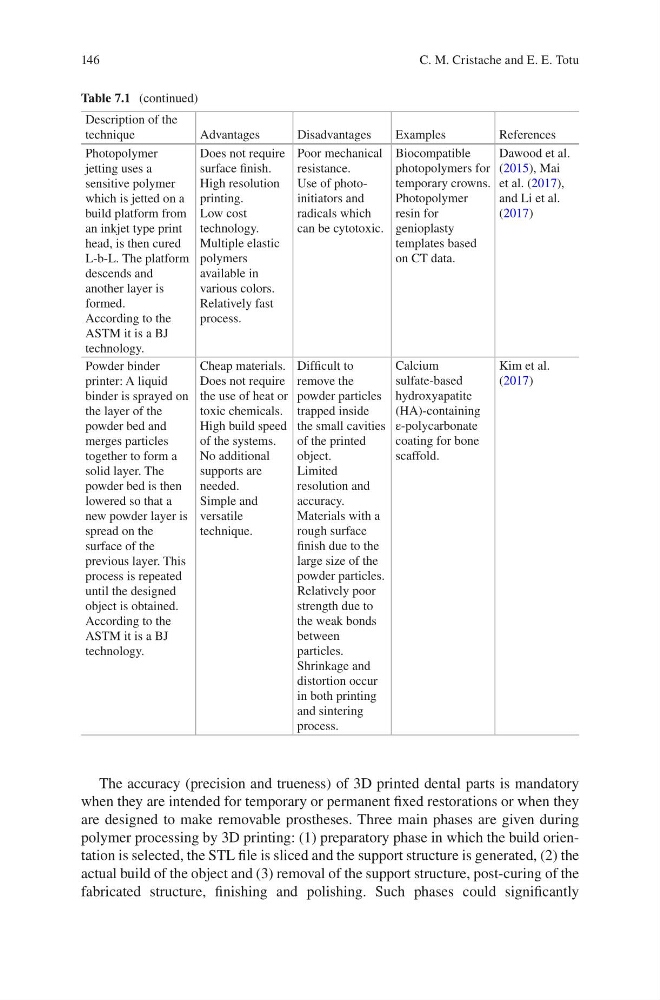
Table 7.1 (continued)
Description of the
technique
Advantages
Disadvantages
Examples
References
Photopolymer
jetting uses a
sensitive polymer
which is jetted on a
build platform from
an inkjet type print
head, is then cured
L-b-L. The platform
descends and
another layer is
formed.
According to the
ASTM it is a BJ
technology.
Does not require
surface finish.
High resolution
printing.
Low cost
technology.
Multiple elastic
polymers
available in
various colors.
Relatively fast
process.
Poor mechanical
resistance.
Use of photoinitiators and
radicals which
can be cytotoxic.
Biocompatible
photopolymers for
temporary crowns.
Photopolymer
resin for
genioplasty
templates based
on CT data.
Dawood et al.
(2015), Mai
et al. (2017),
and Li et al.
(2017)
Powder binder
printer: A liquid
binder is sprayed on
the layer of the
powder bed and
merges particles
together to form a
solid layer. The
powder bed is then
lowered so that a
new powder layer is
spread on the
surface of the
previous layer. This
process is repeated
until the designed
object is obtained.
According to the
ASTM it is a BJ
technology.
Cheap materials.
Does not require
the use of heat or
toxic chemicals.
High build speed
of the systems.
No additional
supports are
needed.
Simple and
versatile
technique.
Difficult to
remove the
powder particles
trapped inside
the small cavities
of the printed
object.
Limited
resolution and
accuracy.
Materials with a
rough surface
finish due to the
large size of the
powder particles.
Relatively poor
strength due to
the weak bonds
between
particles.
Shrinkage and
distortion occur
in both printing
and sintering
process.
Calcium
sulfate-based
hydroxyapatite
(HA)-containing
ε-polycarbonate
coating for bone
scaffold.
Kim et al.
(2017)
C. M. Cristache and E. E. Totu
The accuracy (precision and trueness) of 3D printed dental parts is mandatory
when they are intended for temporary or permanent fixed restorations or when they
are designed to make removable prostheses. Three main phases are given during
polymer processing by 3D printing: (1) preparatory phase in which the build orientation is selected, the STL file is sliced and the support structure is generated, (2) the
actual build of the object and (3) removal of the support structure, post-curing of the
fabricated structure, finishing and polishing. Such phases could significantly
Table 7.1 (continued)
Description of the
technique
Advantages
Disadvantages
Examples
References
Photopolymer
jetting uses a
sensitive polymer
which is jetted on a
build platform from
an inkjet type print
head, is then cured
L-b-L. The platform
descends and
another layer is
formed.
According to the
ASTM it is a BJ
technology.
Does not require
surface finish.
High resolution
printing.
Low cost
technology.
Multiple elastic
polymers
available in
various colors.
Relatively fast
process.
Poor mechanical
resistance.
Use of photoinitiators and
radicals which
can be cytotoxic.
Biocompatible
photopolymers for
temporary crowns.
Photopolymer
resin for
genioplasty
templates based
on CT data.
Dawood et al.
(2015), Mai
et al. (2017),
and Li et al.
(2017)
Powder binder
printer: A liquid
binder is sprayed on
the layer of the
powder bed and
merges particles
together to form a
solid layer. The
powder bed is then
lowered so that a
new powder layer is
spread on the
surface of the
previous layer. This
process is repeated
until the designed
object is obtained.
According to the
ASTM it is a BJ
technology.
Cheap materials.
Does not require
the use of heat or
toxic chemicals.
High build speed
of the systems.
No additional
supports are
needed.
Simple and
versatile
technique.
Difficult to
remove the
powder particles
trapped inside
the small cavities
of the printed
object.
Limited
resolution and
accuracy.
Materials with a
rough surface
finish due to the
large size of the
powder particles.
Relatively poor
strength due to
the weak bonds
between
particles.
Shrinkage and
distortion occur
in both printing
and sintering
process.
Calcium
sulfate-based
hydroxyapatite
(HA)-containing
ε-polycarbonate
coating for bone
scaffold.
Kim et al.
(2017)
C. M. Cristache and E. E. Totu