

130
6.3.6 Polymer-Based Self-Assembly
The self-assembly of polymers is well known to produce exotic nano-architects.
The chiral self-assembly of polymer backbone may be possible after incorporating
chiral perturbation substituents. This idea was first verified by Di Nuzzo et al.
(2017). These authors synthesized a D-A type polyfluorene having chiral side
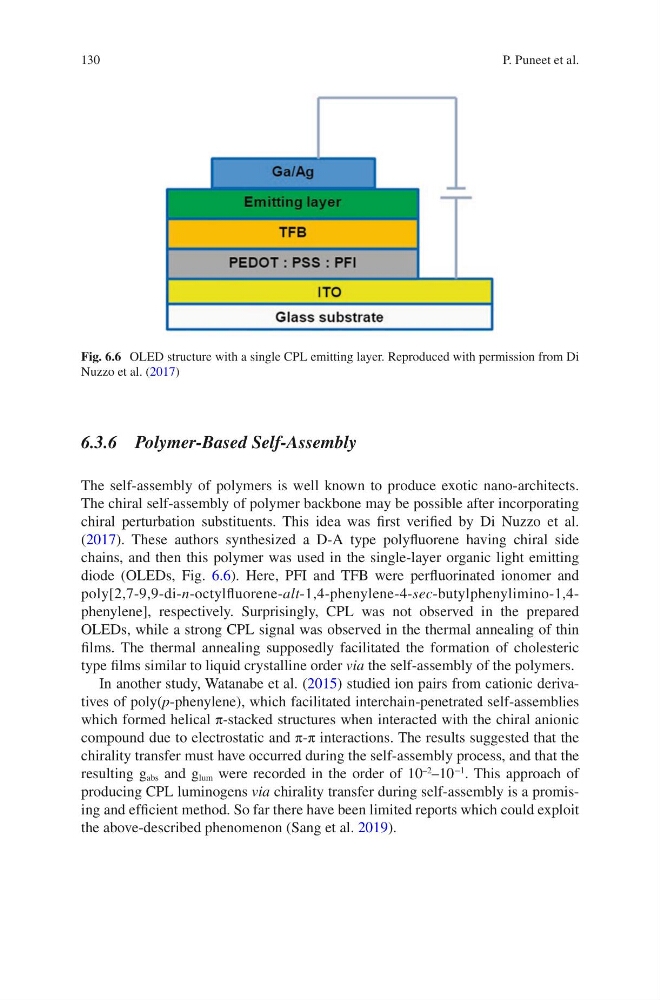
chains, and then this polymer was used in the single-layer organic light emitting
diode (OLEDs, Fig. 6.6). Here, PFI and TFB were perfluorinated ionomer and
poly[2,7-9,9-di-n-octylfluorene-alt-1,4-phenylene-4-sec-butylphenylimino- 1,4phenylene], respectively. Surprisingly, CPL was not observed in the prepared
OLEDs, while a strong CPL signal was observed in the thermal annealing of thin
films. The thermal annealing supposedly facilitated the formation of cholesteric
type films similar to liquid crystalline order via the self-assembly of the polymers.
In another study, Watanabe et al. (2015) studied ion pairs from cationic derivatives of poly(p-phenylene), which facilitated interchain-penetrated self-assemblies
which formed helical π-stacked structures when interacted with the chiral anionic
compound due to electrostatic and π-π interactions. The results suggested that the
chirality transfer must have occurred during the self-assembly process, and that the
resulting g abs and g lum were recorded in the order of 10
–2
–10
−1
. This approach of
producing CPL luminogens via chirality transfer during self-assembly is a promising and efficient method. So far there have been limited reports which could exploit
the above-described phenomenon (Sang et al. 2019).
Fig. 6.6 OLED structure with a single CPL emitting layer. Reproduced with permission from Di
Nuzzo et al. (2017)
P. Puneet et al.
6.3.6 Polymer-Based Self-Assembly
The self-assembly of polymers is well known to produce exotic nano-architects.
The chiral self-assembly of polymer backbone may be possible after incorporating
chiral perturbation substituents. This idea was first verified by Di Nuzzo et al.
(2017). These authors synthesized a D-A type polyfluorene having chiral side
chains, and then this polymer was used in the single-layer organic light emitting
diode (OLEDs, Fig. 6.6). Here, PFI and TFB were perfluorinated ionomer and
poly[2,7-9,9-di-n-octylfluorene-alt-1,4-phenylene-4-sec-butylphenylimino- 1,4phenylene], respectively. Surprisingly, CPL was not observed in the prepared
OLEDs, while a strong CPL signal was observed in the thermal annealing of thin
films. The thermal annealing supposedly facilitated the formation of cholesteric
type films similar to liquid crystalline order via the self-assembly of the polymers.
In another study, Watanabe et al. (2015) studied ion pairs from cationic derivatives of poly(p-phenylene), which facilitated interchain-penetrated self-assemblies
which formed helical π-stacked structures when interacted with the chiral anionic
compound due to electrostatic and π-π interactions. The results suggested that the
chirality transfer must have occurred during the self-assembly process, and that the
resulting g abs and g lum were recorded in the order of 10
–2
–10
−1
. This approach of
producing CPL luminogens via chirality transfer during self-assembly is a promising and efficient method. So far there have been limited reports which could exploit
the above-described phenomenon (Sang et al. 2019).
Fig. 6.6 OLED structure with a single CPL emitting layer. Reproduced with permission from Di
Nuzzo et al. (2017)
P. Puneet et al.