

129
(R)-limonene-induced l-PF8T2 particles. Nevertheless, Fujiki et al. (2015) reported
that CP-photon irradiation allows to produce successfully CPL-active h-PF8T2 particles (Φ F of 8%) from the corresponding CPL-silent particles, thus showing a Φ F
value of 15%. The decrease in Φ F value after prolonged CP-photon irradiation can
be attributed to the less efficient emissive fluorenone, thiophene sulfone and thiophene sulfoxide moieties which are air-oxidation products of thiophene rings and
fluorenone of PF8T2.
6.3.5 Achiral Polymers Doped with Chiral Molecules
The incorporation of a chiral moiety into the π-conjugated polymer main chain is
tedious work, and requires several synthesis steps. However, doping of achiral polymers with a chiral dopant to prepare a homogenous blend could be an alternative.
This particular strategy was first employed by Yang et al. (2013) for the enantiomer
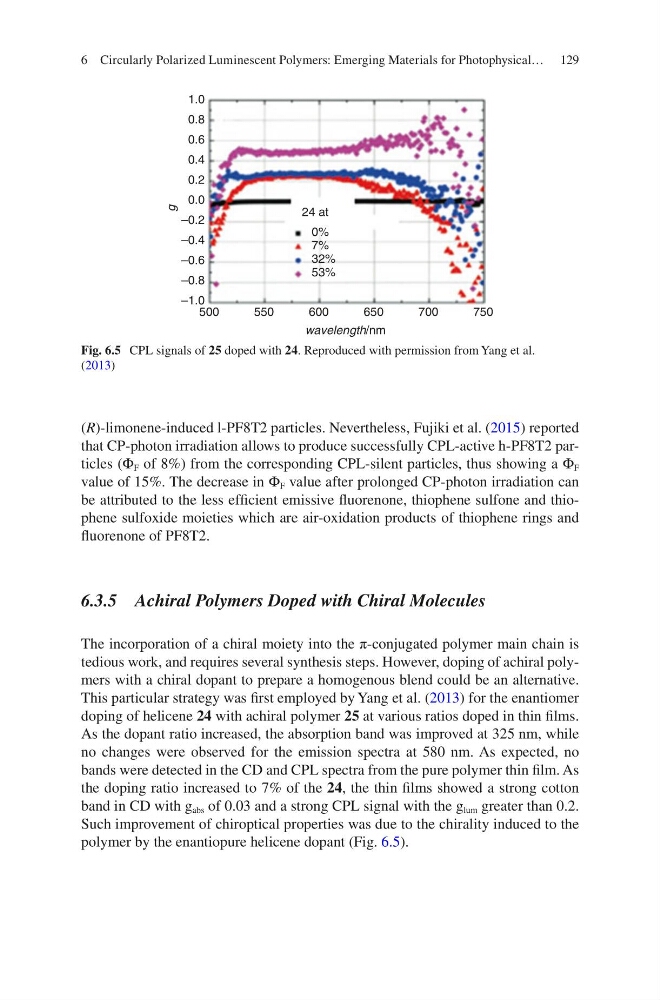
doping of helicene 24 with achiral polymer 25 at various ratios doped in thin films.
As the dopant ratio increased, the absorption band was improved at 325 nm, while
no changes were observed for the emission spectra at 580 nm. As expected, no
bands were detected in the CD and CPL spectra from the pure polymer thin film. As
the doping ratio increased to 7% of the 24, the thin films showed a strong cotton
band in CD with g abs of 0.03 and a strong CPL signal with the g lum greater than 0.2.
Such improvement of chiroptical properties was due to the chirality induced to the
polymer by the enantiopure helicene dopant (Fig. 6.5).
1.0
0.8
0.6
0.4
0.2
0.0
–0.2
–0.4
–0.6
–0.8
–1.0
500
550
600
wavelength/nm
0%
24 at
g
7%
32%
53%
650
700
750
Fig. 6.5 CPL signals of 25 doped with 24. Reproduced with permission from Yang et al.
(2013)
6 Circularly Polarized Luminescent Polymers: Emerging Materials for Photophysical…
(R)-limonene-induced l-PF8T2 particles. Nevertheless, Fujiki et al. (2015) reported
that CP-photon irradiation allows to produce successfully CPL-active h-PF8T2 particles (Φ F of 8%) from the corresponding CPL-silent particles, thus showing a Φ F
value of 15%. The decrease in Φ F value after prolonged CP-photon irradiation can
be attributed to the less efficient emissive fluorenone, thiophene sulfone and thiophene sulfoxide moieties which are air-oxidation products of thiophene rings and
fluorenone of PF8T2.
6.3.5 Achiral Polymers Doped with Chiral Molecules
The incorporation of a chiral moiety into the π-conjugated polymer main chain is
tedious work, and requires several synthesis steps. However, doping of achiral polymers with a chiral dopant to prepare a homogenous blend could be an alternative.
This particular strategy was first employed by Yang et al. (2013) for the enantiomer
doping of helicene 24 with achiral polymer 25 at various ratios doped in thin films.
As the dopant ratio increased, the absorption band was improved at 325 nm, while
no changes were observed for the emission spectra at 580 nm. As expected, no
bands were detected in the CD and CPL spectra from the pure polymer thin film. As
the doping ratio increased to 7% of the 24, the thin films showed a strong cotton
band in CD with g abs of 0.03 and a strong CPL signal with the g lum greater than 0.2.
Such improvement of chiroptical properties was due to the chirality induced to the
polymer by the enantiopure helicene dopant (Fig. 6.5).
1.0
0.8
0.6
0.4
0.2
0.0
–0.2
–0.4
–0.6
–0.8
–1.0
500
550
600
wavelength/nm
0%
24 at
g
7%
32%
53%
650
700
750
Fig. 6.5 CPL signals of 25 doped with 24. Reproduced with permission from Yang et al.
(2013)
6 Circularly Polarized Luminescent Polymers: Emerging Materials for Photophysical…