

125
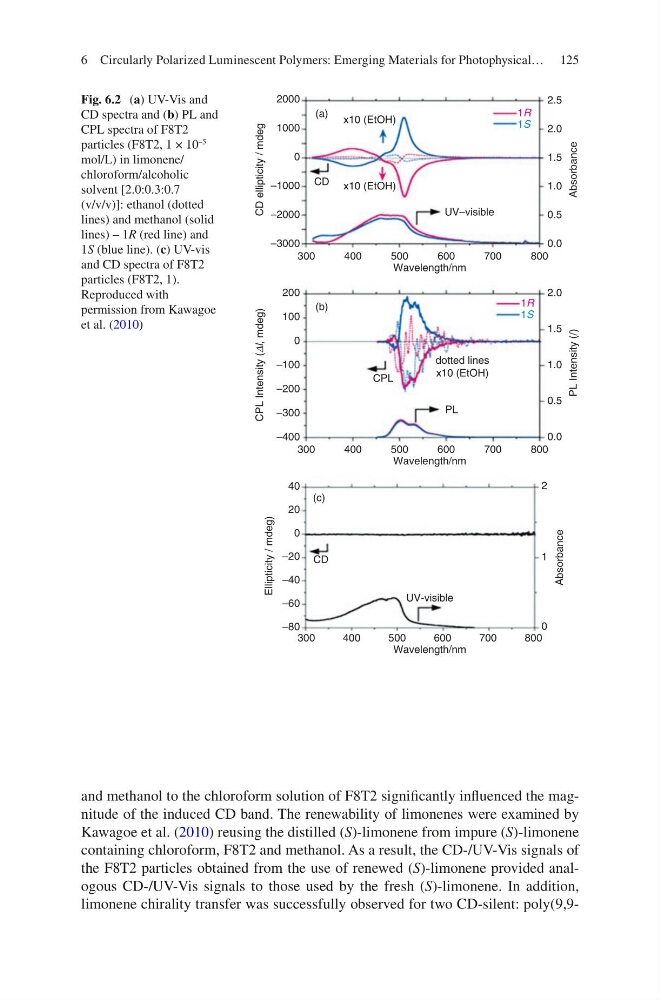
and methanol to the chloroform solution of F8T2 significantly influenced the magnitude of the induced CD band. The renewability of limonenes were examined by
Kawagoe et al. (2010) reusing the distilled (S)-limonene from impure (S)-limonene
containing chloroform, F8T2 and methanol. As a result, the CD-/UV-Vis signals of
the F8T2 particles obtained from the use of renewed (S)-limonene provided analogous CD-/UV-Vis signals to those used by the fresh (S)-limonene. In addition,
limonene chirality transfer was successfully observed for two CD-silent: poly(9,92000
(a)
(b)
x10 (EtOH)
x10 (EtOH)
CD
UV–visible
2.5
1R
1S
2.0
1.5
1.0
0.5
0.0
1000
0
–1000
CD ellipticity / mdeg
Absorbance
2.0
1.5
1.0
0.5
0.0
0
1
2
PL Intensity (/)
Absorbance
–2000
–3000
200
100
0
–200
–100
CPL Intensity (Dl, mdeg)
Ellipticity / mdeg)
–300
–400
40
20
0
–20 CD
(c)
–40
–60
–80
300
400
500
Wavelength/nm
600
700
800
300
400
CPL
PL
dotted lines
x10 (EtOH)
500
Wavelength/nm
600
700
800
300
400
500
Wavelength/nm
UV-visible
600
700
800
1R
1S
Fig. 6.2 (a) UV-Vis and
CD spectra and (b) PL and
CPL spectra of F8T2
particles (F8T2, 1 × 10
–5
mol/L) in limonene/
chloroform/alcoholic
solvent [2.0:0.3:0.7
(v/v/v)]: ethanol (dotted
lines) and methanol (solid
lines) – 1R (red line) and
1S (blue line). (c) UV-vis
and CD spectra of F8T2
particles (F8T2, 1).
Reproduced with
permission from Kawagoe
et al. (2010)
6 Circularly Polarized Luminescent Polymers: Emerging Materials for Photophysical…
and methanol to the chloroform solution of F8T2 significantly influenced the magnitude of the induced CD band. The renewability of limonenes were examined by
Kawagoe et al. (2010) reusing the distilled (S)-limonene from impure (S)-limonene
containing chloroform, F8T2 and methanol. As a result, the CD-/UV-Vis signals of
the F8T2 particles obtained from the use of renewed (S)-limonene provided analogous CD-/UV-Vis signals to those used by the fresh (S)-limonene. In addition,
limonene chirality transfer was successfully observed for two CD-silent: poly(9,92000
(a)
(b)
x10 (EtOH)
x10 (EtOH)
CD
UV–visible
2.5
1R
1S
2.0
1.5
1.0
0.5
0.0
1000
0
–1000
CD ellipticity / mdeg
Absorbance
2.0
1.5
1.0
0.5
0.0
0
1
2
PL Intensity (/)
Absorbance
–2000
–3000
200
100
0
–200
–100
CPL Intensity (Dl, mdeg)
Ellipticity / mdeg)
–300
–400
40
20
0
–20 CD
(c)
–40
–60
–80
300
400
500
Wavelength/nm
600
700
800
300
400
CPL
PL
dotted lines
x10 (EtOH)
500
Wavelength/nm
600
700
800
300
400
500
Wavelength/nm
UV-visible
600
700
800
1R
1S
Fig. 6.2 (a) UV-Vis and
CD spectra and (b) PL and
CPL spectra of F8T2
particles (F8T2, 1 × 10
–5
mol/L) in limonene/
chloroform/alcoholic
solvent [2.0:0.3:0.7
(v/v/v)]: ethanol (dotted
lines) and methanol (solid
lines) – 1R (red line) and
1S (blue line). (c) UV-vis
and CD spectra of F8T2
particles (F8T2, 1).
Reproduced with
permission from Kawagoe
et al. (2010)
6 Circularly Polarized Luminescent Polymers: Emerging Materials for Photophysical…