

124
diagrams, Fourier transform infrared (FTIR) spectra and wide-angle X-ray scattering (WAXS) diffractograms indicated that solvent-driven on-off switching of multiple hydrogen bonds, due to three urethane groups from CTPC play a key role for
the inversion. The intermolecular CH/π and π-π interactions among alkyl groups
and phenyl rings were assumed to be crucial for the helicity/chirality transfer capability based on molecular mechanics and molecular dynamics simulations of PF6CTPC hybrids.
6.3.3 Chirality Transfer to Achiral Polymers Via Interacting
with Chiral Solvents
The (S)- and (R)-limonenes are promising candidates as renewable bioresources.
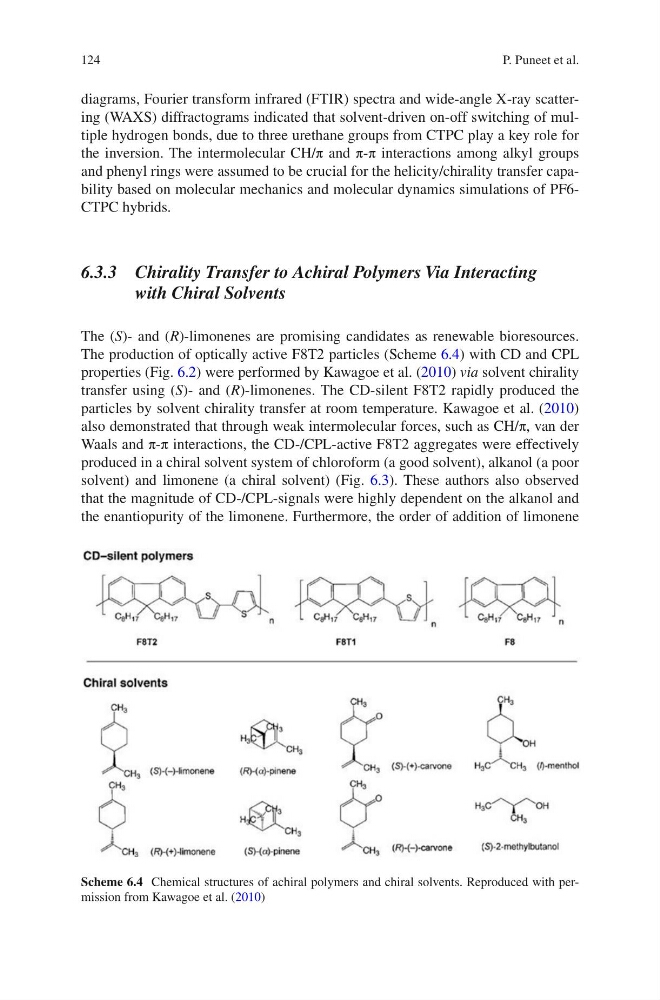
The production of optically active F8T2 particles (Scheme 6.4) with CD and CPL
properties (Fig. 6.2) were performed by Kawagoe et al. (2010) via solvent chirality
transfer using (S)- and (R)-limonenes. The CD-silent F8T2 rapidly produced the
particles by solvent chirality transfer at room temperature. Kawagoe et al. (2010)
also demonstrated that through weak intermolecular forces, such as CH/π, van der
Waals and π-π interactions, the CD-/CPL-active F8T2 aggregates were effectively
produced in a chiral solvent system of chloroform (a good solvent), alkanol (a poor
solvent) and limonene (a chiral solvent) (Fig. 6.3). These authors also observed
that the magnitude of CD-/CPL-signals were highly dependent on the alkanol and
the enantiopurity of the limonene. Furthermore, the order of addition of limonene
Scheme 6.4 Chemical structures of achiral polymers and chiral solvents. Reproduced with permission from Kawagoe et al. (2010)
P. Puneet et al.
diagrams, Fourier transform infrared (FTIR) spectra and wide-angle X-ray scattering (WAXS) diffractograms indicated that solvent-driven on-off switching of multiple hydrogen bonds, due to three urethane groups from CTPC play a key role for
the inversion. The intermolecular CH/π and π-π interactions among alkyl groups
and phenyl rings were assumed to be crucial for the helicity/chirality transfer capability based on molecular mechanics and molecular dynamics simulations of PF6CTPC hybrids.
6.3.3 Chirality Transfer to Achiral Polymers Via Interacting
with Chiral Solvents
The (S)- and (R)-limonenes are promising candidates as renewable bioresources.
The production of optically active F8T2 particles (Scheme 6.4) with CD and CPL
properties (Fig. 6.2) were performed by Kawagoe et al. (2010) via solvent chirality
transfer using (S)- and (R)-limonenes. The CD-silent F8T2 rapidly produced the
particles by solvent chirality transfer at room temperature. Kawagoe et al. (2010)
also demonstrated that through weak intermolecular forces, such as CH/π, van der
Waals and π-π interactions, the CD-/CPL-active F8T2 aggregates were effectively
produced in a chiral solvent system of chloroform (a good solvent), alkanol (a poor
solvent) and limonene (a chiral solvent) (Fig. 6.3). These authors also observed
that the magnitude of CD-/CPL-signals were highly dependent on the alkanol and
the enantiopurity of the limonene. Furthermore, the order of addition of limonene
Scheme 6.4 Chemical structures of achiral polymers and chiral solvents. Reproduced with permission from Kawagoe et al. (2010)
P. Puneet et al.