

172
S. Majidi et al.
Gu et al. [2] using MD simulation demonstrated rapid water permeability and
effective salt rejection of nanoporous BN. Two types of systems including the triangular nanopores with N–H edges and those with B–H edges were investigated. Additionally, three different pore sizes were selected for each of the pore types as X–H–n
(X = N, B; and n = 4, 5, 6). The X–H–n pore has n X–H pairs at each side of
the triangular nanopore. The areas of N–H–4, B–H–4, N–H–5, B–H–5, N–H–6, and
B–H–6 pores were calculated about 0.231, 0.234, 0.397, 0.401, 0.607, and 0.611 nm
2 ,
respectively.
The system containing a total of 8300 water molecules and 0.599 M NaCl in
saltwater was set and MD simulation was conducted by GROMACS software. Periodic boundary conditions were employed in all directions. The number of permeated
water molecules through the nanoporous BN membrane was monitored during the
simulation time. The external pressures at the range of 50–250 MPa were applied by
the piston. Results revealed that the water flux enhances by increasing the applied
pressure. Furthermore, the number of water molecules transferring across the B–H
pores is higher than that of N–H pores at the same pressure, which is in accordance
with pores area. Also, the results showed that when the pore size narrowed to N–H–4
pore, the permeability of water molecules starts to shut off. Besides, the salt rejection performance of pores was studied and results exhibited that B–H–4 pore has
the highest salt rejection, which reaches 100%. They concluded that the orientation
of water molecules close to the pores plays a prominent role, which affects water
permeability and salt rejection.
In the other study by Davoy et al. [1], MD simulations were used to prepare a
microscopic vision of the ions effect on water permeability across sub-nanometer
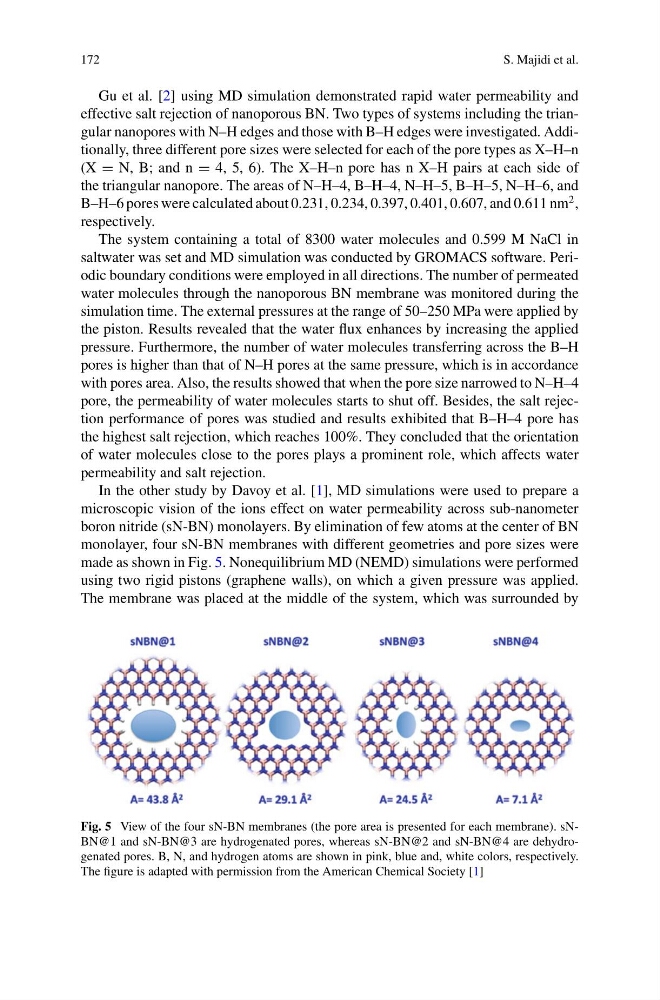
boron nitride (sN-BN) monolayers. By elimination of few atoms at the center of BN
monolayer, four sN-BN membranes with different geometries and pore sizes were
made as shown in Fig. 5. Nonequilibrium MD (NEMD) simulations were performed
using two rigid pistons (graphene walls), on which a given pressure was applied.
The membrane was placed at the middle of the system, which was surrounded by
Fig. 5 View of the four sN-BN membranes (the pore area is presented for each membrane). sNBN@1 and sN-BN@3 are hydrogenated pores, whereas sN-BN@2 and sN-BN@4 are dehydrogenated pores. B, N, and hydrogen atoms are shown in pink, blue and, white colors, respectively.
The figure is adapted with permission from the American Chemical Society [1]
S. Majidi et al.
Gu et al. [2] using MD simulation demonstrated rapid water permeability and
effective salt rejection of nanoporous BN. Two types of systems including the triangular nanopores with N–H edges and those with B–H edges were investigated. Additionally, three different pore sizes were selected for each of the pore types as X–H–n
(X = N, B; and n = 4, 5, 6). The X–H–n pore has n X–H pairs at each side of
the triangular nanopore. The areas of N–H–4, B–H–4, N–H–5, B–H–5, N–H–6, and
B–H–6 pores were calculated about 0.231, 0.234, 0.397, 0.401, 0.607, and 0.611 nm
2 ,
respectively.
The system containing a total of 8300 water molecules and 0.599 M NaCl in
saltwater was set and MD simulation was conducted by GROMACS software. Periodic boundary conditions were employed in all directions. The number of permeated
water molecules through the nanoporous BN membrane was monitored during the
simulation time. The external pressures at the range of 50–250 MPa were applied by
the piston. Results revealed that the water flux enhances by increasing the applied
pressure. Furthermore, the number of water molecules transferring across the B–H
pores is higher than that of N–H pores at the same pressure, which is in accordance
with pores area. Also, the results showed that when the pore size narrowed to N–H–4
pore, the permeability of water molecules starts to shut off. Besides, the salt rejection performance of pores was studied and results exhibited that B–H–4 pore has
the highest salt rejection, which reaches 100%. They concluded that the orientation
of water molecules close to the pores plays a prominent role, which affects water
permeability and salt rejection.
In the other study by Davoy et al. [1], MD simulations were used to prepare a
microscopic vision of the ions effect on water permeability across sub-nanometer
boron nitride (sN-BN) monolayers. By elimination of few atoms at the center of BN
monolayer, four sN-BN membranes with different geometries and pore sizes were
made as shown in Fig. 5. Nonequilibrium MD (NEMD) simulations were performed
using two rigid pistons (graphene walls), on which a given pressure was applied.
The membrane was placed at the middle of the system, which was surrounded by
Fig. 5 View of the four sN-BN membranes (the pore area is presented for each membrane). sNBN@1 and sN-BN@3 are hydrogenated pores, whereas sN-BN@2 and sN-BN@4 are dehydrogenated pores. B, N, and hydrogen atoms are shown in pink, blue and, white colors, respectively.
The figure is adapted with permission from the American Chemical Society [1]