

156
C. Sun et al.
to the water molecules in their hydration shells while the large radii ions were free
from their hydration shells due to their large size without much bonding to the water
molecules. Zhao et al. [69] carried out a promising and comprehensive theoretical
study on charge-modified NPG as the ion exchange membranes for desalination
based on energy conservation. MD simulations were performed to investigate the
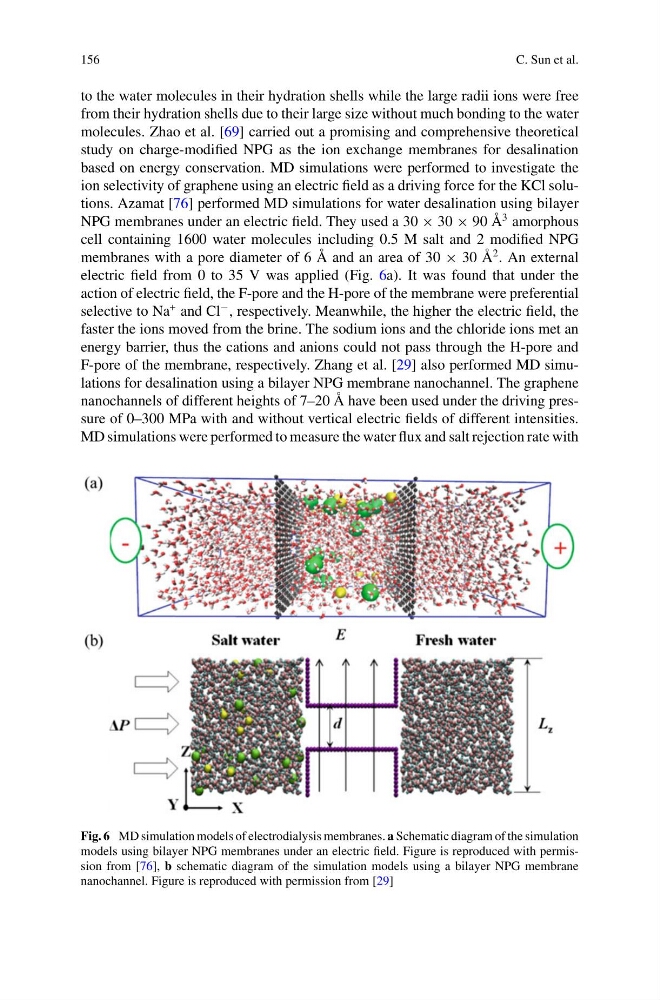
ion selectivity of graphene using an electric field as a driving force for the KCl solutions. Azamat [76] performed MD simulations for water desalination using bilayer
NPG membranes under an electric field. They used a 30 × 30 × 90 Å
3 amorphous
cell containing 1600 water molecules including 0.5 M salt and 2 modified NPG
membranes with a pore diameter of 6 Å and an area of 30 × 30 Å
2 . An external
electric field from 0 to 35 V was applied (Fig. 6a). It was found that under the
action of electric field, the F-pore and the H-pore of the membrane were preferential
selective to Na
+ and Cl
− , respectively. Meanwhile, the higher the electric field, the
faster the ions moved from the brine. The sodium ions and the chloride ions met an
energy barrier, thus the cations and anions could not pass through the H-pore and
F-pore of the membrane, respectively. Zhang et al. [29] also performed MD simulations for desalination using a bilayer NPG membrane nanochannel. The graphene
nanochannels of different heights of 7–20 Å have been used under the driving pressure of 0–300 MPa with and without vertical electric fields of different intensities.
MD simulations were performed to measure the water flux and salt rejection rate with
Fig. 6 MD simulation models of electrodialysis membranes. a Schematic diagram of the simulation
models using bilayer NPG membranes under an electric field. Figure is reproduced with permission from [76], b schematic diagram of the simulation models using a bilayer NPG membrane
nanochannel. Figure is reproduced with permission from [29]
C. Sun et al.
to the water molecules in their hydration shells while the large radii ions were free
from their hydration shells due to their large size without much bonding to the water
molecules. Zhao et al. [69] carried out a promising and comprehensive theoretical
study on charge-modified NPG as the ion exchange membranes for desalination
based on energy conservation. MD simulations were performed to investigate the
ion selectivity of graphene using an electric field as a driving force for the KCl solutions. Azamat [76] performed MD simulations for water desalination using bilayer
NPG membranes under an electric field. They used a 30 × 30 × 90 Å
3 amorphous
cell containing 1600 water molecules including 0.5 M salt and 2 modified NPG
membranes with a pore diameter of 6 Å and an area of 30 × 30 Å
2 . An external
electric field from 0 to 35 V was applied (Fig. 6a). It was found that under the
action of electric field, the F-pore and the H-pore of the membrane were preferential
selective to Na
+ and Cl
− , respectively. Meanwhile, the higher the electric field, the
faster the ions moved from the brine. The sodium ions and the chloride ions met an
energy barrier, thus the cations and anions could not pass through the H-pore and
F-pore of the membrane, respectively. Zhang et al. [29] also performed MD simulations for desalination using a bilayer NPG membrane nanochannel. The graphene
nanochannels of different heights of 7–20 Å have been used under the driving pressure of 0–300 MPa with and without vertical electric fields of different intensities.
MD simulations were performed to measure the water flux and salt rejection rate with
Fig. 6 MD simulation models of electrodialysis membranes. a Schematic diagram of the simulation
models using bilayer NPG membranes under an electric field. Figure is reproduced with permission from [76], b schematic diagram of the simulation models using a bilayer NPG membrane
nanochannel. Figure is reproduced with permission from [29]