

Porous Graphene Membranes for Solute Separation …
155
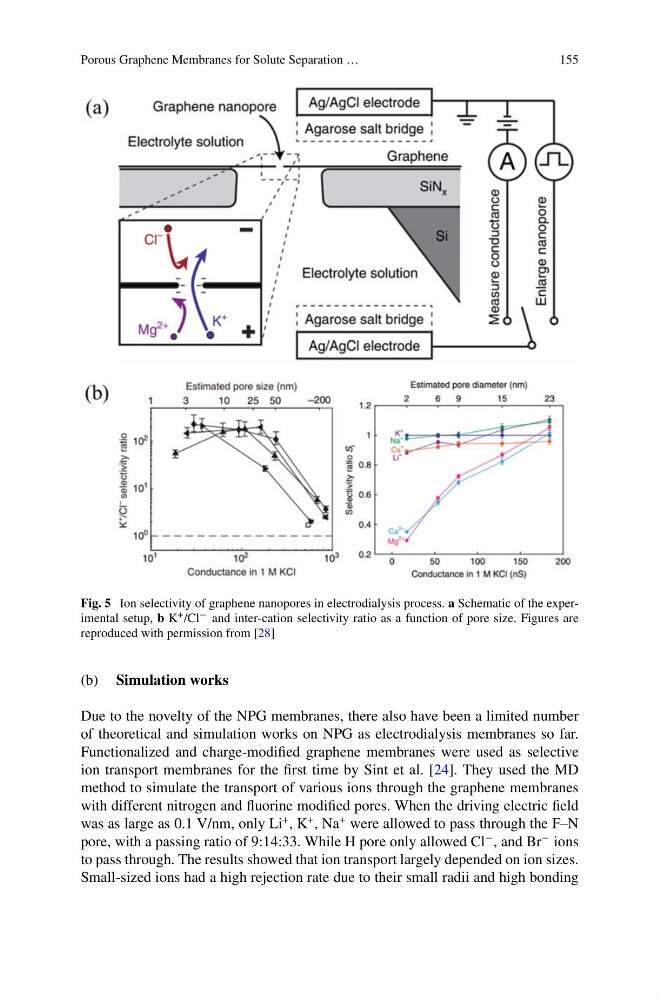
Fig. 5 Ion selectivity of graphene nanopores in electrodialysis process. a Schematic of the experimental setup, b K + /Cl − and inter-cation selectivity ratio as a function of pore size. Figures are
reproduced with permission from [28]
(b) Simulation works
Due to the novelty of the NPG membranes, there also have been a limited number
of theoretical and simulation works on NPG as electrodialysis membranes so far.
Functionalized and charge-modified graphene membranes were used as selective
ion transport membranes for the first time by Sint et al. [24]. They used the MD
method to simulate the transport of various ions through the graphene membranes
with different nitrogen and fluorine modified pores. When the driving electric field
was as large as 0.1 V/nm, only Li
+ , K
+ , Na
+ were allowed to pass through the F–N
pore, with a passing ratio of 9:14:33. While H pore only allowed Cl
− , and Br
− ions
to pass through. The results showed that ion transport largely depended on ion sizes.
Small-sized ions had a high rejection rate due to their small radii and high bonding
155
Fig. 5 Ion selectivity of graphene nanopores in electrodialysis process. a Schematic of the experimental setup, b K + /Cl − and inter-cation selectivity ratio as a function of pore size. Figures are
reproduced with permission from [28]
(b) Simulation works
Due to the novelty of the NPG membranes, there also have been a limited number
of theoretical and simulation works on NPG as electrodialysis membranes so far.
Functionalized and charge-modified graphene membranes were used as selective
ion transport membranes for the first time by Sint et al. [24]. They used the MD
method to simulate the transport of various ions through the graphene membranes
with different nitrogen and fluorine modified pores. When the driving electric field
was as large as 0.1 V/nm, only Li
+ , K
+ , Na
+ were allowed to pass through the F–N
pore, with a passing ratio of 9:14:33. While H pore only allowed Cl
− , and Br
− ions
to pass through. The results showed that ion transport largely depended on ion sizes.
Small-sized ions had a high rejection rate due to their small radii and high bonding