

Graphene Oxide and Reduced Graphene Oxide as Nanofillers …
131
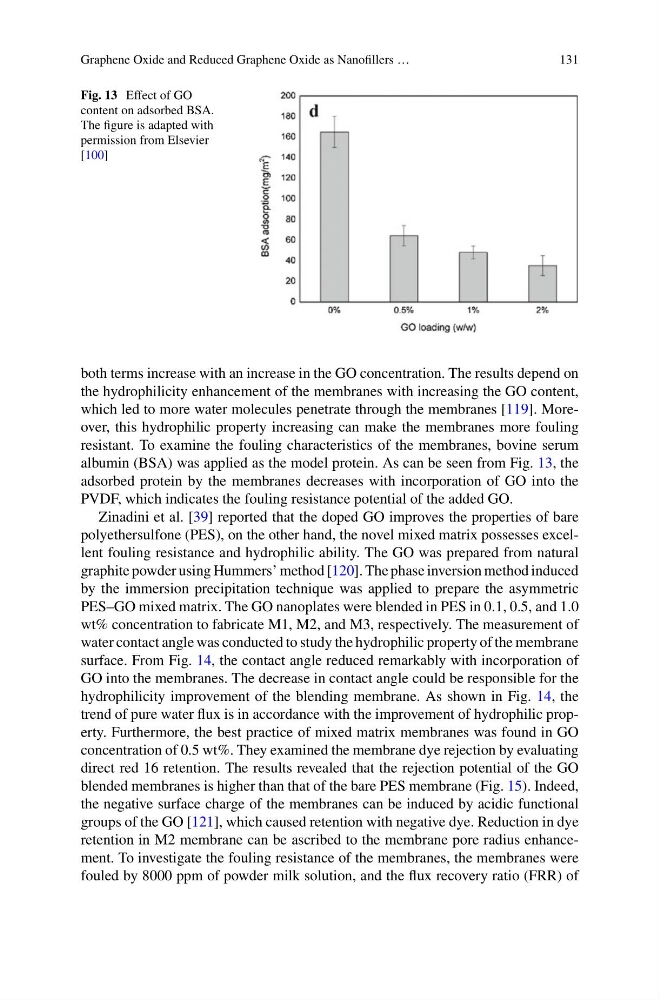
Fig. 13 Effect of GO
content on adsorbed BSA.
The figure is adapted with
permission from Elsevier
[100]
both terms increase with an increase in the GO concentration. The results depend on
the hydrophilicity enhancement of the membranes with increasing the GO content,
which led to more water molecules penetrate through the membranes [119]. Moreover, this hydrophilic property increasing can make the membranes more fouling
resistant. To examine the fouling characteristics of the membranes, bovine serum
albumin (BSA) was applied as the model protein. As can be seen from Fig. 13, the
adsorbed protein by the membranes decreases with incorporation of GO into the
PVDF, which indicates the fouling resistance potential of the added GO.
Zinadini et al. [39] reported that the doped GO improves the properties of bare
polyethersulfone (PES), on the other hand, the novel mixed matrix possesses excellent fouling resistance and hydrophilic ability. The GO was prepared from natural
graphite powder using Hummers’ method [120]. The phase inversion method induced
by the immersion precipitation technique was applied to prepare the asymmetric
PES–GO mixed matrix. The GO nanoplates were blended in PES in 0.1, 0.5, and 1.0
wt% concentration to fabricate M1, M2, and M3, respectively. The measurement of
water contact angle was conducted to study the hydrophilic property of the membrane
surface. From Fig. 14, the contact angle reduced remarkably with incorporation of
GO into the membranes. The decrease in contact angle could be responsible for the
hydrophilicity improvement of the blending membrane. As shown in Fig. 14, the
trend of pure water flux is in accordance with the improvement of hydrophilic property. Furthermore, the best practice of mixed matrix membranes was found in GO
concentration of 0.5 wt%. They examined the membrane dye rejection by evaluating
direct red 16 retention. The results revealed that the rejection potential of the GO
blended membranes is higher than that of the bare PES membrane (Fig. 15). Indeed,
the negative surface charge of the membranes can be induced by acidic functional
groups of the GO [121], which caused retention with negative dye. Reduction in dye
retention in M2 membrane can be ascribed to the membrane pore radius enhancement. To investigate the fouling resistance of the membranes, the membranes were
fouled by 8000 ppm of powder milk solution, and the flux recovery ratio (FRR) of
131
Fig. 13 Effect of GO
content on adsorbed BSA.
The figure is adapted with
permission from Elsevier
[100]
both terms increase with an increase in the GO concentration. The results depend on
the hydrophilicity enhancement of the membranes with increasing the GO content,
which led to more water molecules penetrate through the membranes [119]. Moreover, this hydrophilic property increasing can make the membranes more fouling
resistant. To examine the fouling characteristics of the membranes, bovine serum
albumin (BSA) was applied as the model protein. As can be seen from Fig. 13, the
adsorbed protein by the membranes decreases with incorporation of GO into the
PVDF, which indicates the fouling resistance potential of the added GO.
Zinadini et al. [39] reported that the doped GO improves the properties of bare
polyethersulfone (PES), on the other hand, the novel mixed matrix possesses excellent fouling resistance and hydrophilic ability. The GO was prepared from natural
graphite powder using Hummers’ method [120]. The phase inversion method induced
by the immersion precipitation technique was applied to prepare the asymmetric
PES–GO mixed matrix. The GO nanoplates were blended in PES in 0.1, 0.5, and 1.0
wt% concentration to fabricate M1, M2, and M3, respectively. The measurement of
water contact angle was conducted to study the hydrophilic property of the membrane
surface. From Fig. 14, the contact angle reduced remarkably with incorporation of
GO into the membranes. The decrease in contact angle could be responsible for the
hydrophilicity improvement of the blending membrane. As shown in Fig. 14, the
trend of pure water flux is in accordance with the improvement of hydrophilic property. Furthermore, the best practice of mixed matrix membranes was found in GO
concentration of 0.5 wt%. They examined the membrane dye rejection by evaluating
direct red 16 retention. The results revealed that the rejection potential of the GO
blended membranes is higher than that of the bare PES membrane (Fig. 15). Indeed,
the negative surface charge of the membranes can be induced by acidic functional
groups of the GO [121], which caused retention with negative dye. Reduction in dye
retention in M2 membrane can be ascribed to the membrane pore radius enhancement. To investigate the fouling resistance of the membranes, the membranes were
fouled by 8000 ppm of powder milk solution, and the flux recovery ratio (FRR) of