

130
S. Pakdel et al.
Table 2 Contact angle of
PVDF and PVDF/GO
membranes [100]
Membrane
Contact angle (deg)
PVDF
72.6 ± 1.5
PVDF/GO-0.5
70.5 ± 1.1
PVDF/GO-1
64.2 ± 0.8
PVDF/GO-2
60.5 ± 1.8
GO in the membrane at different applied pressures. Indeed, impregnation of GO into
the polymer matrix led to more hydrophilic sites, which facilities the sorption of
water into the membrane [117]. Salt rejection test was conducted by evaluating the
rejection of 1000 ppm of Na 2 SO 4 and NaCl solutions. The rejection results showed
an increasing trend with increasing GO content in the polymer matrix. Membrane
with 2000 ppm of GO doping demonstrated a maximum of 72% Na 2 SO 4 rejection
at 4 bar applied pressure.
The effect of the GO impregnation into the polyvinylidene fluoride (PVDF)
membranes was reported by Zhao et al. [100]. In this study, GO was obtained
from natural graphite powder using modified Hummers’ method [118]. Then, PVDF
applied as the bulk material, N,N-dimethylacetamide (DMAc) as the solvent, GO as
the nanofiller and deionized water as the non-solvent coagulation bath to prepare the
PVDF/GO membranes via immersion precipitation phase inversion technique. The
GO nanosheets in the concentration range from 0 to 2 wt% were incorporated into
PVDF membranes, and the nanocomposites were defined as PVDF (as reference),
PVDF/GO-0.5, PVDF/GO-1, and PVDF/GO-2. The contact angle of the membranes
was measured as presented in Table 2. By increasing the impregnated GO from 0 to
2 wt%, the contact angle reduced from 72.6 ± 1.5˚ to 60.5 ± 1.8˚, which resulted
in the improvement of surface hydrophilicity. The ultrafiltration system was applied
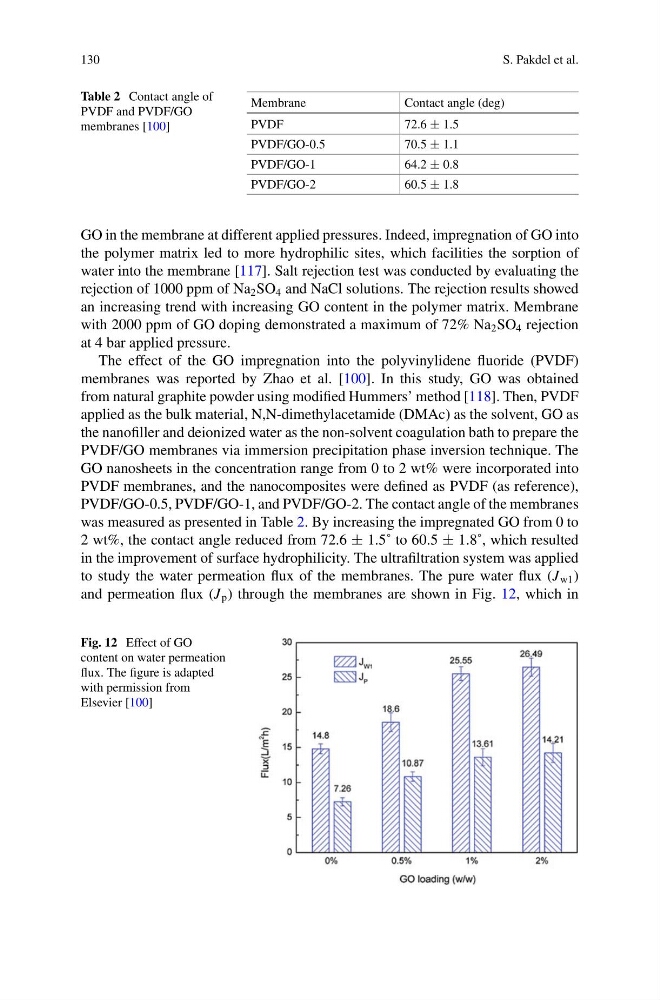
to study the water permeation flux of the membranes. The pure water flux (J w1 )
and permeation flux (J p ) through the membranes are shown in Fig. 12, which in
Fig. 12 Effect of GO
content on water permeation
flux. The figure is adapted
with permission from
Elsevier [100]
S. Pakdel et al.
Table 2 Contact angle of
PVDF and PVDF/GO
membranes [100]
Membrane
Contact angle (deg)
PVDF
72.6 ± 1.5
PVDF/GO-0.5
70.5 ± 1.1
PVDF/GO-1
64.2 ± 0.8
PVDF/GO-2
60.5 ± 1.8
GO in the membrane at different applied pressures. Indeed, impregnation of GO into
the polymer matrix led to more hydrophilic sites, which facilities the sorption of
water into the membrane [117]. Salt rejection test was conducted by evaluating the
rejection of 1000 ppm of Na 2 SO 4 and NaCl solutions. The rejection results showed
an increasing trend with increasing GO content in the polymer matrix. Membrane
with 2000 ppm of GO doping demonstrated a maximum of 72% Na 2 SO 4 rejection
at 4 bar applied pressure.
The effect of the GO impregnation into the polyvinylidene fluoride (PVDF)
membranes was reported by Zhao et al. [100]. In this study, GO was obtained
from natural graphite powder using modified Hummers’ method [118]. Then, PVDF
applied as the bulk material, N,N-dimethylacetamide (DMAc) as the solvent, GO as
the nanofiller and deionized water as the non-solvent coagulation bath to prepare the
PVDF/GO membranes via immersion precipitation phase inversion technique. The
GO nanosheets in the concentration range from 0 to 2 wt% were incorporated into
PVDF membranes, and the nanocomposites were defined as PVDF (as reference),
PVDF/GO-0.5, PVDF/GO-1, and PVDF/GO-2. The contact angle of the membranes
was measured as presented in Table 2. By increasing the impregnated GO from 0 to
2 wt%, the contact angle reduced from 72.6 ± 1.5˚ to 60.5 ± 1.8˚, which resulted
in the improvement of surface hydrophilicity. The ultrafiltration system was applied
to study the water permeation flux of the membranes. The pure water flux (J w1 )
and permeation flux (J p ) through the membranes are shown in Fig. 12, which in
Fig. 12 Effect of GO
content on water permeation
flux. The figure is adapted
with permission from
Elsevier [100]