

126
S. Pakdel et al.
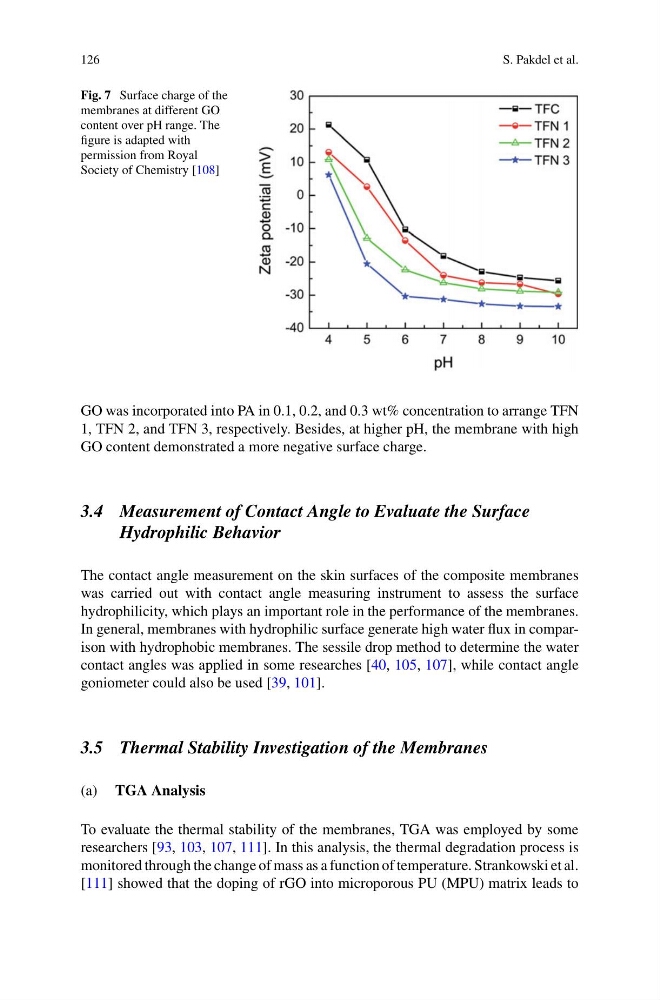
Fig. 7 Surface charge of the
membranes at different GO
content over pH range. The
figure is adapted with
permission from Royal
Society of Chemistry [108]
GO was incorporated into PA in 0.1, 0.2, and 0.3 wt% concentration to arrange TFN
1, TFN 2, and TFN 3, respectively. Besides, at higher pH, the membrane with high
GO content demonstrated a more negative surface charge.
3.4 Measurement of Contact Angle to Evaluate the Surface
Hydrophilic Behavior
The contact angle measurement on the skin surfaces of the composite membranes
was carried out with contact angle measuring instrument to assess the surface
hydrophilicity, which plays an important role in the performance of the membranes.
In general, membranes with hydrophilic surface generate high water flux in comparison with hydrophobic membranes. The sessile drop method to determine the water
contact angles was applied in some researches [40, 105, 107], while contact angle
goniometer could also be used [39, 101].
3.5 Thermal Stability Investigation of the Membranes
(a) TGA Analysis
To evaluate the thermal stability of the membranes, TGA was employed by some
researchers [93, 103, 107, 111]. In this analysis, the thermal degradation process is
monitored through the change of mass as a function of temperature. Strankowski et al.
[111] showed that the doping of rGO into microporous PU (MPU) matrix leads to
S. Pakdel et al.
Fig. 7 Surface charge of the
membranes at different GO
content over pH range. The
figure is adapted with
permission from Royal
Society of Chemistry [108]
GO was incorporated into PA in 0.1, 0.2, and 0.3 wt% concentration to arrange TFN
1, TFN 2, and TFN 3, respectively. Besides, at higher pH, the membrane with high
GO content demonstrated a more negative surface charge.
3.4 Measurement of Contact Angle to Evaluate the Surface
Hydrophilic Behavior
The contact angle measurement on the skin surfaces of the composite membranes
was carried out with contact angle measuring instrument to assess the surface
hydrophilicity, which plays an important role in the performance of the membranes.
In general, membranes with hydrophilic surface generate high water flux in comparison with hydrophobic membranes. The sessile drop method to determine the water
contact angles was applied in some researches [40, 105, 107], while contact angle
goniometer could also be used [39, 101].
3.5 Thermal Stability Investigation of the Membranes
(a) TGA Analysis
To evaluate the thermal stability of the membranes, TGA was employed by some
researchers [93, 103, 107, 111]. In this analysis, the thermal degradation process is
monitored through the change of mass as a function of temperature. Strankowski et al.
[111] showed that the doping of rGO into microporous PU (MPU) matrix leads to