

Three-Dimensional and Lamellar Graphene Oxide Membranes …
103
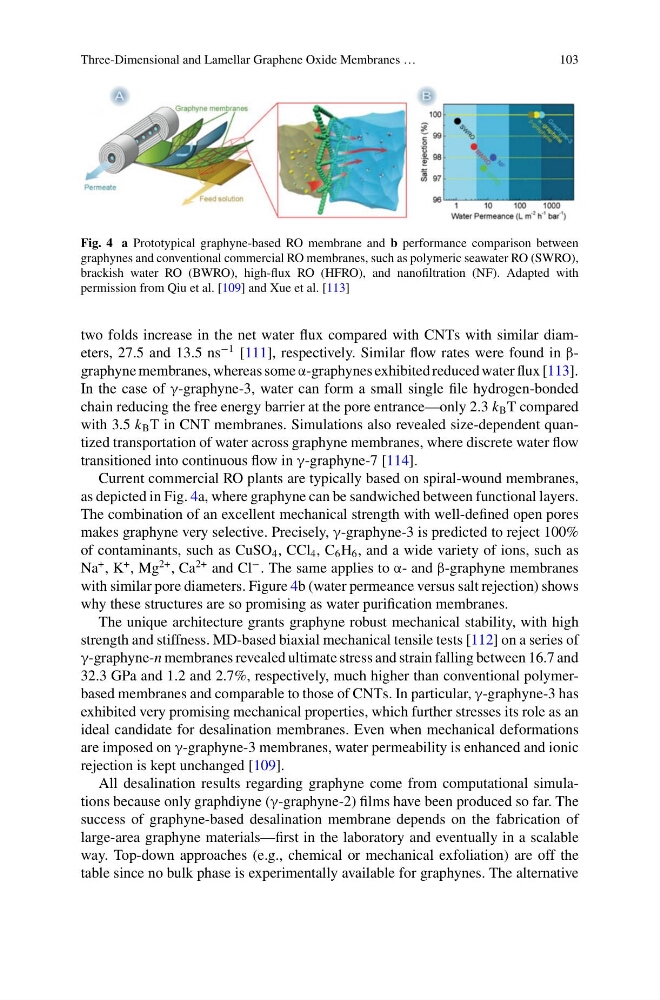
Fig. 4 a Prototypical graphyne-based RO membrane and b performance comparison between
graphynes and conventional commercial RO membranes, such as polymeric seawater RO (SWRO),
brackish water RO (BWRO), high-flux RO (HFRO), and nanofiltration (NF). Adapted with
permission from Qiu et al. [109] and Xue et al. [113]
two folds increase in the net water flux compared with CNTs with similar diameters, 27.5 and 13.5 ns
−1 [111], respectively. Similar flow rates were found in βgraphyne membranes, whereas some α-graphynes exhibited reduced water flux [113].
In the case of γ-graphyne-3, water can form a small single file hydrogen-bonded
chain reducing the free energy barrier at the pore entrance—only 2.3 k B T compared
with 3.5 k B T in CNT membranes. Simulations also revealed size-dependent quantized transportation of water across graphyne membranes, where discrete water flow
transitioned into continuous flow in γ-graphyne-7 [114].
Current commercial RO plants are typically based on spiral-wound membranes,
as depicted in Fig. 4a, where graphyne can be sandwiched between functional layers.
The combination of an excellent mechanical strength with well-defined open pores
makes graphyne very selective. Precisely, γ-graphyne-3 is predicted to reject 100%
of contaminants, such as CuSO 4 , CCl 4 , C 6 H 6 , and a wide variety of ions, such as
Na
+ , K
+ , Mg
2+ , Ca
2+ and Cl
− . The same applies to α- and β-graphyne membranes
with similar pore diameters. Figure 4b (water permeance versus salt rejection) shows
why these structures are so promising as water purification membranes.
The unique architecture grants graphyne robust mechanical stability, with high
strength and stiffness. MD-based biaxial mechanical tensile tests [112] on a series of
γ-graphyne-n membranes revealed ultimate stress and strain falling between 16.7 and
32.3 GPa and 1.2 and 2.7%, respectively, much higher than conventional polymerbased membranes and comparable to those of CNTs. In particular, γ-graphyne-3 has
exhibited very promising mechanical properties, which further stresses its role as an
ideal candidate for desalination membranes. Even when mechanical deformations
are imposed on γ-graphyne-3 membranes, water permeability is enhanced and ionic
rejection is kept unchanged [109].
All desalination results regarding graphyne come from computational simulations because only graphdiyne (γ-graphyne-2) films have been produced so far. The
success of graphyne-based desalination membrane depends on the fabrication of
large-area graphyne materials—first in the laboratory and eventually in a scalable
way. Top-down approaches (e.g., chemical or mechanical exfoliation) are off the
table since no bulk phase is experimentally available for graphynes. The alternative
103
Fig. 4 a Prototypical graphyne-based RO membrane and b performance comparison between
graphynes and conventional commercial RO membranes, such as polymeric seawater RO (SWRO),
brackish water RO (BWRO), high-flux RO (HFRO), and nanofiltration (NF). Adapted with
permission from Qiu et al. [109] and Xue et al. [113]
two folds increase in the net water flux compared with CNTs with similar diameters, 27.5 and 13.5 ns
−1 [111], respectively. Similar flow rates were found in βgraphyne membranes, whereas some α-graphynes exhibited reduced water flux [113].
In the case of γ-graphyne-3, water can form a small single file hydrogen-bonded
chain reducing the free energy barrier at the pore entrance—only 2.3 k B T compared
with 3.5 k B T in CNT membranes. Simulations also revealed size-dependent quantized transportation of water across graphyne membranes, where discrete water flow
transitioned into continuous flow in γ-graphyne-7 [114].
Current commercial RO plants are typically based on spiral-wound membranes,
as depicted in Fig. 4a, where graphyne can be sandwiched between functional layers.
The combination of an excellent mechanical strength with well-defined open pores
makes graphyne very selective. Precisely, γ-graphyne-3 is predicted to reject 100%
of contaminants, such as CuSO 4 , CCl 4 , C 6 H 6 , and a wide variety of ions, such as
Na
+ , K
+ , Mg
2+ , Ca
2+ and Cl
− . The same applies to α- and β-graphyne membranes
with similar pore diameters. Figure 4b (water permeance versus salt rejection) shows
why these structures are so promising as water purification membranes.
The unique architecture grants graphyne robust mechanical stability, with high
strength and stiffness. MD-based biaxial mechanical tensile tests [112] on a series of
γ-graphyne-n membranes revealed ultimate stress and strain falling between 16.7 and
32.3 GPa and 1.2 and 2.7%, respectively, much higher than conventional polymerbased membranes and comparable to those of CNTs. In particular, γ-graphyne-3 has
exhibited very promising mechanical properties, which further stresses its role as an
ideal candidate for desalination membranes. Even when mechanical deformations
are imposed on γ-graphyne-3 membranes, water permeability is enhanced and ionic
rejection is kept unchanged [109].
All desalination results regarding graphyne come from computational simulations because only graphdiyne (γ-graphyne-2) films have been produced so far. The
success of graphyne-based desalination membrane depends on the fabrication of
large-area graphyne materials—first in the laboratory and eventually in a scalable
way. Top-down approaches (e.g., chemical or mechanical exfoliation) are off the
table since no bulk phase is experimentally available for graphynes. The alternative