

88
M. Yamanaka
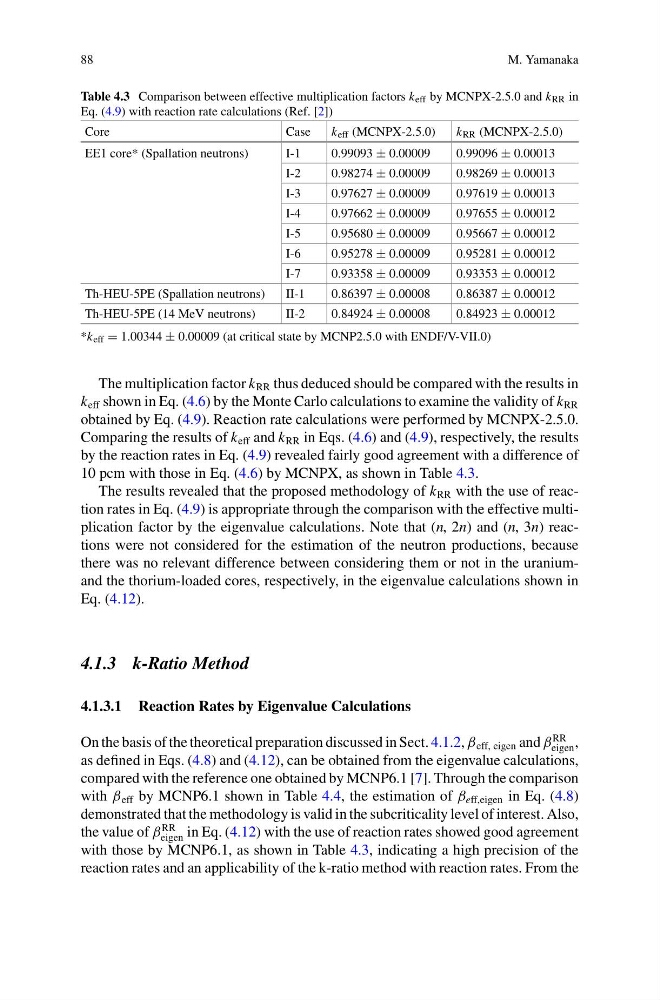
Table 4.3 Comparison between effective multiplication factors k eff by MCNPX-2.5.0 and k RR in
Eq. (4.9) with reaction rate calculations (Ref. [2])
Core
Case
k eff (MCNPX-2.5.0)
k RR (MCNPX-2.5.0)
EE1 core* (Spallation neutrons)
I-1
0.99093 ± 0.00009
0.99096 ± 0.00013
I-2
0.98274 ± 0.00009
0.98269 ± 0.00013
I-3
0.97627 ± 0.00009
0.97619 ± 0.00013
I-4
0.97662 ± 0.00009
0.97655 ± 0.00012
I-5
0.95680 ± 0.00009
0.95667 ± 0.00012
I-6
0.95278 ± 0.00009
0.95281 ± 0.00012
I-7
0.93358 ± 0.00009
0.93353 ± 0.00012
Th-HEU-5PE (Spallation neutrons)
II-1
0.86397 ± 0.00008
0.86387 ± 0.00012
Th-HEU-5PE (14 MeV neutrons)
II-2
0.84924 ± 0.00008
0.84923 ± 0.00012
*k eff = 1.00344 ± 0.00009 (at critical state by MCNP2.5.0 with ENDF/V-VII.0)
The multiplication factor k RR thus deduced should be compared with the results in
k eff shown in Eq. (4.6) by the Monte Carlo calculations to examine the validity of k RR
obtained by Eq. (4.9). Reaction rate calculations were performed by MCNPX-2.5.0.
Comparing the results of k eff and k RR in Eqs. (4.6) and (4.9), respectively, the results
by the reaction rates in Eq. (4.9) revealed fairly good agreement with a difference of
10 pcm with those in Eq. (4.6) by MCNPX, as shown in Table 4.3.
The results revealed that the proposed methodology of k RR with the use of reaction rates in Eq. (4.9) is appropriate through the comparison with the effective multiplication factor by the eigenvalue calculations. Note that (n, 2n) and (n, 3n) reactions were not considered for the estimation of the neutron productions, because
there was no relevant difference between considering them or not in the uraniumand the thorium-loaded cores, respectively, in the eigenvalue calculations shown in
Eq. (4.12).
4.1.3 k-Ratio Method
4.1.3.1 Reaction Rates by Eigenvalue Calculations
On the basis of the theoretical preparation discussed in Sect. 4.1.2, β eff, eigen and β
RR
eigen ,
as defined in Eqs. (4.8) and (4.12), can be obtained from the eigenvalue calculations,
compared with the reference one obtained by MCNP6.1 [7]. Through the comparison
with β eff by MCNP6.1 shown in Table 4.4, the estimation of β eff,eigen in Eq. (4.8)
demonstrated that the methodology is valid in the subcriticality level of interest. Also,
the value of β
RR
eigen in Eq. (4.12) with the use of reaction rates showed good agreement
with those by MCNP6.1, as shown in Table 4.3, indicating a high precision of the
reaction rates and an applicability of the k-ratio method with reaction rates. From the
M. Yamanaka
Table 4.3 Comparison between effective multiplication factors k eff by MCNPX-2.5.0 and k RR in
Eq. (4.9) with reaction rate calculations (Ref. [2])
Core
Case
k eff (MCNPX-2.5.0)
k RR (MCNPX-2.5.0)
EE1 core* (Spallation neutrons)
I-1
0.99093 ± 0.00009
0.99096 ± 0.00013
I-2
0.98274 ± 0.00009
0.98269 ± 0.00013
I-3
0.97627 ± 0.00009
0.97619 ± 0.00013
I-4
0.97662 ± 0.00009
0.97655 ± 0.00012
I-5
0.95680 ± 0.00009
0.95667 ± 0.00012
I-6
0.95278 ± 0.00009
0.95281 ± 0.00012
I-7
0.93358 ± 0.00009
0.93353 ± 0.00012
Th-HEU-5PE (Spallation neutrons)
II-1
0.86397 ± 0.00008
0.86387 ± 0.00012
Th-HEU-5PE (14 MeV neutrons)
II-2
0.84924 ± 0.00008
0.84923 ± 0.00012
*k eff = 1.00344 ± 0.00009 (at critical state by MCNP2.5.0 with ENDF/V-VII.0)
The multiplication factor k RR thus deduced should be compared with the results in
k eff shown in Eq. (4.6) by the Monte Carlo calculations to examine the validity of k RR
obtained by Eq. (4.9). Reaction rate calculations were performed by MCNPX-2.5.0.
Comparing the results of k eff and k RR in Eqs. (4.6) and (4.9), respectively, the results
by the reaction rates in Eq. (4.9) revealed fairly good agreement with a difference of
10 pcm with those in Eq. (4.6) by MCNPX, as shown in Table 4.3.
The results revealed that the proposed methodology of k RR with the use of reaction rates in Eq. (4.9) is appropriate through the comparison with the effective multiplication factor by the eigenvalue calculations. Note that (n, 2n) and (n, 3n) reactions were not considered for the estimation of the neutron productions, because
there was no relevant difference between considering them or not in the uraniumand the thorium-loaded cores, respectively, in the eigenvalue calculations shown in
Eq. (4.12).
4.1.3 k-Ratio Method
4.1.3.1 Reaction Rates by Eigenvalue Calculations
On the basis of the theoretical preparation discussed in Sect. 4.1.2, β eff, eigen and β
RR
eigen ,
as defined in Eqs. (4.8) and (4.12), can be obtained from the eigenvalue calculations,
compared with the reference one obtained by MCNP6.1 [7]. Through the comparison
with β eff by MCNP6.1 shown in Table 4.4, the estimation of β eff,eigen in Eq. (4.8)
demonstrated that the methodology is valid in the subcriticality level of interest. Also,
the value of β
RR
eigen in Eq. (4.12) with the use of reaction rates showed good agreement
with those by MCNP6.1, as shown in Table 4.3, indicating a high precision of the
reaction rates and an applicability of the k-ratio method with reaction rates. From the