

4 Effective Delayed Neutron Fraction
87
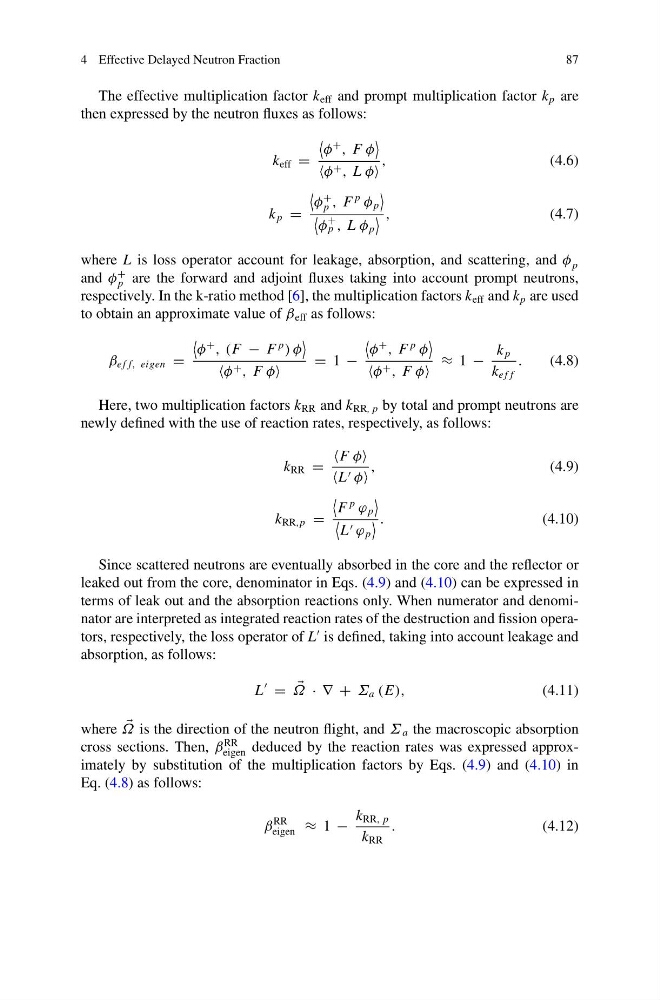
The effective multiplication factor k eff and prompt multiplication factor k p are
then expressed by the neutron fluxes as follows:
k eff =
φ
+
, F φ
φ + , L φ
,
(4.6)
k p =
φ
+
p , F
p
φ p
φ
+
p , L φ p
,
(4.7)
where L is loss operator account for leakage, absorption, and scattering, and φ p
and φ
+
p are the forward and adjoint fluxes taking into account prompt neutrons,
respectively. In the k-ratio method [6], the multiplication factors k eff and k p are used
to obtain an approximate value of β eff as follows:
β e f f, eigen =
φ
+
, (F − F
p
) φ
φ + , F φ
= 1 −
φ
+
, F
p
φ
φ + , F φ
≈ 1 −
k p
k e f f
.
(4.8)
Here, two multiplication factors k RR and k RR, p by total and prompt neutrons are
newly defined with the use of reaction rates, respectively, as follows:
k RR =
F φ
L φ
,
(4.9)
k RR, p =
F
p
ϕ p
L ϕ p
.
(4.10)
Since scattered neutrons are eventually absorbed in the core and the reflector or
leaked out from the core, denominator in Eqs. (4.9) and (4.10) can be expressed in
terms of leak out and the absorption reactions only. When numerator and denominator are interpreted as integrated reaction rates of the destruction and fission operators, respectively, the loss operator of L
is defined, taking into account leakage and
absorption, as follows:
L
=
Ω · ∇ + Σ a (E),
(4.11)
where
Ω is the direction of the neutron flight, and Σ a the macroscopic absorption
cross sections. Then, β
RR
eigen deduced by the reaction rates was expressed approximately by substitution of the multiplication factors by Eqs. (4.9) and (4.10) in
Eq. (4.8) as follows:
β
RR
eigen ≈ 1 −
k RR, p
k RR
.
(4.12)
87
The effective multiplication factor k eff and prompt multiplication factor k p are
then expressed by the neutron fluxes as follows:
k eff =
φ
+
, F φ
φ + , L φ
,
(4.6)
k p =
φ
+
p , F
p
φ p
φ
+
p , L φ p
,
(4.7)
where L is loss operator account for leakage, absorption, and scattering, and φ p
and φ
+
p are the forward and adjoint fluxes taking into account prompt neutrons,
respectively. In the k-ratio method [6], the multiplication factors k eff and k p are used
to obtain an approximate value of β eff as follows:
β e f f, eigen =
φ
+
, (F − F
p
) φ
φ + , F φ
= 1 −
φ
+
, F
p
φ
φ + , F φ
≈ 1 −
k p
k e f f
.
(4.8)
Here, two multiplication factors k RR and k RR, p by total and prompt neutrons are
newly defined with the use of reaction rates, respectively, as follows:
k RR =
F φ
L φ
,
(4.9)
k RR, p =
F
p
ϕ p
L ϕ p
.
(4.10)
Since scattered neutrons are eventually absorbed in the core and the reflector or
leaked out from the core, denominator in Eqs. (4.9) and (4.10) can be expressed in
terms of leak out and the absorption reactions only. When numerator and denominator are interpreted as integrated reaction rates of the destruction and fission operators, respectively, the loss operator of L
is defined, taking into account leakage and
absorption, as follows:
L
=
Ω · ∇ + Σ a (E),
(4.11)
where
Ω is the direction of the neutron flight, and Σ a the macroscopic absorption
cross sections. Then, β
RR
eigen deduced by the reaction rates was expressed approximately by substitution of the multiplication factors by Eqs. (4.9) and (4.10) in
Eq. (4.8) as follows:
β
RR
eigen ≈ 1 −
k RR, p
k RR
.
(4.12)