

2 Subcriticality
39
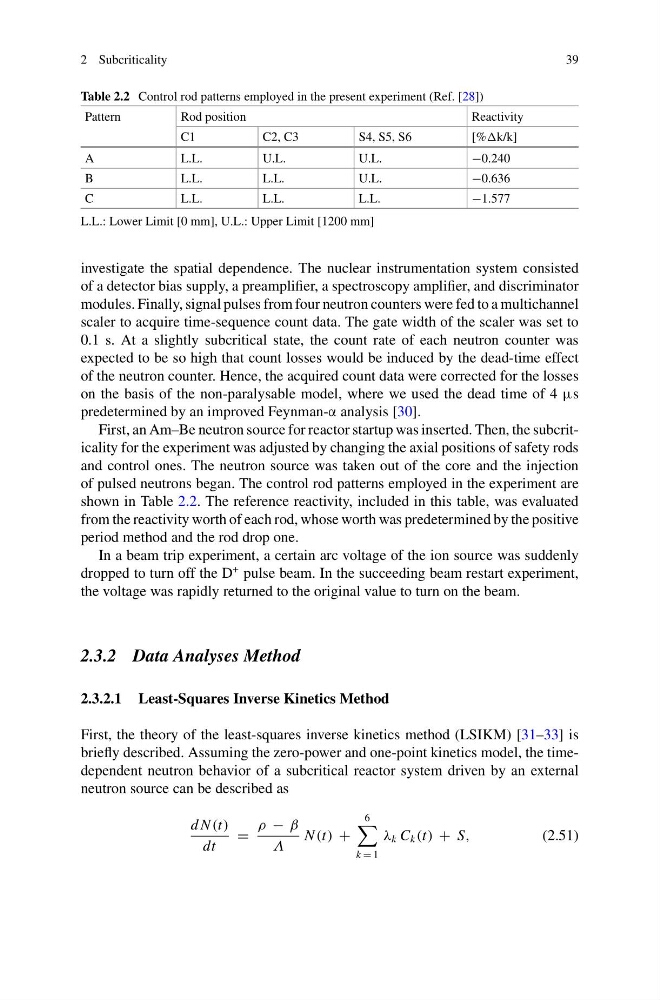
Table 2.2 Control rod patterns employed in the present experiment (Ref. [28])
Pattern
Rod position
Reactivity
C1
C2, C3
S4, S5, S6
[%k/k]
A
L.L.
U.L.
U.L.
−0.240
B
L.L.
L.L.
U.L.
−0.636
C
L.L.
L.L.
L.L.
−1.577
L.L.: Lower Limit [0 mm], U.L.: Upper Limit [1200 mm]
investigate the spatial dependence. The nuclear instrumentation system consisted
of a detector bias supply, a preamplifier, a spectroscopy amplifier, and discriminator
modules. Finally, signal pulses from four neutron counters were fed to a multichannel
scaler to acquire time-sequence count data. The gate width of the scaler was set to
0.1 s. At a slightly subcritical state, the count rate of each neutron counter was
expected to be so high that count losses would be induced by the dead-time effect
of the neutron counter. Hence, the acquired count data were corrected for the losses
on the basis of the non-paralysable model, where we used the dead time of 4 μs
predetermined by an improved Feynman-α analysis [30].
First, an Am–Be neutron source for reactor startup was inserted. Then, the subcriticality for the experiment was adjusted by changing the axial positions of safety rods
and control ones. The neutron source was taken out of the core and the injection
of pulsed neutrons began. The control rod patterns employed in the experiment are
shown in Table 2.2. The reference reactivity, included in this table, was evaluated
from the reactivity worth of each rod, whose worth was predetermined by the positive
period method and the rod drop one.
In a beam trip experiment, a certain arc voltage of the ion source was suddenly
dropped to turn off the D
+ pulse beam. In the succeeding beam restart experiment,
the voltage was rapidly returned to the original value to turn on the beam.
2.3.2 Data Analyses Method
2.3.2.1 Least-Squares Inverse Kinetics Method
First, the theory of the least-squares inverse kinetics method (LSIKM) [31–33] is
briefly described. Assuming the zero-power and one-point kinetics model, the timedependent neutron behavior of a subcritical reactor system driven by an external
neutron source can be described as
d N (t)
dt
=
ρ − β
Λ
N (t) +
6
k = 1
λ k C k (t) + S,
(2.51)
39
Table 2.2 Control rod patterns employed in the present experiment (Ref. [28])
Pattern
Rod position
Reactivity
C1
C2, C3
S4, S5, S6
[%k/k]
A
L.L.
U.L.
U.L.
−0.240
B
L.L.
L.L.
U.L.
−0.636
C
L.L.
L.L.
L.L.
−1.577
L.L.: Lower Limit [0 mm], U.L.: Upper Limit [1200 mm]
investigate the spatial dependence. The nuclear instrumentation system consisted
of a detector bias supply, a preamplifier, a spectroscopy amplifier, and discriminator
modules. Finally, signal pulses from four neutron counters were fed to a multichannel
scaler to acquire time-sequence count data. The gate width of the scaler was set to
0.1 s. At a slightly subcritical state, the count rate of each neutron counter was
expected to be so high that count losses would be induced by the dead-time effect
of the neutron counter. Hence, the acquired count data were corrected for the losses
on the basis of the non-paralysable model, where we used the dead time of 4 μs
predetermined by an improved Feynman-α analysis [30].
First, an Am–Be neutron source for reactor startup was inserted. Then, the subcriticality for the experiment was adjusted by changing the axial positions of safety rods
and control ones. The neutron source was taken out of the core and the injection
of pulsed neutrons began. The control rod patterns employed in the experiment are
shown in Table 2.2. The reference reactivity, included in this table, was evaluated
from the reactivity worth of each rod, whose worth was predetermined by the positive
period method and the rod drop one.
In a beam trip experiment, a certain arc voltage of the ion source was suddenly
dropped to turn off the D
+ pulse beam. In the succeeding beam restart experiment,
the voltage was rapidly returned to the original value to turn on the beam.
2.3.2 Data Analyses Method
2.3.2.1 Least-Squares Inverse Kinetics Method
First, the theory of the least-squares inverse kinetics method (LSIKM) [31–33] is
briefly described. Assuming the zero-power and one-point kinetics model, the timedependent neutron behavior of a subcritical reactor system driven by an external
neutron source can be described as
d N (t)
dt
=
ρ − β
Λ
N (t) +
6
k = 1
λ k C k (t) + S,
(2.51)