

38
K. Hashimoto
1
2
3
4
5
6
7
8
9 10 11 12 13
14 1 5 1 6 1 7 1 8 1 9 2 0 2 1 2 2
2 3 2 4 2 5 2 6
F
12
E
G
H
I
F
F
F
F
F
J
F
F
F
F
F
K
F
F
F
F
F
L
F
F
F
F
F
M
12
O
P
Q
R
T
U
W
BF3 counter
Uncompendated ionization chamber
Fission chamber
Partial fuel (3/8"P12EU)
Aluminum sheath
Neutron source
Tritium target
Deuteron beam line
Fuel (3/8"P36EU)
Polyethylene reflector
Control rod
Safety rod
FC#1
N
UIC#4
FC#3
FC#2
UIC#5
FC
C3
S5
S4
C1
C2
S6
C
S
N
UIC
FC
UIC#6
B1
B2
B3
B4
B
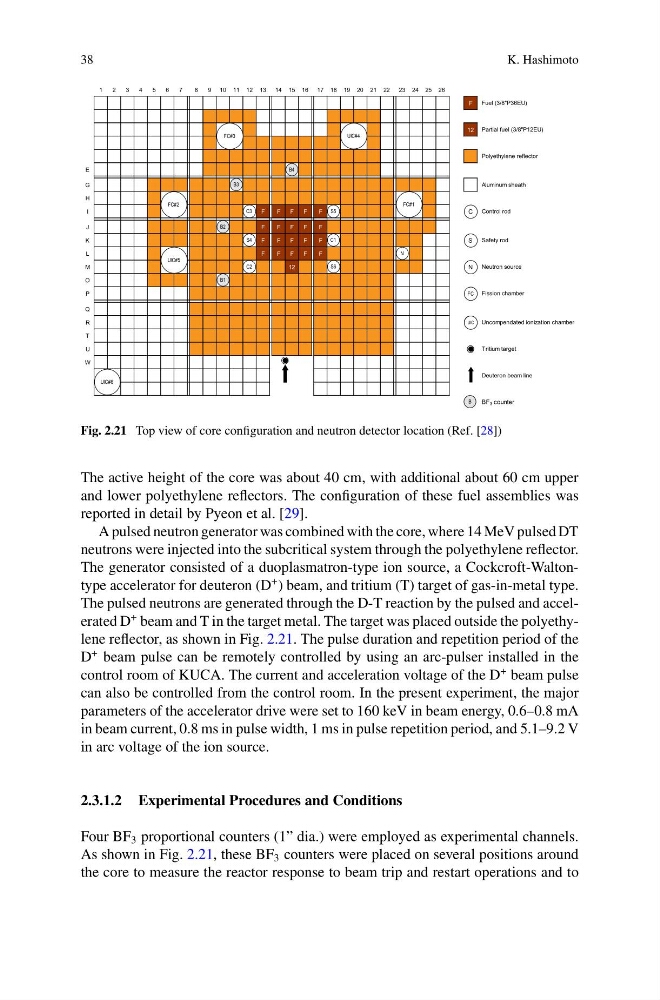
Fig. 2.21 Top view of core configuration and neutron detector location (Ref. [28])
The active height of the core was about 40 cm, with additional about 60 cm upper
and lower polyethylene reflectors. The configuration of these fuel assemblies was
reported in detail by Pyeon et al. [29].
A pulsed neutron generator was combined with the core, where 14 MeV pulsed DT
neutrons were injected into the subcritical system through the polyethylene reflector.
The generator consisted of a duoplasmatron-type ion source, a Cockcroft-Waltontype accelerator for deuteron (D
+ ) beam, and tritium (T) target of gas-in-metal type.
The pulsed neutrons are generated through the D-T reaction by the pulsed and accelerated D
+ beam and T in the target metal. The target was placed outside the polyethylene reflector, as shown in Fig. 2.21. The pulse duration and repetition period of the
D
+ beam pulse can be remotely controlled by using an arc-pulser installed in the
control room of KUCA. The current and acceleration voltage of the D
+ beam pulse
can also be controlled from the control room. In the present experiment, the major
parameters of the accelerator drive were set to 160 keV in beam energy, 0.6–0.8 mA
in beam current, 0.8 ms in pulse width, 1 ms in pulse repetition period, and 5.1–9.2 V
in arc voltage of the ion source.
2.3.1.2 Experimental Procedures and Conditions
Four BF 3 proportional counters (1” dia.) were employed as experimental channels.
As shown in Fig. 2.21, these BF 3 counters were placed on several positions around
the core to measure the reactor response to beam trip and restart operations and to
K. Hashimoto
1
2
3
4
5
6
7
8
9 10 11 12 13
14 1 5 1 6 1 7 1 8 1 9 2 0 2 1 2 2
2 3 2 4 2 5 2 6
F
12
E
G
H
I
F
F
F
F
F
J
F
F
F
F
F
K
F
F
F
F
F
L
F
F
F
F
F
M
12
O
P
Q
R
T
U
W
BF3 counter
Uncompendated ionization chamber
Fission chamber
Partial fuel (3/8"P12EU)
Aluminum sheath
Neutron source
Tritium target
Deuteron beam line
Fuel (3/8"P36EU)
Polyethylene reflector
Control rod
Safety rod
FC#1
N
UIC#4
FC#3
FC#2
UIC#5
FC
C3
S5
S4
C1
C2
S6
C
S
N
UIC
FC
UIC#6
B1
B2
B3
B4
B
Fig. 2.21 Top view of core configuration and neutron detector location (Ref. [28])
The active height of the core was about 40 cm, with additional about 60 cm upper
and lower polyethylene reflectors. The configuration of these fuel assemblies was
reported in detail by Pyeon et al. [29].
A pulsed neutron generator was combined with the core, where 14 MeV pulsed DT
neutrons were injected into the subcritical system through the polyethylene reflector.
The generator consisted of a duoplasmatron-type ion source, a Cockcroft-Waltontype accelerator for deuteron (D
+ ) beam, and tritium (T) target of gas-in-metal type.
The pulsed neutrons are generated through the D-T reaction by the pulsed and accelerated D
+ beam and T in the target metal. The target was placed outside the polyethylene reflector, as shown in Fig. 2.21. The pulse duration and repetition period of the
D
+ beam pulse can be remotely controlled by using an arc-pulser installed in the
control room of KUCA. The current and acceleration voltage of the D
+ beam pulse
can also be controlled from the control room. In the present experiment, the major
parameters of the accelerator drive were set to 160 keV in beam energy, 0.6–0.8 mA
in beam current, 0.8 ms in pulse width, 1 ms in pulse repetition period, and 5.1–9.2 V
in arc voltage of the ion source.
2.3.1.2 Experimental Procedures and Conditions
Four BF 3 proportional counters (1” dia.) were employed as experimental channels.
As shown in Fig. 2.21, these BF 3 counters were placed on several positions around
the core to measure the reactor response to beam trip and restart operations and to