

226
M. Yamanaka
(a) EE1 core
(b) E3 core
-2.0E-02
0.0E+00
2.0E-02
4.0E-02
6.0E-02
8.0E-02
1.0E-04
1.0E-02
1.0E+00
1.0E+02
1.0E+04
1.0E+06
Sensitivity coefficient per lethargy [-]
Neutron energy [eV]
Al-27
B-10
B-11
C-12
H-1
O-16
U-234
U-235
U-236
U-238
Al-27
H-1
C-12
-2.0E-02
0.0E+00
2.0E-02
4.0E-02
6.0E-02
8.0E-02
1.0E-04
1.0E-02
1.0E+00
1.0E+02
1.0E+04
1.0E+06
Sensitivity coefficient per lethargy [-]
Neutron energy [eV]
Al-27
B-10
B-11
C-12
H-1
O-16
U-234
U-235
U-236
U-238
Al-27
H-1
C-12
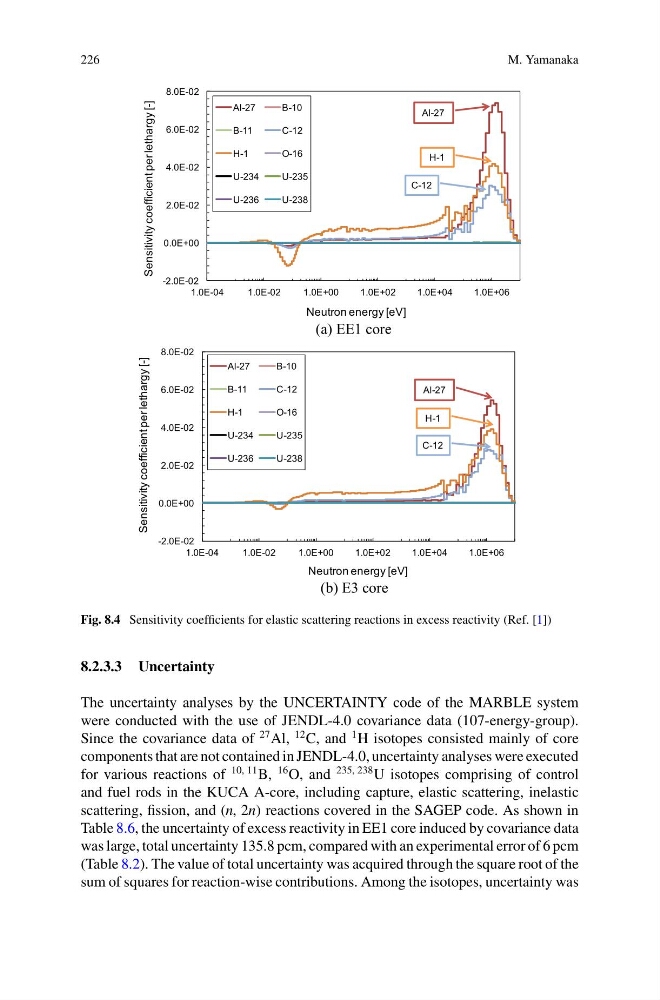
Fig. 8.4 Sensitivity coefficients for elastic scattering reactions in excess reactivity (Ref. [1])
8.2.3.3 Uncertainty
The uncertainty analyses by the UNCERTAINTY code of the MARBLE system
were conducted with the use of JENDL-4.0 covariance data (107-energy-group).
Since the covariance data of
27 Al,
12 C, and
1 H isotopes consisted mainly of core
components that are not contained in JENDL-4.0, uncertainty analyses were executed
for various reactions of
10, 11 B,
16 O, and
235, 238 U isotopes comprising of control
and fuel rods in the KUCA A-core, including capture, elastic scattering, inelastic
scattering, fission, and (n, 2n) reactions covered in the SAGEP code. As shown in
Table 8.6, the uncertainty of excess reactivity in EE1 core induced by covariance data
was large, total uncertainty 135.8 pcm, compared with an experimental error of 6 pcm
(Table 8.2). The value of total uncertainty was acquired through the square root of the
sum of squares for reaction-wise contributions. Among the isotopes, uncertainty was
M. Yamanaka
(a) EE1 core
(b) E3 core
-2.0E-02
0.0E+00
2.0E-02
4.0E-02
6.0E-02
8.0E-02
1.0E-04
1.0E-02
1.0E+00
1.0E+02
1.0E+04
1.0E+06
Sensitivity coefficient per lethargy [-]
Neutron energy [eV]
Al-27
B-10
B-11
C-12
H-1
O-16
U-234
U-235
U-236
U-238
Al-27
H-1
C-12
-2.0E-02
0.0E+00
2.0E-02
4.0E-02
6.0E-02
8.0E-02
1.0E-04
1.0E-02
1.0E+00
1.0E+02
1.0E+04
1.0E+06
Sensitivity coefficient per lethargy [-]
Neutron energy [eV]
Al-27
B-10
B-11
C-12
H-1
O-16
U-234
U-235
U-236
U-238
Al-27
H-1
C-12
Fig. 8.4 Sensitivity coefficients for elastic scattering reactions in excess reactivity (Ref. [1])
8.2.3.3 Uncertainty
The uncertainty analyses by the UNCERTAINTY code of the MARBLE system
were conducted with the use of JENDL-4.0 covariance data (107-energy-group).
Since the covariance data of
27 Al,
12 C, and
1 H isotopes consisted mainly of core
components that are not contained in JENDL-4.0, uncertainty analyses were executed
for various reactions of
10, 11 B,
16 O, and
235, 238 U isotopes comprising of control
and fuel rods in the KUCA A-core, including capture, elastic scattering, inelastic
scattering, fission, and (n, 2n) reactions covered in the SAGEP code. As shown in
Table 8.6, the uncertainty of excess reactivity in EE1 core induced by covariance data
was large, total uncertainty 135.8 pcm, compared with an experimental error of 6 pcm
(Table 8.2). The value of total uncertainty was acquired through the square root of the
sum of squares for reaction-wise contributions. Among the isotopes, uncertainty was