

8 Sensitivity and Uncertainty of Criticality
225
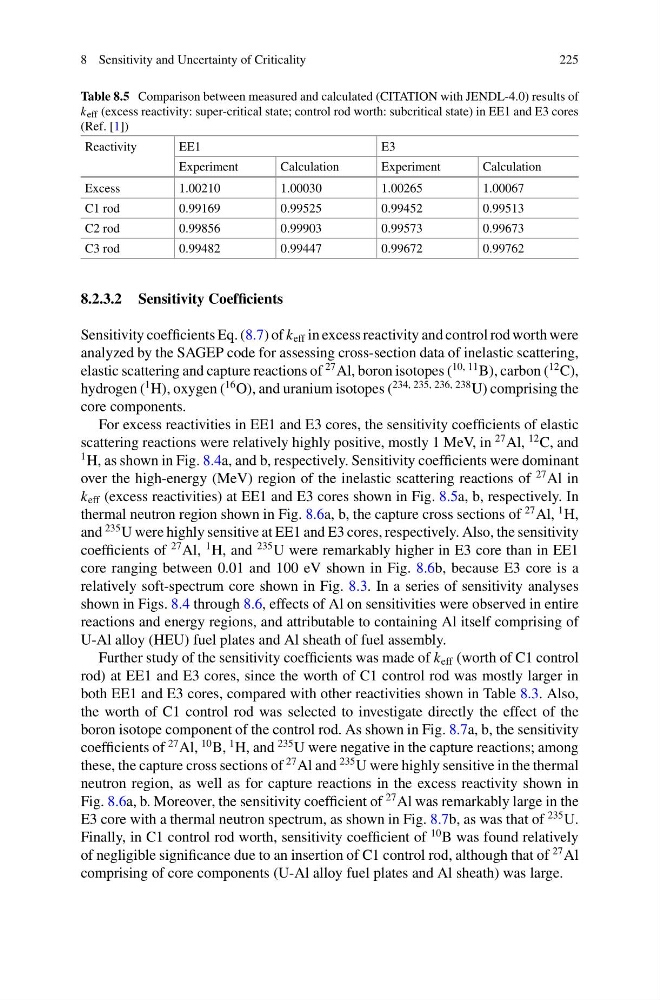
Table 8.5 Comparison between measured and calculated (CITATION with JENDL-4.0) results of
k eff (excess reactivity: super-critical state; control rod worth: subcritical state) in EE1 and E3 cores
(Ref. [1])
Reactivity
EE1
E3
Experiment
Calculation
Experiment
Calculation
Excess
1.00210
1.00030
1.00265
1.00067
C1 rod
0.99169
0.99525
0.99452
0.99513
C2 rod
0.99856
0.99903
0.99573
0.99673
C3 rod
0.99482
0.99447
0.99672
0.99762
8.2.3.2 Sensitivity Coefficients
Sensitivity coefficients Eq. (8.7) of k eff in excess reactivity and control rod worth were
analyzed by the SAGEP code for assessing cross-section data of inelastic scattering,
elastic scattering and capture reactions of
27 Al, boron isotopes (
10, 11 B), carbon (
12 C),
hydrogen (
1 H), oxygen (
16 O), and uranium isotopes (
234, 235, 236, 238 U) comprising the
core components.
For excess reactivities in EE1 and E3 cores, the sensitivity coefficients of elastic
scattering reactions were relatively highly positive, mostly 1 MeV, in
27 Al,
12 C, and
1 H, as shown in Fig. 8.4a, and b, respectively. Sensitivity coefficients were dominant
over the high-energy (MeV) region of the inelastic scattering reactions of
27 Al in
k eff (excess reactivities) at EE1 and E3 cores shown in Fig. 8.5a, b, respectively. In
thermal neutron region shown in Fig. 8.6a, b, the capture cross sections of
27 Al,
1 H,
and
235 U were highly sensitive at EE1 and E3 cores, respectively. Also, the sensitivity
coefficients of
27 Al,
1 H, and
235 U were remarkably higher in E3 core than in EE1
core ranging between 0.01 and 100 eV shown in Fig. 8.6b, because E3 core is a
relatively soft-spectrum core shown in Fig. 8.3. In a series of sensitivity analyses
shown in Figs. 8.4 through 8.6, effects of Al on sensitivities were observed in entire
reactions and energy regions, and attributable to containing Al itself comprising of
U-Al alloy (HEU) fuel plates and Al sheath of fuel assembly.
Further study of the sensitivity coefficients was made of k eff (worth of C1 control
rod) at EE1 and E3 cores, since the worth of C1 control rod was mostly larger in
both EE1 and E3 cores, compared with other reactivities shown in Table 8.3. Also,
the worth of C1 control rod was selected to investigate directly the effect of the
boron isotope component of the control rod. As shown in Fig. 8.7a, b, the sensitivity
coefficients of
27 Al,
10 B,
1 H, and
235 U were negative in the capture reactions; among
these, the capture cross sections of
27 Al and
235 U were highly sensitive in the thermal
neutron region, as well as for capture reactions in the excess reactivity shown in
Fig. 8.6a, b. Moreover, the sensitivity coefficient of
27 Al was remarkably large in the
E3 core with a thermal neutron spectrum, as shown in Fig. 8.7b, as was that of
235 U.
Finally, in C1 control rod worth, sensitivity coefficient of
10 B was found relatively
of negligible significance due to an insertion of C1 control rod, although that of
27 Al
comprising of core components (U-Al alloy fuel plates and Al sheath) was large.
225
Table 8.5 Comparison between measured and calculated (CITATION with JENDL-4.0) results of
k eff (excess reactivity: super-critical state; control rod worth: subcritical state) in EE1 and E3 cores
(Ref. [1])
Reactivity
EE1
E3
Experiment
Calculation
Experiment
Calculation
Excess
1.00210
1.00030
1.00265
1.00067
C1 rod
0.99169
0.99525
0.99452
0.99513
C2 rod
0.99856
0.99903
0.99573
0.99673
C3 rod
0.99482
0.99447
0.99672
0.99762
8.2.3.2 Sensitivity Coefficients
Sensitivity coefficients Eq. (8.7) of k eff in excess reactivity and control rod worth were
analyzed by the SAGEP code for assessing cross-section data of inelastic scattering,
elastic scattering and capture reactions of
27 Al, boron isotopes (
10, 11 B), carbon (
12 C),
hydrogen (
1 H), oxygen (
16 O), and uranium isotopes (
234, 235, 236, 238 U) comprising the
core components.
For excess reactivities in EE1 and E3 cores, the sensitivity coefficients of elastic
scattering reactions were relatively highly positive, mostly 1 MeV, in
27 Al,
12 C, and
1 H, as shown in Fig. 8.4a, and b, respectively. Sensitivity coefficients were dominant
over the high-energy (MeV) region of the inelastic scattering reactions of
27 Al in
k eff (excess reactivities) at EE1 and E3 cores shown in Fig. 8.5a, b, respectively. In
thermal neutron region shown in Fig. 8.6a, b, the capture cross sections of
27 Al,
1 H,
and
235 U were highly sensitive at EE1 and E3 cores, respectively. Also, the sensitivity
coefficients of
27 Al,
1 H, and
235 U were remarkably higher in E3 core than in EE1
core ranging between 0.01 and 100 eV shown in Fig. 8.6b, because E3 core is a
relatively soft-spectrum core shown in Fig. 8.3. In a series of sensitivity analyses
shown in Figs. 8.4 through 8.6, effects of Al on sensitivities were observed in entire
reactions and energy regions, and attributable to containing Al itself comprising of
U-Al alloy (HEU) fuel plates and Al sheath of fuel assembly.
Further study of the sensitivity coefficients was made of k eff (worth of C1 control
rod) at EE1 and E3 cores, since the worth of C1 control rod was mostly larger in
both EE1 and E3 cores, compared with other reactivities shown in Table 8.3. Also,
the worth of C1 control rod was selected to investigate directly the effect of the
boron isotope component of the control rod. As shown in Fig. 8.7a, b, the sensitivity
coefficients of
27 Al,
10 B,
1 H, and
235 U were negative in the capture reactions; among
these, the capture cross sections of
27 Al and
235 U were highly sensitive in the thermal
neutron region, as well as for capture reactions in the excess reactivity shown in
Fig. 8.6a, b. Moreover, the sensitivity coefficient of
27 Al was remarkably large in the
E3 core with a thermal neutron spectrum, as shown in Fig. 8.7b, as was that of
235 U.
Finally, in C1 control rod worth, sensitivity coefficient of
10 B was found relatively
of negligible significance due to an insertion of C1 control rod, although that of
27 Al
comprising of core components (U-Al alloy fuel plates and Al sheath) was large.