

7 Neutronics of Lead and Bismuth
207
Table 7.12 Reaction-wise uncertainty contribution [pcm] to changes in sample reactivity induced
by covariance data of JENDL-4.0 (Ref. [2])
Isotopes
Reactions
Capture
Elastic
Inelastic
Fission
(n, 2n)
Total
235 U
19.4
1.9
4.1
9.7
0.1
22.2
238 U
2.6
0.0
0.3
0.1
0.0
2.6
204 Pb
0.1
−0.4
1.6
–
0.0
1.7
206 Pb
−1.0
−4.9
20.0
–
−0.8
19.4
207 Pb
0.9
−2.6
9.0
–
1.5
8.8
208 Pb
−0.6
2.2
9.0
–
3.1
11.9
Total
33.1
a square root of the sum of squares for reaction-wise contributions, ignoring the
covariance between different nuclides in the sum of squares. Among the nuclides,
the reaction-wise contribution was dominant over the capture (19.4 pcm) and the
inelastic scattering (20.0 pcm) reactions of
235 U and
206 Pb, respectively, shown in
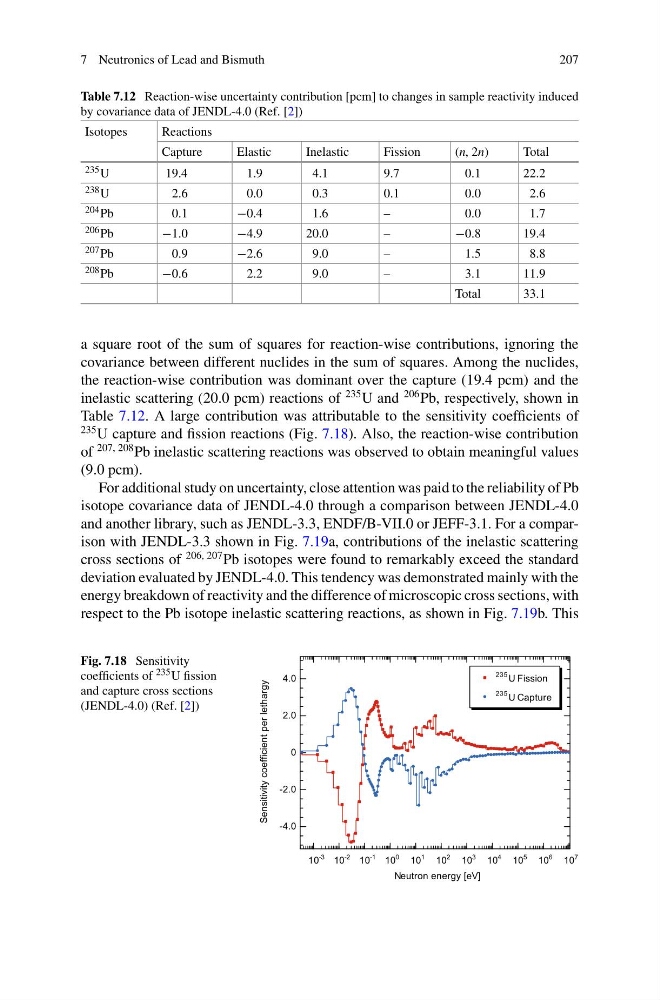
Table 7.12. A large contribution was attributable to the sensitivity coefficients of
235 U capture and fission reactions (Fig. 7.18). Also, the reaction-wise contribution
of
207, 208 Pb inelastic scattering reactions was observed to obtain meaningful values
(9.0 pcm).
For additional study on uncertainty, close attention was paid to the reliability of Pb
isotope covariance data of JENDL-4.0 through a comparison between JENDL-4.0
and another library, such as JENDL-3.3, ENDF/B-VII.0 or JEFF-3.1. For a comparison with JENDL-3.3 shown in Fig. 7.19a, contributions of the inelastic scattering
cross sections of
206, 207 Pb isotopes were found to remarkably exceed the standard
deviation evaluated by JENDL-4.0. This tendency was demonstrated mainly with the
energy breakdown of reactivity and the difference of microscopic cross sections, with
respect to the Pb isotope inelastic scattering reactions, as shown in Fig. 7.19b. This
Fig. 7.18 Sensitivity
coefficients of 235 U fission
and capture cross sections
(JENDL-4.0) (Ref. [2])
10
-3 10
-2 10
-1 10
0
10
1
10
2
10
3
10
4
10
5
10
6
10
7
-4.0
-2.0
0
2.0
4.0
235 U Fission
235 U Capture
Neutron energy [eV]
Sensitivity coefficient per lethargy
207
Table 7.12 Reaction-wise uncertainty contribution [pcm] to changes in sample reactivity induced
by covariance data of JENDL-4.0 (Ref. [2])
Isotopes
Reactions
Capture
Elastic
Inelastic
Fission
(n, 2n)
Total
235 U
19.4
1.9
4.1
9.7
0.1
22.2
238 U
2.6
0.0
0.3
0.1
0.0
2.6
204 Pb
0.1
−0.4
1.6
–
0.0
1.7
206 Pb
−1.0
−4.9
20.0
–
−0.8
19.4
207 Pb
0.9
−2.6
9.0
–
1.5
8.8
208 Pb
−0.6
2.2
9.0
–
3.1
11.9
Total
33.1
a square root of the sum of squares for reaction-wise contributions, ignoring the
covariance between different nuclides in the sum of squares. Among the nuclides,
the reaction-wise contribution was dominant over the capture (19.4 pcm) and the
inelastic scattering (20.0 pcm) reactions of
235 U and
206 Pb, respectively, shown in
Table 7.12. A large contribution was attributable to the sensitivity coefficients of
235 U capture and fission reactions (Fig. 7.18). Also, the reaction-wise contribution
of
207, 208 Pb inelastic scattering reactions was observed to obtain meaningful values
(9.0 pcm).
For additional study on uncertainty, close attention was paid to the reliability of Pb
isotope covariance data of JENDL-4.0 through a comparison between JENDL-4.0
and another library, such as JENDL-3.3, ENDF/B-VII.0 or JEFF-3.1. For a comparison with JENDL-3.3 shown in Fig. 7.19a, contributions of the inelastic scattering
cross sections of
206, 207 Pb isotopes were found to remarkably exceed the standard
deviation evaluated by JENDL-4.0. This tendency was demonstrated mainly with the
energy breakdown of reactivity and the difference of microscopic cross sections, with
respect to the Pb isotope inelastic scattering reactions, as shown in Fig. 7.19b. This
Fig. 7.18 Sensitivity
coefficients of 235 U fission
and capture cross sections
(JENDL-4.0) (Ref. [2])
10
-3 10
-2 10
-1 10
0
10
1
10
2
10
3
10
4
10
5
10
6
10
7
-4.0
-2.0
0
2.0
4.0
235 U Fission
235 U Capture
Neutron energy [eV]
Sensitivity coefficient per lethargy