

7 Neutronics of Lead and Bismuth
201
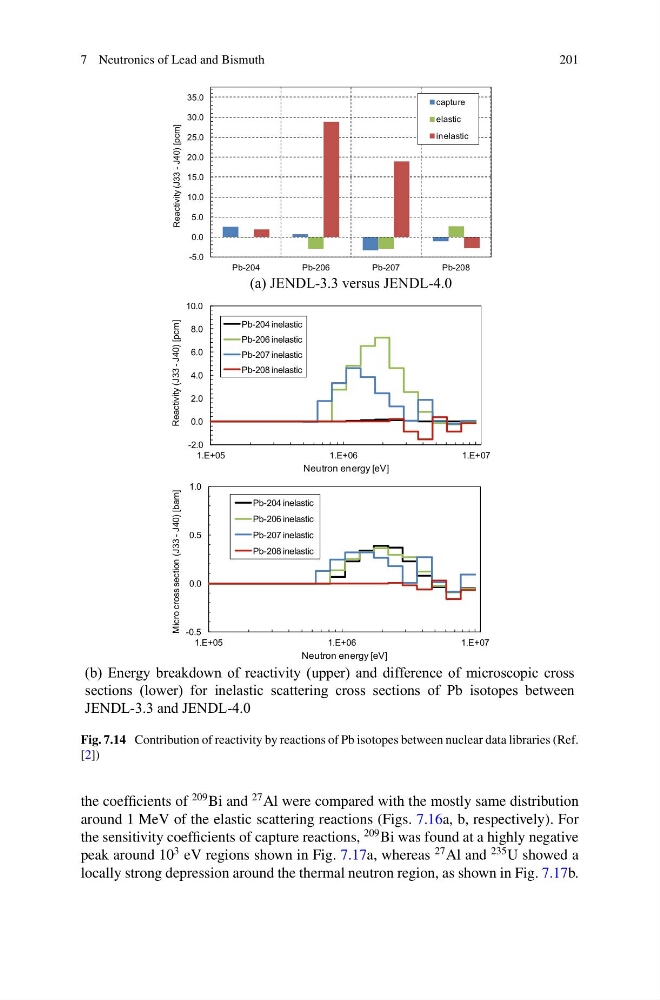
(a) JENDL-3.3 versus JENDL-4.0
(b) Energy breakdown of reactivity (upper) and difference of microscopic cross
sections (lower) for inelastic scattering cross sections of Pb isotopes between
JENDL-3.3 and JENDL-4.0
-5.0
0.0
5.0
10.0
15.0
20.0
25.0
30.0
35.0
Pb-204
Pb-206
Pb-207
Pb-208
Reactivity (J33 - J40) [pcm]
capture
elastic
inelastic
-2.0
0.0
2.0
4.0
6.0
8.0
10.0
7
0
+
E
.
1
6
0
+
E
.
1
5
0
+
E
.
1
Reactivity (J33 - J40) [pcm]
Neutron energy [eV]
Pb-204 inelastic
Pb-206 inelastic
Pb-207 inelastic
Pb-208 inelastic
-0.5
0.0
0.5
1.0
7
0
+
E
.
1
6
0
+
E
.
1
5
0
+
E
.
1
Micro cross section (J33 - J40) [barn]
Neutron energy [eV]
Pb-204 inelastic
Pb-206 inelastic
Pb-207 inelastic
Pb-208 inelastic
Fig. 7.14 Contribution of reactivity by reactions of Pb isotopes between nuclear data libraries (Ref.
[2])
the coefficients of
209 Bi and
27 Al were compared with the mostly same distribution
around 1 MeV of the elastic scattering reactions (Figs. 7.16a, b, respectively). For
the sensitivity coefficients of capture reactions,
209 Bi was found at a highly negative
peak around 10
3 eV regions shown in Fig. 7.17a, whereas
27 Al and
235 U showed a
locally strong depression around the thermal neutron region, as shown in Fig. 7.17b.
201
(a) JENDL-3.3 versus JENDL-4.0
(b) Energy breakdown of reactivity (upper) and difference of microscopic cross
sections (lower) for inelastic scattering cross sections of Pb isotopes between
JENDL-3.3 and JENDL-4.0
-5.0
0.0
5.0
10.0
15.0
20.0
25.0
30.0
35.0
Pb-204
Pb-206
Pb-207
Pb-208
Reactivity (J33 - J40) [pcm]
capture
elastic
inelastic
-2.0
0.0
2.0
4.0
6.0
8.0
10.0
7
0
+
E
.
1
6
0
+
E
.
1
5
0
+
E
.
1
Reactivity (J33 - J40) [pcm]
Neutron energy [eV]
Pb-204 inelastic
Pb-206 inelastic
Pb-207 inelastic
Pb-208 inelastic
-0.5
0.0
0.5
1.0
7
0
+
E
.
1
6
0
+
E
.
1
5
0
+
E
.
1
Micro cross section (J33 - J40) [barn]
Neutron energy [eV]
Pb-204 inelastic
Pb-206 inelastic
Pb-207 inelastic
Pb-208 inelastic
Fig. 7.14 Contribution of reactivity by reactions of Pb isotopes between nuclear data libraries (Ref.
[2])
the coefficients of
209 Bi and
27 Al were compared with the mostly same distribution
around 1 MeV of the elastic scattering reactions (Figs. 7.16a, b, respectively). For
the sensitivity coefficients of capture reactions,
209 Bi was found at a highly negative
peak around 10
3 eV regions shown in Fig. 7.17a, whereas
27 Al and
235 U showed a
locally strong depression around the thermal neutron region, as shown in Fig. 7.17b.