

200
C. H. Pyeon
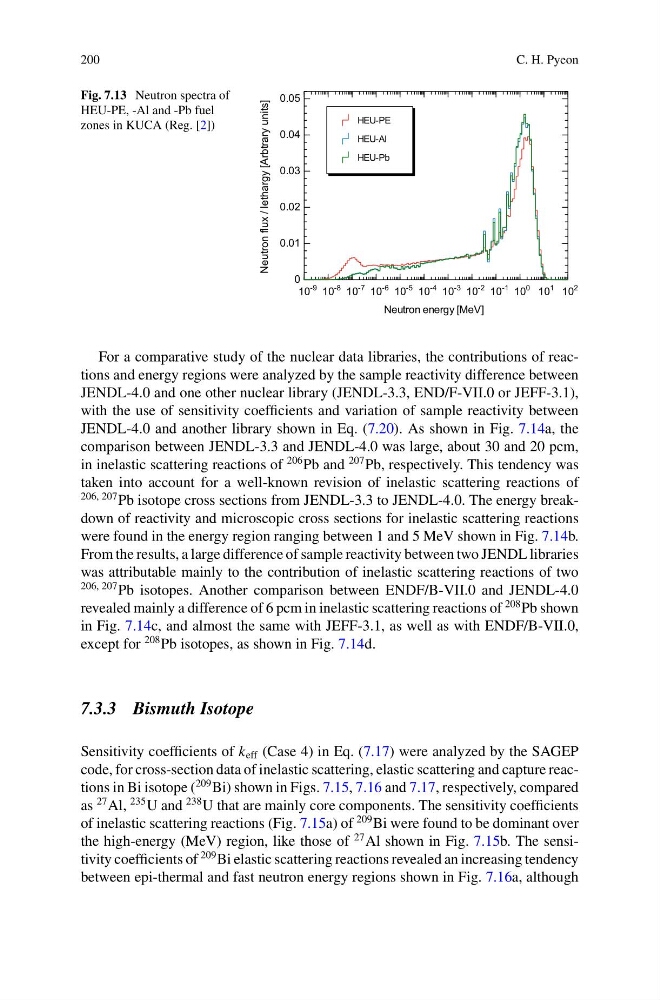
Fig. 7.13 Neutron spectra of
HEU-PE, -Al and -Pb fuel
zones in KUCA (Reg. [2])
10
-9 10
-8 10
-7 10
-6 10
-5 10
-4 10
-3 10
-2 10
-1 10
0 10
1 10
2
0
0.01
0.02
0.03
0.04
0.05
Neutron energy [MeV]
Neutron flux / lethargy [Arbtrary units]
HEU-PE
HEU-Al
HEU-Pb
For a comparative study of the nuclear data libraries, the contributions of reactions and energy regions were analyzed by the sample reactivity difference between
JENDL-4.0 and one other nuclear library (JENDL-3.3, END/F-VII.0 or JEFF-3.1),
with the use of sensitivity coefficients and variation of sample reactivity between
JENDL-4.0 and another library shown in Eq. (7.20). As shown in Fig. 7.14a, the
comparison between JENDL-3.3 and JENDL-4.0 was large, about 30 and 20 pcm,
in inelastic scattering reactions of
206 Pb and
207 Pb, respectively. This tendency was
taken into account for a well-known revision of inelastic scattering reactions of
206, 207 Pb isotope cross sections from JENDL-3.3 to JENDL-4.0. The energy breakdown of reactivity and microscopic cross sections for inelastic scattering reactions
were found in the energy region ranging between 1 and 5 MeV shown in Fig. 7.14b.
From the results, a large difference of sample reactivity between two JENDL libraries
was attributable mainly to the contribution of inelastic scattering reactions of two
206, 207 Pb isotopes. Another comparison between ENDF/B-VII.0 and JENDL-4.0
revealed mainly a difference of 6 pcm in inelastic scattering reactions of
208 Pb shown
in Fig. 7.14c, and almost the same with JEFF-3.1, as well as with ENDF/B-VII.0,
except for
208 Pb isotopes, as shown in Fig. 7.14d.
7.3.3 Bismuth Isotope
Sensitivity coefficients of k eff (Case 4) in Eq. (7.17) were analyzed by the SAGEP
code, for cross-section data of inelastic scattering, elastic scattering and capture reactions in Bi isotope (
209 Bi) shown in Figs. 7.15, 7.16 and 7.17, respectively, compared
as
27 Al,
235 U and
238 U that are mainly core components. The sensitivity coefficients
of inelastic scattering reactions (Fig. 7.15a) of
209 Bi were found to be dominant over
the high-energy (MeV) region, like those of
27 Al shown in Fig. 7.15b. The sensitivity coefficients of
209 Bi elastic scattering reactions revealed an increasing tendency
between epi-thermal and fast neutron energy regions shown in Fig. 7.16a, although
C. H. Pyeon
Fig. 7.13 Neutron spectra of
HEU-PE, -Al and -Pb fuel
zones in KUCA (Reg. [2])
10
-9 10
-8 10
-7 10
-6 10
-5 10
-4 10
-3 10
-2 10
-1 10
0 10
1 10
2
0
0.01
0.02
0.03
0.04
0.05
Neutron energy [MeV]
Neutron flux / lethargy [Arbtrary units]
HEU-PE
HEU-Al
HEU-Pb
For a comparative study of the nuclear data libraries, the contributions of reactions and energy regions were analyzed by the sample reactivity difference between
JENDL-4.0 and one other nuclear library (JENDL-3.3, END/F-VII.0 or JEFF-3.1),
with the use of sensitivity coefficients and variation of sample reactivity between
JENDL-4.0 and another library shown in Eq. (7.20). As shown in Fig. 7.14a, the
comparison between JENDL-3.3 and JENDL-4.0 was large, about 30 and 20 pcm,
in inelastic scattering reactions of
206 Pb and
207 Pb, respectively. This tendency was
taken into account for a well-known revision of inelastic scattering reactions of
206, 207 Pb isotope cross sections from JENDL-3.3 to JENDL-4.0. The energy breakdown of reactivity and microscopic cross sections for inelastic scattering reactions
were found in the energy region ranging between 1 and 5 MeV shown in Fig. 7.14b.
From the results, a large difference of sample reactivity between two JENDL libraries
was attributable mainly to the contribution of inelastic scattering reactions of two
206, 207 Pb isotopes. Another comparison between ENDF/B-VII.0 and JENDL-4.0
revealed mainly a difference of 6 pcm in inelastic scattering reactions of
208 Pb shown
in Fig. 7.14c, and almost the same with JEFF-3.1, as well as with ENDF/B-VII.0,
except for
208 Pb isotopes, as shown in Fig. 7.14d.
7.3.3 Bismuth Isotope
Sensitivity coefficients of k eff (Case 4) in Eq. (7.17) were analyzed by the SAGEP
code, for cross-section data of inelastic scattering, elastic scattering and capture reactions in Bi isotope (
209 Bi) shown in Figs. 7.15, 7.16 and 7.17, respectively, compared
as
27 Al,
235 U and
238 U that are mainly core components. The sensitivity coefficients
of inelastic scattering reactions (Fig. 7.15a) of
209 Bi were found to be dominant over
the high-energy (MeV) region, like those of
27 Al shown in Fig. 7.15b. The sensitivity coefficients of
209 Bi elastic scattering reactions revealed an increasing tendency
between epi-thermal and fast neutron energy regions shown in Fig. 7.16a, although