

7 Neutronics of Lead and Bismuth
185
(Al) and after (Pb or Bi) substituting Al plates for Pb ones, respectively, under the
condition of all the control and safety rods withdrawn.
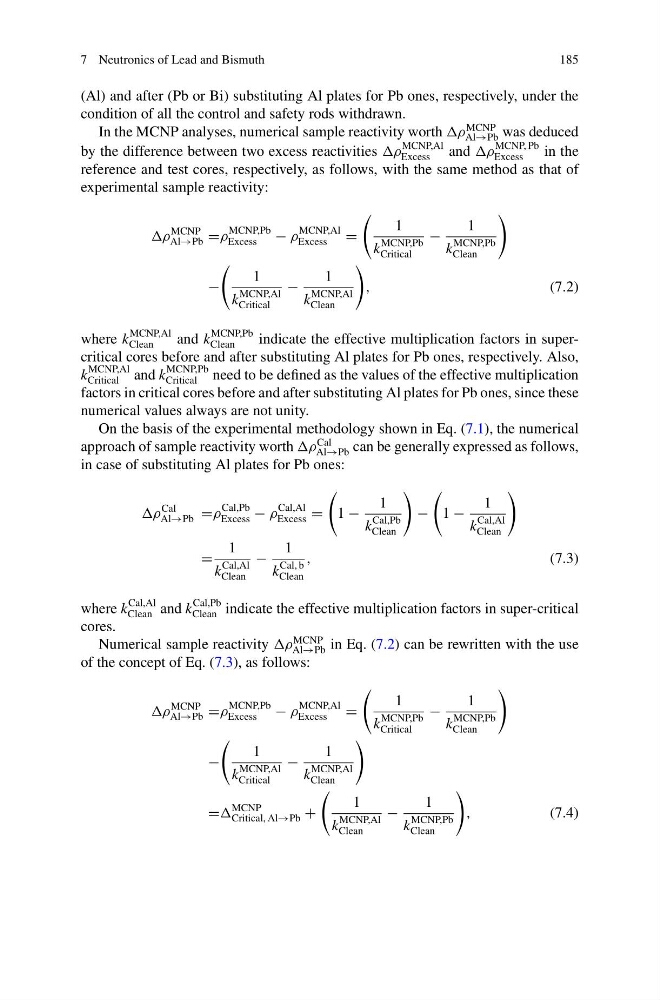
In the MCNP analyses, numerical sample reactivity worth ρ
MCNP
Al→Pb was deduced
by the difference between two excess reactivities ρ
MCNP,Al
Excess
and ρ
MCNP, Pb
Excess
in the
reference and test cores, respectively, as follows, with the same method as that of
experimental sample reactivity:
ρ
MCNP
Al→Pb =ρ
MCNP,Pb
Excess
− ρ
MCNP,Al
Excess
=
1
k
MCNP,Pb
Critical
−
1
k
MCNP,Pb
Clean
−
1
k
MCNP,Al
Critical
−
1
k
MCNP,Al
Clean
,
(7.2)
where k
MCNP,Al
Clean
and k
MCNP,Pb
Clean
indicate the effective multiplication factors in supercritical cores before and after substituting Al plates for Pb ones, respectively. Also,
k
MCNP,Al
Critical and k
MCNP,Pb
Critical need to be defined as the values of the effective multiplication
factors in critical cores before and after substituting Al plates for Pb ones, since these
numerical values always are not unity.
On the basis of the experimental methodology shown in Eq. (7.1), the numerical
approach of sample reactivity worth ρ
Cal
Al→Pb can be generally expressed as follows,
in case of substituting Al plates for Pb ones:
ρ
Cal
Al→Pb =ρ
Cal,Pb
Excess − ρ
Cal,Al
Excess =
1 −
1
k
Cal,Pb
Clean
−
1 −
1
k
Cal,Al
Clean
=
1
k
Cal,Al
Clean
−
1
k
Cal, b
Clean
,
(7.3)
where k
Cal,Al
Clean and k
Cal,Pb
Clean indicate the effective multiplication factors in super-critical
cores.
Numerical sample reactivity ρ
MCNP
Al→Pb in Eq. (7.2) can be rewritten with the use
of the concept of Eq. (7.3), as follows:
ρ
MCNP
Al→Pb =ρ
MCNP,Pb
Excess
− ρ
MCNP,Al
Excess
=
1
k
MCNP,Pb
Critical
−
1
k
MCNP,Pb
Clean
−
1
k
MCNP,Al
Critical
−
1
k
MCNP,Al
Clean
=
MCNP
Critical, Al→Pb +
1
k
MCNP,Al
Clean
−
1
k
MCNP,Pb
Clean
,
(7.4)
185
(Al) and after (Pb or Bi) substituting Al plates for Pb ones, respectively, under the
condition of all the control and safety rods withdrawn.
In the MCNP analyses, numerical sample reactivity worth ρ
MCNP
Al→Pb was deduced
by the difference between two excess reactivities ρ
MCNP,Al
Excess
and ρ
MCNP, Pb
Excess
in the
reference and test cores, respectively, as follows, with the same method as that of
experimental sample reactivity:
ρ
MCNP
Al→Pb =ρ
MCNP,Pb
Excess
− ρ
MCNP,Al
Excess
=
1
k
MCNP,Pb
Critical
−
1
k
MCNP,Pb
Clean
−
1
k
MCNP,Al
Critical
−
1
k
MCNP,Al
Clean
,
(7.2)
where k
MCNP,Al
Clean
and k
MCNP,Pb
Clean
indicate the effective multiplication factors in supercritical cores before and after substituting Al plates for Pb ones, respectively. Also,
k
MCNP,Al
Critical and k
MCNP,Pb
Critical need to be defined as the values of the effective multiplication
factors in critical cores before and after substituting Al plates for Pb ones, since these
numerical values always are not unity.
On the basis of the experimental methodology shown in Eq. (7.1), the numerical
approach of sample reactivity worth ρ
Cal
Al→Pb can be generally expressed as follows,
in case of substituting Al plates for Pb ones:
ρ
Cal
Al→Pb =ρ
Cal,Pb
Excess − ρ
Cal,Al
Excess =
1 −
1
k
Cal,Pb
Clean
−
1 −
1
k
Cal,Al
Clean
=
1
k
Cal,Al
Clean
−
1
k
Cal, b
Clean
,
(7.3)
where k
Cal,Al
Clean and k
Cal,Pb
Clean indicate the effective multiplication factors in super-critical
cores.
Numerical sample reactivity ρ
MCNP
Al→Pb in Eq. (7.2) can be rewritten with the use
of the concept of Eq. (7.3), as follows:
ρ
MCNP
Al→Pb =ρ
MCNP,Pb
Excess
− ρ
MCNP,Al
Excess
=
1
k
MCNP,Pb
Critical
−
1
k
MCNP,Pb
Clean
−
1
k
MCNP,Al
Critical
−
1
k
MCNP,Al
Clean
=
MCNP
Critical, Al→Pb +
1
k
MCNP,Al
Clean
−
1
k
MCNP,Pb
Clean
,
(7.4)