

168
C. H. Pyeon
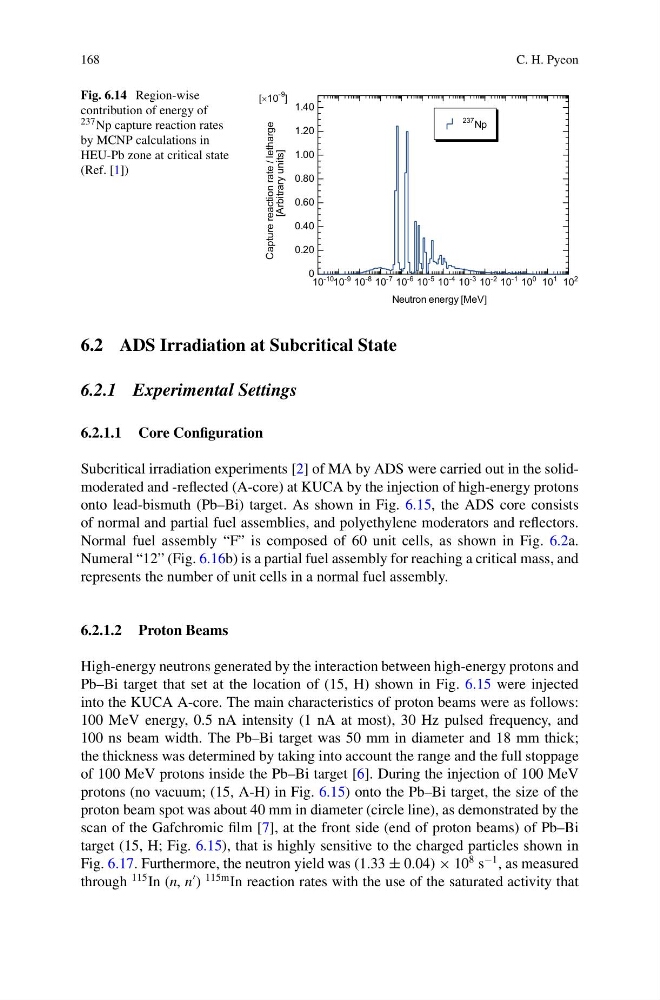
Fig. 6.14 Region-wise
contribution of energy of
237 Np capture reaction rates
by MCNP calculations in
HEU-Pb zone at critical state
(Ref. [1])
10
-10
10
-9 10
-8 10
-7 10
-6 10
-5 10
-4 10
-3 10
-2 10
-1 10
0 10
1 10
2
0
0.20
0.40
0.60
0.80
1.00
1.20
1.40
[ 10
-9
]
Neutron energy [MeV]
Capture reaction rate / letharge
[Arbitrary units]
237 Np
6.2 ADS Irradiation at Subcritical State
6.2.1 Experimental Settings
6.2.1.1 Core Configuration
Subcritical irradiation experiments [2] of MA by ADS were carried out in the solidmoderated and -reflected (A-core) at KUCA by the injection of high-energy protons
onto lead-bismuth (Pb–Bi) target. As shown in Fig. 6.15, the ADS core consists
of normal and partial fuel assemblies, and polyethylene moderators and reflectors.
Normal fuel assembly “F” is composed of 60 unit cells, as shown in Fig. 6.2a.
Numeral “12” (Fig. 6.16b) is a partial fuel assembly for reaching a critical mass, and
represents the number of unit cells in a normal fuel assembly.
6.2.1.2 Proton Beams
High-energy neutrons generated by the interaction between high-energy protons and
Pb–Bi target that set at the location of (15, H) shown in Fig. 6.15 were injected
into the KUCA A-core. The main characteristics of proton beams were as follows:
100 MeV energy, 0.5 nA intensity (1 nA at most), 30 Hz pulsed frequency, and
100 ns beam width. The Pb–Bi target was 50 mm in diameter and 18 mm thick;
the thickness was determined by taking into account the range and the full stoppage
of 100 MeV protons inside the Pb–Bi target [6]. During the injection of 100 MeV
protons (no vacuum; (15, A-H) in Fig. 6.15) onto the Pb–Bi target, the size of the
proton beam spot was about 40 mm in diameter (circle line), as demonstrated by the
scan of the Gafchromic film [7], at the front side (end of proton beams) of Pb–Bi
target (15, H; Fig. 6.15), that is highly sensitive to the charged particles shown in
Fig. 6.17. Furthermore, the neutron yield was (1.33 ± 0.04) × 10
8 s
−1 , as measured
through
115 In (n, n
)
115m In reaction rates with the use of the saturated activity that
C. H. Pyeon
Fig. 6.14 Region-wise
contribution of energy of
237 Np capture reaction rates
by MCNP calculations in
HEU-Pb zone at critical state
(Ref. [1])
10
-10
10
-9 10
-8 10
-7 10
-6 10
-5 10
-4 10
-3 10
-2 10
-1 10
0 10
1 10
2
0
0.20
0.40
0.60
0.80
1.00
1.20
1.40
[ 10
-9
]
Neutron energy [MeV]
Capture reaction rate / letharge
[Arbitrary units]
237 Np
6.2 ADS Irradiation at Subcritical State
6.2.1 Experimental Settings
6.2.1.1 Core Configuration
Subcritical irradiation experiments [2] of MA by ADS were carried out in the solidmoderated and -reflected (A-core) at KUCA by the injection of high-energy protons
onto lead-bismuth (Pb–Bi) target. As shown in Fig. 6.15, the ADS core consists
of normal and partial fuel assemblies, and polyethylene moderators and reflectors.
Normal fuel assembly “F” is composed of 60 unit cells, as shown in Fig. 6.2a.
Numeral “12” (Fig. 6.16b) is a partial fuel assembly for reaching a critical mass, and
represents the number of unit cells in a normal fuel assembly.
6.2.1.2 Proton Beams
High-energy neutrons generated by the interaction between high-energy protons and
Pb–Bi target that set at the location of (15, H) shown in Fig. 6.15 were injected
into the KUCA A-core. The main characteristics of proton beams were as follows:
100 MeV energy, 0.5 nA intensity (1 nA at most), 30 Hz pulsed frequency, and
100 ns beam width. The Pb–Bi target was 50 mm in diameter and 18 mm thick;
the thickness was determined by taking into account the range and the full stoppage
of 100 MeV protons inside the Pb–Bi target [6]. During the injection of 100 MeV
protons (no vacuum; (15, A-H) in Fig. 6.15) onto the Pb–Bi target, the size of the
proton beam spot was about 40 mm in diameter (circle line), as demonstrated by the
scan of the Gafchromic film [7], at the front side (end of proton beams) of Pb–Bi
target (15, H; Fig. 6.15), that is highly sensitive to the charged particles shown in
Fig. 6.17. Furthermore, the neutron yield was (1.33 ± 0.04) × 10
8 s
−1 , as measured
through
115 In (n, n
)
115m In reaction rates with the use of the saturated activity that