

6 Nuclear Transmutation of Minor Actinide
167
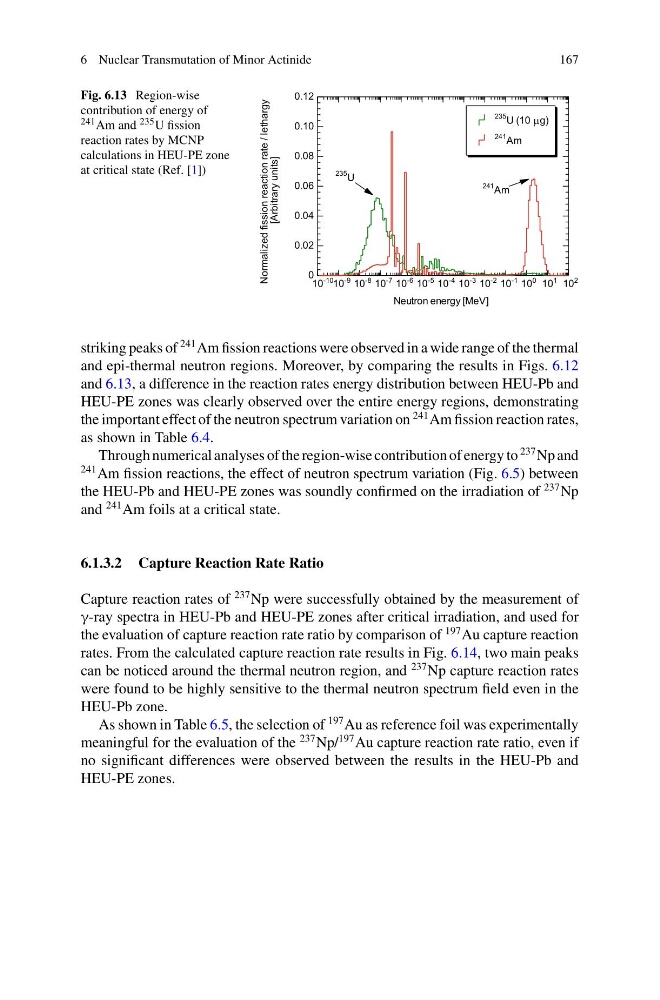
Fig. 6.13 Region-wise
contribution of energy of
241 Am and 235 U fission
reaction rates by MCNP
calculations in HEU-PE zone
at critical state (Ref. [1])
10
-10
10
-9 10
-8 10
-7 10
-6 10
-5 10
-4 10
-3 10
-2 10
-1 10
0 10
1 10
2
0
0.02
0.04
0.06
0.08
0.10
0.12
Neutron energy [MeV]
Normalized fission reaction rate / lethargy
[Arbitrary units]
235 U (10 g)
241 Am
241 Am
235 U
striking peaks of
241 Am fission reactions were observed in a wide range of the thermal
and epi-thermal neutron regions. Moreover, by comparing the results in Figs. 6.12
and 6.13, a difference in the reaction rates energy distribution between HEU-Pb and
HEU-PE zones was clearly observed over the entire energy regions, demonstrating
the important effect of the neutron spectrum variation on
241 Am fission reaction rates,
as shown in Table 6.4.
Through numerical analyses of the region-wise contribution of energy to
237 Np and
241 Am fission reactions, the effect of neutron spectrum variation (Fig. 6.5) between
the HEU-Pb and HEU-PE zones was soundly confirmed on the irradiation of
237 Np
and
241 Am foils at a critical state.
6.1.3.2 Capture Reaction Rate Ratio
Capture reaction rates of
237 Np were successfully obtained by the measurement of
γ-ray spectra in HEU-Pb and HEU-PE zones after critical irradiation, and used for
the evaluation of capture reaction rate ratio by comparison of
197 Au capture reaction
rates. From the calculated capture reaction rate results in Fig. 6.14, two main peaks
can be noticed around the thermal neutron region, and
237 Np capture reaction rates
were found to be highly sensitive to the thermal neutron spectrum field even in the
HEU-Pb zone.
As shown in Table 6.5, the selection of
197 Au as reference foil was experimentally
meaningful for the evaluation of the
237 Np/
197 Au capture reaction rate ratio, even if
no significant differences were observed between the results in the HEU-Pb and
HEU-PE zones.
167
Fig. 6.13 Region-wise
contribution of energy of
241 Am and 235 U fission
reaction rates by MCNP
calculations in HEU-PE zone
at critical state (Ref. [1])
10
-10
10
-9 10
-8 10
-7 10
-6 10
-5 10
-4 10
-3 10
-2 10
-1 10
0 10
1 10
2
0
0.02
0.04
0.06
0.08
0.10
0.12
Neutron energy [MeV]
Normalized fission reaction rate / lethargy
[Arbitrary units]
235 U (10 g)
241 Am
241 Am
235 U
striking peaks of
241 Am fission reactions were observed in a wide range of the thermal
and epi-thermal neutron regions. Moreover, by comparing the results in Figs. 6.12
and 6.13, a difference in the reaction rates energy distribution between HEU-Pb and
HEU-PE zones was clearly observed over the entire energy regions, demonstrating
the important effect of the neutron spectrum variation on
241 Am fission reaction rates,
as shown in Table 6.4.
Through numerical analyses of the region-wise contribution of energy to
237 Np and
241 Am fission reactions, the effect of neutron spectrum variation (Fig. 6.5) between
the HEU-Pb and HEU-PE zones was soundly confirmed on the irradiation of
237 Np
and
241 Am foils at a critical state.
6.1.3.2 Capture Reaction Rate Ratio
Capture reaction rates of
237 Np were successfully obtained by the measurement of
γ-ray spectra in HEU-Pb and HEU-PE zones after critical irradiation, and used for
the evaluation of capture reaction rate ratio by comparison of
197 Au capture reaction
rates. From the calculated capture reaction rate results in Fig. 6.14, two main peaks
can be noticed around the thermal neutron region, and
237 Np capture reaction rates
were found to be highly sensitive to the thermal neutron spectrum field even in the
HEU-Pb zone.
As shown in Table 6.5, the selection of
197 Au as reference foil was experimentally
meaningful for the evaluation of the
237 Np/
197 Au capture reaction rate ratio, even if
no significant differences were observed between the results in the HEU-Pb and
HEU-PE zones.