

152
C. H. Pyeon
Table 5.14 Measured results
of 115 In(n, n ) 115m In and
27 Al(p, n + 3p) 24 Na reaction
rates (Ref. [22])
Reactions
Measured reaction rates (s −1 cm −3 )
115 In(n, n ) 115m In
(2.89 ± 0.03) × 10 5
27 Al(p, n + 3p) 24 Na
(1.58 ± 0.02) × 10 6
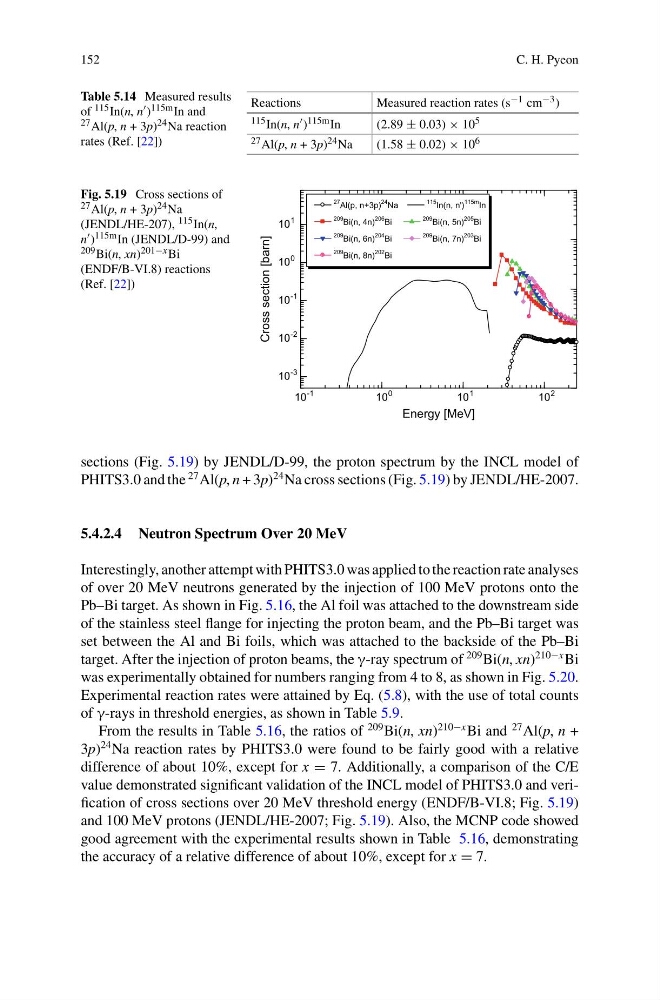
Fig. 5.19 Cross sections of
27 Al(p, n + 3p) 24 Na
(JENDL/HE-207), 115 In(n,
n ) 115m In (JENDL/D-99) and
209 Bi(n, xn) 201−x Bi
(ENDF/B-VI.8) reactions
(Ref. [22])
10
-1
10
0
10
1
10
2
10
-3
10
-2
10
-1
10
0
10
1
Energy [MeV]
Cross section [barn]
27
Al(p, n+3p)
24
Na
115
In(n, n')
115m In
209
Bi(n, 4n)
206 Bi
209 Bi(n, 5n)
205 Bi
209
Bi(n, 6n)
204 Bi
209 Bi(n, 7n)
203 Bi
209
Bi(n, 8n)
202 Bi
sections (Fig. 5.19) by JENDL/D-99, the proton spectrum by the INCL model of
PHITS3.0 and the
27 Al(p, n + 3p)
24 Na cross sections (Fig. 5.19) by JENDL/HE-2007.
5.4.2.4 Neutron Spectrum Over 20 MeV
Interestingly, another attempt with PHITS3.0 was applied to the reaction rate analyses
of over 20 MeV neutrons generated by the injection of 100 MeV protons onto the
Pb–Bi target. As shown in Fig. 5.16, the Al foil was attached to the downstream side
of the stainless steel flange for injecting the proton beam, and the Pb–Bi target was
set between the Al and Bi foils, which was attached to the backside of the Pb–Bi
target. After the injection of proton beams, the γ-ray spectrum of
209 Bi(n, xn)
210−x Bi
was experimentally obtained for numbers ranging from 4 to 8, as shown in Fig. 5.20.
Experimental reaction rates were attained by Eq. (5.8), with the use of total counts
of γ-rays in threshold energies, as shown in Table 5.9.
From the results in Table 5.16, the ratios of
209 Bi(n, xn)
210−x Bi and
27 Al(p, n +
3p)
24 Na reaction rates by PHITS3.0 were found to be fairly good with a relative
difference of about 10%, except for x = 7. Additionally, a comparison of the C/E
value demonstrated significant validation of the INCL model of PHITS3.0 and verification of cross sections over 20 MeV threshold energy (ENDF/B-VI.8; Fig. 5.19)
and 100 MeV protons (JENDL/HE-2007; Fig. 5.19). Also, the MCNP code showed
good agreement with the experimental results shown in Table 5.16, demonstrating
the accuracy of a relative difference of about 10%, except for x = 7.
C. H. Pyeon
Table 5.14 Measured results
of 115 In(n, n ) 115m In and
27 Al(p, n + 3p) 24 Na reaction
rates (Ref. [22])
Reactions
Measured reaction rates (s −1 cm −3 )
115 In(n, n ) 115m In
(2.89 ± 0.03) × 10 5
27 Al(p, n + 3p) 24 Na
(1.58 ± 0.02) × 10 6
Fig. 5.19 Cross sections of
27 Al(p, n + 3p) 24 Na
(JENDL/HE-207), 115 In(n,
n ) 115m In (JENDL/D-99) and
209 Bi(n, xn) 201−x Bi
(ENDF/B-VI.8) reactions
(Ref. [22])
10
-1
10
0
10
1
10
2
10
-3
10
-2
10
-1
10
0
10
1
Energy [MeV]
Cross section [barn]
27
Al(p, n+3p)
24
Na
115
In(n, n')
115m In
209
Bi(n, 4n)
206 Bi
209 Bi(n, 5n)
205 Bi
209
Bi(n, 6n)
204 Bi
209 Bi(n, 7n)
203 Bi
209
Bi(n, 8n)
202 Bi
sections (Fig. 5.19) by JENDL/D-99, the proton spectrum by the INCL model of
PHITS3.0 and the
27 Al(p, n + 3p)
24 Na cross sections (Fig. 5.19) by JENDL/HE-2007.
5.4.2.4 Neutron Spectrum Over 20 MeV
Interestingly, another attempt with PHITS3.0 was applied to the reaction rate analyses
of over 20 MeV neutrons generated by the injection of 100 MeV protons onto the
Pb–Bi target. As shown in Fig. 5.16, the Al foil was attached to the downstream side
of the stainless steel flange for injecting the proton beam, and the Pb–Bi target was
set between the Al and Bi foils, which was attached to the backside of the Pb–Bi
target. After the injection of proton beams, the γ-ray spectrum of
209 Bi(n, xn)
210−x Bi
was experimentally obtained for numbers ranging from 4 to 8, as shown in Fig. 5.20.
Experimental reaction rates were attained by Eq. (5.8), with the use of total counts
of γ-rays in threshold energies, as shown in Table 5.9.
From the results in Table 5.16, the ratios of
209 Bi(n, xn)
210−x Bi and
27 Al(p, n +
3p)
24 Na reaction rates by PHITS3.0 were found to be fairly good with a relative
difference of about 10%, except for x = 7. Additionally, a comparison of the C/E
value demonstrated significant validation of the INCL model of PHITS3.0 and verification of cross sections over 20 MeV threshold energy (ENDF/B-VI.8; Fig. 5.19)
and 100 MeV protons (JENDL/HE-2007; Fig. 5.19). Also, the MCNP code showed
good agreement with the experimental results shown in Table 5.16, demonstrating
the accuracy of a relative difference of about 10%, except for x = 7.