

5 Neutron Spectrum
149
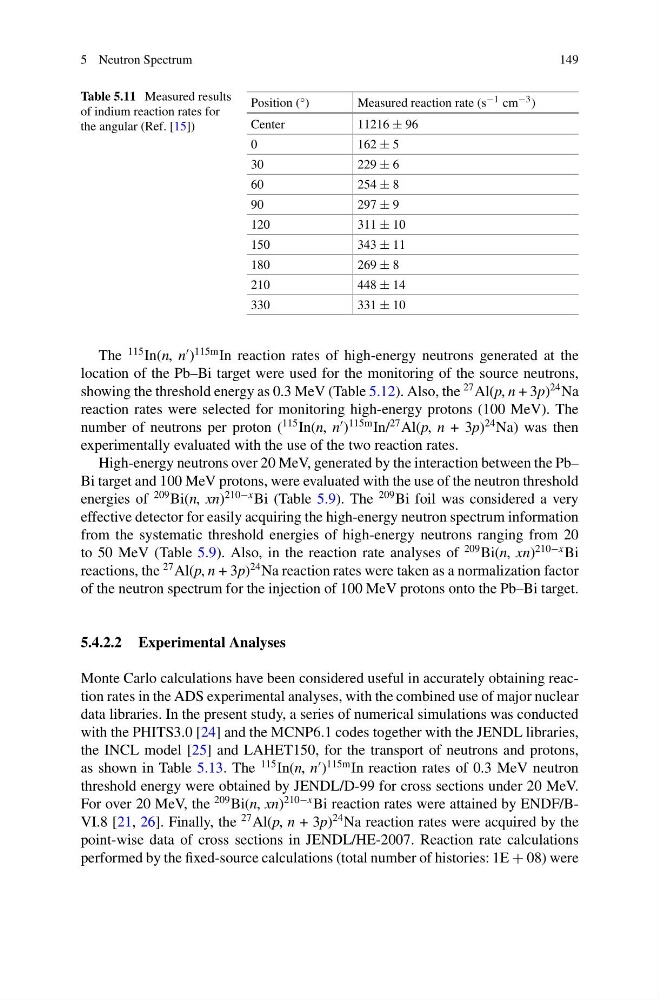
Table 5.11 Measured results
of indium reaction rates for
the angular (Ref. [15])
Position (°)
Measured reaction rate (s −1 cm −3 )
Center
11216 ± 96
0
162 ± 5
30
229 ± 6
60
254 ± 8
90
297 ± 9
120
311 ± 10
150
343 ± 11
180
269 ± 8
210
448 ± 14
330
331 ± 10
The
115 In(n, n
)
115m In reaction rates of high-energy neutrons generated at the
location of the Pb–Bi target were used for the monitoring of the source neutrons,
showing the threshold energy as 0.3 MeV (Table 5.12). Also, the
27 Al(p, n + 3p)
24 Na
reaction rates were selected for monitoring high-energy protons (100 MeV). The
number of neutrons per proton (
115 In(n, n
)
115m In/
27 Al(p, n + 3p)
24 Na) was then
experimentally evaluated with the use of the two reaction rates.
High-energy neutrons over 20 MeV, generated by the interaction between the Pb–
Bi target and 100 MeV protons, were evaluated with the use of the neutron threshold
energies of
209 Bi(n, xn)
210−x Bi (Table 5.9). The
209 Bi foil was considered a very
effective detector for easily acquiring the high-energy neutron spectrum information
from the systematic threshold energies of high-energy neutrons ranging from 20
to 50 MeV (Table 5.9). Also, in the reaction rate analyses of
209 Bi(n, xn)
210−x Bi
reactions, the
27 Al(p, n + 3p)
24 Na reaction rates were taken as a normalization factor
of the neutron spectrum for the injection of 100 MeV protons onto the Pb–Bi target.
5.4.2.2 Experimental Analyses
Monte Carlo calculations have been considered useful in accurately obtaining reaction rates in the ADS experimental analyses, with the combined use of major nuclear
data libraries. In the present study, a series of numerical simulations was conducted
with the PHITS3.0 [24] and the MCNP6.1 codes together with the JENDL libraries,
the INCL model [25] and LAHET150, for the transport of neutrons and protons,
as shown in Table 5.13. The
115 In(n, n
)
115m In reaction rates of 0.3 MeV neutron
threshold energy were obtained by JENDL/D-99 for cross sections under 20 MeV.
For over 20 MeV, the
209 Bi(n, xn)
210−x Bi reaction rates were attained by ENDF/BVI.8 [21, 26]. Finally, the
27 Al(p, n + 3p)
24 Na reaction rates were acquired by the
point-wise data of cross sections in JENDL/HE-2007. Reaction rate calculations
performed by the fixed-source calculations (total number of histories: 1E + 08) were
149
Table 5.11 Measured results
of indium reaction rates for
the angular (Ref. [15])
Position (°)
Measured reaction rate (s −1 cm −3 )
Center
11216 ± 96
0
162 ± 5
30
229 ± 6
60
254 ± 8
90
297 ± 9
120
311 ± 10
150
343 ± 11
180
269 ± 8
210
448 ± 14
330
331 ± 10
The
115 In(n, n
)
115m In reaction rates of high-energy neutrons generated at the
location of the Pb–Bi target were used for the monitoring of the source neutrons,
showing the threshold energy as 0.3 MeV (Table 5.12). Also, the
27 Al(p, n + 3p)
24 Na
reaction rates were selected for monitoring high-energy protons (100 MeV). The
number of neutrons per proton (
115 In(n, n
)
115m In/
27 Al(p, n + 3p)
24 Na) was then
experimentally evaluated with the use of the two reaction rates.
High-energy neutrons over 20 MeV, generated by the interaction between the Pb–
Bi target and 100 MeV protons, were evaluated with the use of the neutron threshold
energies of
209 Bi(n, xn)
210−x Bi (Table 5.9). The
209 Bi foil was considered a very
effective detector for easily acquiring the high-energy neutron spectrum information
from the systematic threshold energies of high-energy neutrons ranging from 20
to 50 MeV (Table 5.9). Also, in the reaction rate analyses of
209 Bi(n, xn)
210−x Bi
reactions, the
27 Al(p, n + 3p)
24 Na reaction rates were taken as a normalization factor
of the neutron spectrum for the injection of 100 MeV protons onto the Pb–Bi target.
5.4.2.2 Experimental Analyses
Monte Carlo calculations have been considered useful in accurately obtaining reaction rates in the ADS experimental analyses, with the combined use of major nuclear
data libraries. In the present study, a series of numerical simulations was conducted
with the PHITS3.0 [24] and the MCNP6.1 codes together with the JENDL libraries,
the INCL model [25] and LAHET150, for the transport of neutrons and protons,
as shown in Table 5.13. The
115 In(n, n
)
115m In reaction rates of 0.3 MeV neutron
threshold energy were obtained by JENDL/D-99 for cross sections under 20 MeV.
For over 20 MeV, the
209 Bi(n, xn)
210−x Bi reaction rates were attained by ENDF/BVI.8 [21, 26]. Finally, the
27 Al(p, n + 3p)
24 Na reaction rates were acquired by the
point-wise data of cross sections in JENDL/HE-2007. Reaction rate calculations
performed by the fixed-source calculations (total number of histories: 1E + 08) were