

5 Neutron Spectrum
137
5.3 Spectrum Index
5.3.1 Cd Ratio
In reactor physics experiments, the Cd ratio is generally interpreted as the neutron
spectrum index, where the relation between absorption cross sections of Au and
Cd is used in foil activation analyses. For thermal and resonance regions, 0.18 eV
corresponds to the boundary energy (cut-off energy) between thermal and epithermal
neutron regions. By defining the Cd ratio as that of activation reaction rates R Au−bare
and R Au−Cd of Au foils (Au-bare and Au-Cd-sandwiched plates, respectively), the
Cd ratio can be expressed as follows:
Cd ratio =
R Au−bare
R Au−Cd
.
(5.9)
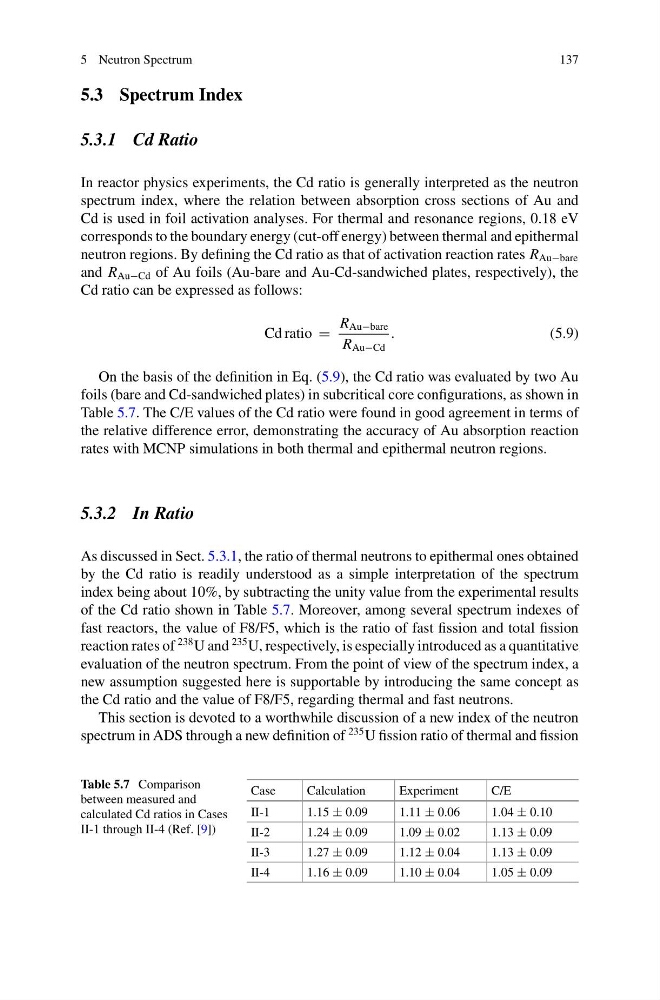
On the basis of the definition in Eq. (5.9), the Cd ratio was evaluated by two Au
foils (bare and Cd-sandwiched plates) in subcritical core configurations, as shown in
Table 5.7. The C/E values of the Cd ratio were found in good agreement in terms of
the relative difference error, demonstrating the accuracy of Au absorption reaction
rates with MCNP simulations in both thermal and epithermal neutron regions.
5.3.2 In Ratio
As discussed in Sect. 5.3.1, the ratio of thermal neutrons to epithermal ones obtained
by the Cd ratio is readily understood as a simple interpretation of the spectrum
index being about 10%, by subtracting the unity value from the experimental results
of the Cd ratio shown in Table 5.7. Moreover, among several spectrum indexes of
fast reactors, the value of F8/F5, which is the ratio of fast fission and total fission
reaction rates of
238 U and
235 U, respectively, is especially introduced as a quantitative
evaluation of the neutron spectrum. From the point of view of the spectrum index, a
new assumption suggested here is supportable by introducing the same concept as
the Cd ratio and the value of F8/F5, regarding thermal and fast neutrons.
This section is devoted to a worthwhile discussion of a new index of the neutron
spectrum in ADS through a new definition of
235 U fission ratio of thermal and fission
Table 5.7 Comparison
between measured and
calculated Cd ratios in Cases
II-1 through II-4 (Ref. [9])
Case
Calculation
Experiment
C/E
II-1
1.15 ± 0.09
1.11 ± 0.06
1.04 ± 0.10
II-2
1.24 ± 0.09
1.09 ± 0.02
1.13 ± 0.09
II-3
1.27 ± 0.09
1.12 ± 0.04
1.13 ± 0.09
II-4
1.16 ± 0.09
1.10 ± 0.04
1.05 ± 0.09
137
5.3 Spectrum Index
5.3.1 Cd Ratio
In reactor physics experiments, the Cd ratio is generally interpreted as the neutron
spectrum index, where the relation between absorption cross sections of Au and
Cd is used in foil activation analyses. For thermal and resonance regions, 0.18 eV
corresponds to the boundary energy (cut-off energy) between thermal and epithermal
neutron regions. By defining the Cd ratio as that of activation reaction rates R Au−bare
and R Au−Cd of Au foils (Au-bare and Au-Cd-sandwiched plates, respectively), the
Cd ratio can be expressed as follows:
Cd ratio =
R Au−bare
R Au−Cd
.
(5.9)
On the basis of the definition in Eq. (5.9), the Cd ratio was evaluated by two Au
foils (bare and Cd-sandwiched plates) in subcritical core configurations, as shown in
Table 5.7. The C/E values of the Cd ratio were found in good agreement in terms of
the relative difference error, demonstrating the accuracy of Au absorption reaction
rates with MCNP simulations in both thermal and epithermal neutron regions.
5.3.2 In Ratio
As discussed in Sect. 5.3.1, the ratio of thermal neutrons to epithermal ones obtained
by the Cd ratio is readily understood as a simple interpretation of the spectrum
index being about 10%, by subtracting the unity value from the experimental results
of the Cd ratio shown in Table 5.7. Moreover, among several spectrum indexes of
fast reactors, the value of F8/F5, which is the ratio of fast fission and total fission
reaction rates of
238 U and
235 U, respectively, is especially introduced as a quantitative
evaluation of the neutron spectrum. From the point of view of the spectrum index, a
new assumption suggested here is supportable by introducing the same concept as
the Cd ratio and the value of F8/F5, regarding thermal and fast neutrons.
This section is devoted to a worthwhile discussion of a new index of the neutron
spectrum in ADS through a new definition of
235 U fission ratio of thermal and fission
Table 5.7 Comparison
between measured and
calculated Cd ratios in Cases
II-1 through II-4 (Ref. [9])
Case
Calculation
Experiment
C/E
II-1
1.15 ± 0.09
1.11 ± 0.06
1.04 ± 0.10
II-2
1.24 ± 0.09
1.09 ± 0.02
1.13 ± 0.09
II-3
1.27 ± 0.09
1.12 ± 0.04
1.13 ± 0.09
II-4
1.16 ± 0.09
1.10 ± 0.04
1.05 ± 0.09