

136
C. H. Pyeon
Table 5.6 C/E values between measured and calculated reaction rates in Cases II-1 through II-4
(Ref. [9])
Reaction
Case II-1
Case II-2
Case II-3
Case II-4
197 Au(n, γ) 198 Au (bare)
1.14 ± 0.09
0.96 ± 0.06
0.90 ± 0.06
0.75 ± 0.07
197 Au(n, γ) 198 Au (Cd)
1.10 ± 0.09
0.81 ± 0.05
0.80 ± 0.06
0.71 ± 0.07
115 In(n, n ) 115m In (Core)
0.86 ± 0.02
0.69 ± 0.04
0.52 ± 0.01
0.47 ± 0.02
58 Ni(n, p) 58 Co
0.99 ± 0.04
0.74 ± 0.03
0.59 ± 0.03
0.67 ± 0.04
56 Fe(n, p) 56 Mn
0.60 ± 0.03
0.54 ± 0.03
0.47 ± 0.02
0.40 ± 0.02
27 Al(n, α) 24 Na
0.47 ± 0.01
0.26 ± 0.02
0.19 ± 0.01
0.22 ± 0.02
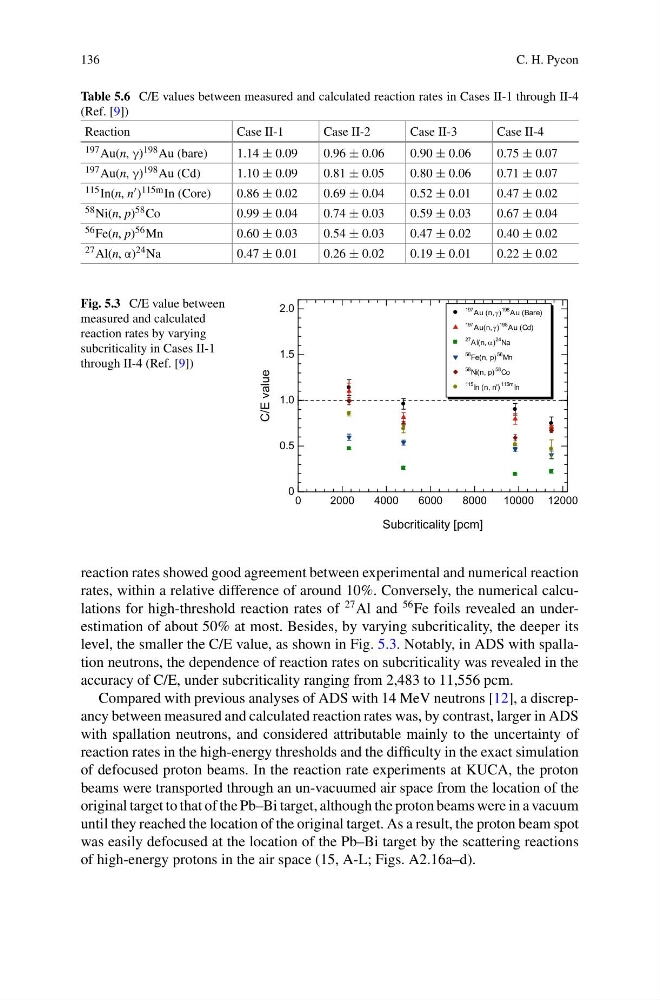
Fig. 5.3 C/E value between
measured and calculated
reaction rates by varying
subcriticality in Cases II-1
through II-4 (Ref. [9])
0
2000
4000
6000
8000
10000 12000
0
0.5
1.0
1.5
2.0
197 Au (n, ) 198 Au (Bare)
197 Au(n, ) 198 Au (Cd)
27 Al(n, )
24 Na
56 Fe(n, p)
56 Mn
58 Ni(n, p) 58 Co
115 In (n, n')
115m In
Subcriticality [pcm]
C/E value
reaction rates showed good agreement between experimental and numerical reaction
rates, within a relative difference of around 10%. Conversely, the numerical calculations for high-threshold reaction rates of
27 Al and
56 Fe foils revealed an underestimation of about 50% at most. Besides, by varying subcriticality, the deeper its
level, the smaller the C/E value, as shown in Fig. 5.3. Notably, in ADS with spallation neutrons, the dependence of reaction rates on subcriticality was revealed in the
accuracy of C/E, under subcriticality ranging from 2,483 to 11,556 pcm.
Compared with previous analyses of ADS with 14 MeV neutrons [12], a discrepancy between measured and calculated reaction rates was, by contrast, larger in ADS
with spallation neutrons, and considered attributable mainly to the uncertainty of
reaction rates in the high-energy thresholds and the difficulty in the exact simulation
of defocused proton beams. In the reaction rate experiments at KUCA, the proton
beams were transported through an un-vacuumed air space from the location of the
original target to that of the Pb–Bi target, although the proton beams were in a vacuum
until they reached the location of the original target. As a result, the proton beam spot
was easily defocused at the location of the Pb–Bi target by the scattering reactions
of high-energy protons in the air space (15, A-L; Figs. A2.16a–d).
C. H. Pyeon
Table 5.6 C/E values between measured and calculated reaction rates in Cases II-1 through II-4
(Ref. [9])
Reaction
Case II-1
Case II-2
Case II-3
Case II-4
197 Au(n, γ) 198 Au (bare)
1.14 ± 0.09
0.96 ± 0.06
0.90 ± 0.06
0.75 ± 0.07
197 Au(n, γ) 198 Au (Cd)
1.10 ± 0.09
0.81 ± 0.05
0.80 ± 0.06
0.71 ± 0.07
115 In(n, n ) 115m In (Core)
0.86 ± 0.02
0.69 ± 0.04
0.52 ± 0.01
0.47 ± 0.02
58 Ni(n, p) 58 Co
0.99 ± 0.04
0.74 ± 0.03
0.59 ± 0.03
0.67 ± 0.04
56 Fe(n, p) 56 Mn
0.60 ± 0.03
0.54 ± 0.03
0.47 ± 0.02
0.40 ± 0.02
27 Al(n, α) 24 Na
0.47 ± 0.01
0.26 ± 0.02
0.19 ± 0.01
0.22 ± 0.02
Fig. 5.3 C/E value between
measured and calculated
reaction rates by varying
subcriticality in Cases II-1
through II-4 (Ref. [9])
0
2000
4000
6000
8000
10000 12000
0
0.5
1.0
1.5
2.0
197 Au (n, ) 198 Au (Bare)
197 Au(n, ) 198 Au (Cd)
27 Al(n, )
24 Na
56 Fe(n, p)
56 Mn
58 Ni(n, p) 58 Co
115 In (n, n')
115m In
Subcriticality [pcm]
C/E value
reaction rates showed good agreement between experimental and numerical reaction
rates, within a relative difference of around 10%. Conversely, the numerical calculations for high-threshold reaction rates of
27 Al and
56 Fe foils revealed an underestimation of about 50% at most. Besides, by varying subcriticality, the deeper its
level, the smaller the C/E value, as shown in Fig. 5.3. Notably, in ADS with spallation neutrons, the dependence of reaction rates on subcriticality was revealed in the
accuracy of C/E, under subcriticality ranging from 2,483 to 11,556 pcm.
Compared with previous analyses of ADS with 14 MeV neutrons [12], a discrepancy between measured and calculated reaction rates was, by contrast, larger in ADS
with spallation neutrons, and considered attributable mainly to the uncertainty of
reaction rates in the high-energy thresholds and the difficulty in the exact simulation
of defocused proton beams. In the reaction rate experiments at KUCA, the proton
beams were transported through an un-vacuumed air space from the location of the
original target to that of the Pb–Bi target, although the proton beams were in a vacuum
until they reached the location of the original target. As a result, the proton beam spot
was easily defocused at the location of the Pb–Bi target by the scattering reactions
of high-energy protons in the air space (15, A-L; Figs. A2.16a–d).