

4 Effective Delayed Neutron Fraction
95
C = g
λ d λ f
ν p
ν p − 1
2α
.
(4.28)
4.2.1.2 Estimation of β eff
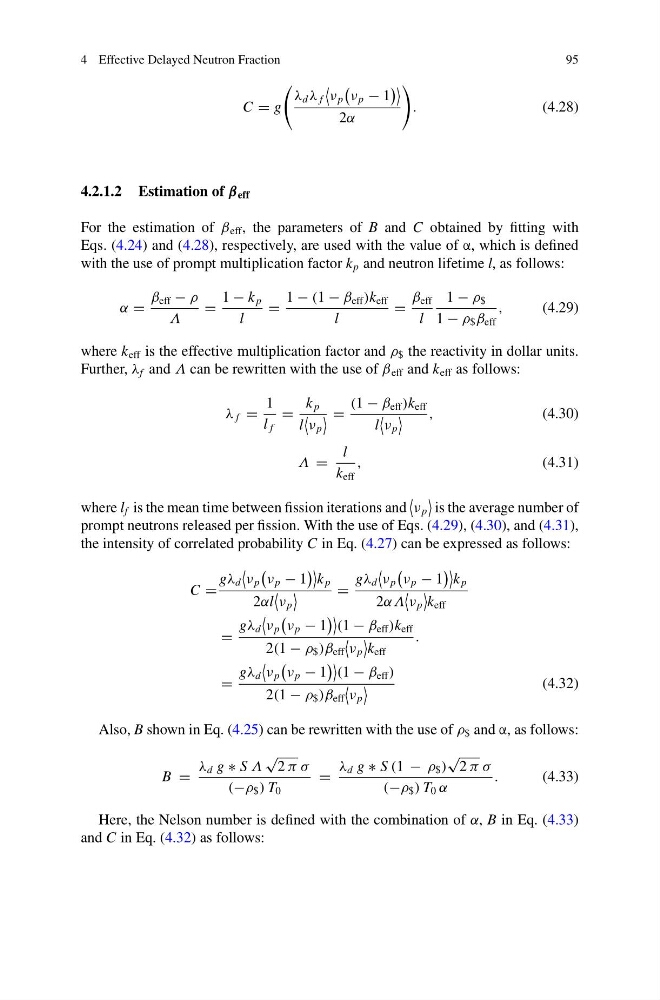
For the estimation of β eff , the parameters of B and C obtained by fitting with
Eqs. (4.24) and (4.28), respectively, are used with the value of α, which is defined
with the use of prompt multiplication factor k p and neutron lifetime l, as follows:
α =
β eff − ρ
Λ
=
1 − k p
l
=
1 − (1 − β eff )k eff
l
=
β eff
l
1 − ρ $
1 − ρ $ β eff
,
(4.29)
where k eff is the effective multiplication factor and ρ $ the reactivity in dollar units.
Further, λ f and Λ can be rewritten with the use of β eff and k eff as follows:
λ f =
1
l f
=
k p
l
ν p
=
(1 − β eff )k eff
l
ν p
,
(4.30)
Λ =
l
k eff
,
(4.31)
where l f is the mean time between fission iterations and
ν p
is the average number of
prompt neutrons released per fission. With the use of Eqs. (4.29), (4.30), and (4.31),
the intensity of correlated probability C in Eq. (4.27) can be expressed as follows:
C =
gλ d
ν p
ν p − 1
k p
2αl
ν p
=
gλ d
ν p
ν p − 1
k p
2αΛ
ν p
k eff
=
gλ d
ν p
ν p − 1
(1 − β eff )k eff
2(1 − ρ $ )β eff
ν p
k eff
.
=
gλ d
ν p
ν p − 1
(1 − β eff )
2(1 − ρ $ )β eff
ν p
(4.32)
Also, B shown in Eq. (4.25) can be rewritten with the use of ρ $ and α, as follows:
B =
λ d g ∗ S Λ
√
2 π σ
(−ρ $ ) T 0
=
λ d g ∗ S (1 − ρ $ )
√
2 π σ
(−ρ $ ) T 0 α
.
(4.33)
Here, the Nelson number is defined with the combination of α, B in Eq. (4.33)
and C in Eq. (4.32) as follows:
95
C = g
λ d λ f
ν p
ν p − 1
2α
.
(4.28)
4.2.1.2 Estimation of β eff
For the estimation of β eff , the parameters of B and C obtained by fitting with
Eqs. (4.24) and (4.28), respectively, are used with the value of α, which is defined
with the use of prompt multiplication factor k p and neutron lifetime l, as follows:
α =
β eff − ρ
Λ
=
1 − k p
l
=
1 − (1 − β eff )k eff
l
=
β eff
l
1 − ρ $
1 − ρ $ β eff
,
(4.29)
where k eff is the effective multiplication factor and ρ $ the reactivity in dollar units.
Further, λ f and Λ can be rewritten with the use of β eff and k eff as follows:
λ f =
1
l f
=
k p
l
ν p
=
(1 − β eff )k eff
l
ν p
,
(4.30)
Λ =
l
k eff
,
(4.31)
where l f is the mean time between fission iterations and
ν p
is the average number of
prompt neutrons released per fission. With the use of Eqs. (4.29), (4.30), and (4.31),
the intensity of correlated probability C in Eq. (4.27) can be expressed as follows:
C =
gλ d
ν p
ν p − 1
k p
2αl
ν p
=
gλ d
ν p
ν p − 1
k p
2αΛ
ν p
k eff
=
gλ d
ν p
ν p − 1
(1 − β eff )k eff
2(1 − ρ $ )β eff
ν p
k eff
.
=
gλ d
ν p
ν p − 1
(1 − β eff )
2(1 − ρ $ )β eff
ν p
(4.32)
Also, B shown in Eq. (4.25) can be rewritten with the use of ρ $ and α, as follows:
B =
λ d g ∗ S Λ
√
2 π σ
(−ρ $ ) T 0
=
λ d g ∗ S (1 − ρ $ )
√
2 π σ
(−ρ $ ) T 0 α
.
(4.33)
Here, the Nelson number is defined with the combination of α, B in Eq. (4.33)
and C in Eq. (4.32) as follows: