

4 Effective Delayed Neutron Fraction
93
Finally, these results demonstrated the fact that proper values for subcriticality determination with the area ratio technique were successfully obtained for the subcriticality estimation with the use of the proposed methodology by the fixed-source
calculations.
4.2 Measurement
4.2.1 Nelson Number Method
4.2.1.1 Formulation of Rossi-α Method
In the measurement methodology for β eff , the Nelson number method based on the
Rossi-α method [9] provides the advantage of reducing the parameters that are considered difficult to obtain experimentally, including detection efficiency, fission rate at
the core center, and the number of neutrons. The methodology assumes, however, that
β eff is measured near the critical state and by locating the external neutron source at
the core center. It is also applicable to the PNS experiments by modifying the formulation of the Rossi-α method. In the PNS experiments, the formulation by the Rossi-α
method is already available for processing neutron signals by the methodology used
in the analysis with the pulsed-neutron source [10, 11].
In the Rossi-α method, the joint probability P(t 1 ,t 2 ) between two neutron signals
detected at times t 1 and t 2 is evaluated by categorizing the same fission chain reactions
into correlated probability P C and the different fission chain reactions and the neutron
sources into uncorrelated probability P U , as follows:
P(t 1 , t 2 ) dt 1 dt 2 = P C (t 1 , t 2 ) dt 1 dt 2 + P U (t 1 , t 2 ) dt 1 dt 2 .
(4.21)
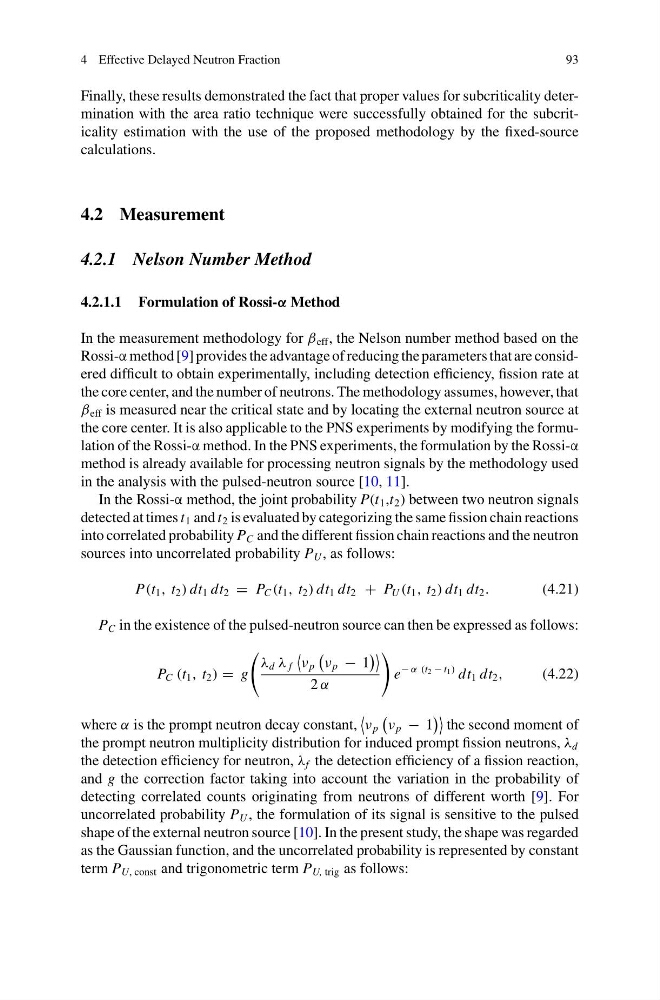
P C in the existence of the pulsed-neutron source can then be expressed as follows:
P C (t 1 , t 2 ) = g
λ d λ f
ν p
ν p − 1
2 α
e
− α (t2 − t 1) dt 1 dt 2 ,
(4.22)
where α is the prompt neutron decay constant,
ν p
ν p − 1
the second moment of
the prompt neutron multiplicity distribution for induced prompt fission neutrons, λ d
the detection efficiency for neutron, λ f the detection efficiency of a fission reaction,
and g the correction factor taking into account the variation in the probability of
detecting correlated counts originating from neutrons of different worth [9]. For
uncorrelated probability P U , the formulation of its signal is sensitive to the pulsed
shape of the external neutron source [10]. In the present study, the shape was regarded
as the Gaussian function, and the uncorrelated probability is represented by constant
term P U, const and trigonometric term P U, trig as follows:
93
Finally, these results demonstrated the fact that proper values for subcriticality determination with the area ratio technique were successfully obtained for the subcriticality estimation with the use of the proposed methodology by the fixed-source
calculations.
4.2 Measurement
4.2.1 Nelson Number Method
4.2.1.1 Formulation of Rossi-α Method
In the measurement methodology for β eff , the Nelson number method based on the
Rossi-α method [9] provides the advantage of reducing the parameters that are considered difficult to obtain experimentally, including detection efficiency, fission rate at
the core center, and the number of neutrons. The methodology assumes, however, that
β eff is measured near the critical state and by locating the external neutron source at
the core center. It is also applicable to the PNS experiments by modifying the formulation of the Rossi-α method. In the PNS experiments, the formulation by the Rossi-α
method is already available for processing neutron signals by the methodology used
in the analysis with the pulsed-neutron source [10, 11].
In the Rossi-α method, the joint probability P(t 1 ,t 2 ) between two neutron signals
detected at times t 1 and t 2 is evaluated by categorizing the same fission chain reactions
into correlated probability P C and the different fission chain reactions and the neutron
sources into uncorrelated probability P U , as follows:
P(t 1 , t 2 ) dt 1 dt 2 = P C (t 1 , t 2 ) dt 1 dt 2 + P U (t 1 , t 2 ) dt 1 dt 2 .
(4.21)
P C in the existence of the pulsed-neutron source can then be expressed as follows:
P C (t 1 , t 2 ) = g
λ d λ f
ν p
ν p − 1
2 α
e
− α (t2 − t 1) dt 1 dt 2 ,
(4.22)
where α is the prompt neutron decay constant,
ν p
ν p − 1
the second moment of
the prompt neutron multiplicity distribution for induced prompt fission neutrons, λ d
the detection efficiency for neutron, λ f the detection efficiency of a fission reaction,
and g the correction factor taking into account the variation in the probability of
detecting correlated counts originating from neutrons of different worth [9]. For
uncorrelated probability P U , the formulation of its signal is sensitive to the pulsed
shape of the external neutron source [10]. In the present study, the shape was regarded
as the Gaussian function, and the uncorrelated probability is represented by constant
term P U, const and trigonometric term P U, trig as follows: