

113
In March 2015, congress restated bipartisan support for the Southern Gas
Corridor, a project in which a large energy initiative would largely benefit EU countries with a reliable source of natural gas from the Caspian as an alternative to
Russia. Southern gas corridor will be a tool to connect the EU energy market to gas
fields of Central Asia and Caspian Sea regions (www.americansecurityproject.
org 2015).
The SGC has been a bipartisan priority for US foreign policy going back through
both Obama and Bush administrations. Congress also increasingly lauds US exports
of LNG to the EU with aim of supporting EU energy security and EU diversification
policy and break Russia’s monopoly in the EU natural gas market (www.americansecurityproject.org 2015).
David Goldwyn believes that EU–US energy security relations should already
have shifted from pipeline promotion to policy reform.
The progress Western Europe has made on diversity of supply and competitive pricing has
not reached Central Asian states largely due to their own policies and incomplete EU market reforms. But US policy can help move this progress eastward through diplomacy, and
through a clear and unequivocal signal that US LNG is available for export to these markets
in a useful time frame. A business as usual approach will further entrench the current energy
situation, in which Western Europe, where most countries have access to diverse sources of
LNG, will continue to be distanced from the reality of Central and Eastern Europe, where
Russian dependence persists. (www.brookings.edu 2016)
Transit Pipelines
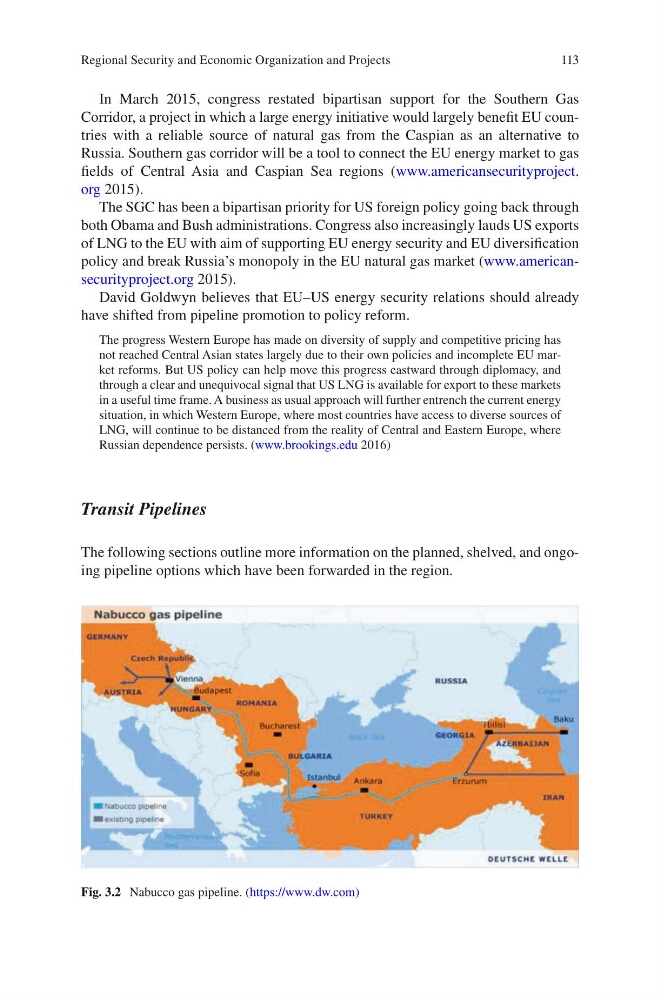
The following sections outline more information on the planned, shelved, and ongoing pipeline options which have been forwarded in the region.
Fig. 3.2 Nabucco gas pipeline. (https://www.dw.com)
Regional Security and Economic Organization and Projects
In March 2015, congress restated bipartisan support for the Southern Gas
Corridor, a project in which a large energy initiative would largely benefit EU countries with a reliable source of natural gas from the Caspian as an alternative to
Russia. Southern gas corridor will be a tool to connect the EU energy market to gas
fields of Central Asia and Caspian Sea regions (www.americansecurityproject.
org 2015).
The SGC has been a bipartisan priority for US foreign policy going back through
both Obama and Bush administrations. Congress also increasingly lauds US exports
of LNG to the EU with aim of supporting EU energy security and EU diversification
policy and break Russia’s monopoly in the EU natural gas market (www.americansecurityproject.org 2015).
David Goldwyn believes that EU–US energy security relations should already
have shifted from pipeline promotion to policy reform.
The progress Western Europe has made on diversity of supply and competitive pricing has
not reached Central Asian states largely due to their own policies and incomplete EU market reforms. But US policy can help move this progress eastward through diplomacy, and
through a clear and unequivocal signal that US LNG is available for export to these markets
in a useful time frame. A business as usual approach will further entrench the current energy
situation, in which Western Europe, where most countries have access to diverse sources of
LNG, will continue to be distanced from the reality of Central and Eastern Europe, where
Russian dependence persists. (www.brookings.edu 2016)
Transit Pipelines
The following sections outline more information on the planned, shelved, and ongoing pipeline options which have been forwarded in the region.
Fig. 3.2 Nabucco gas pipeline. (https://www.dw.com)
Regional Security and Economic Organization and Projects