

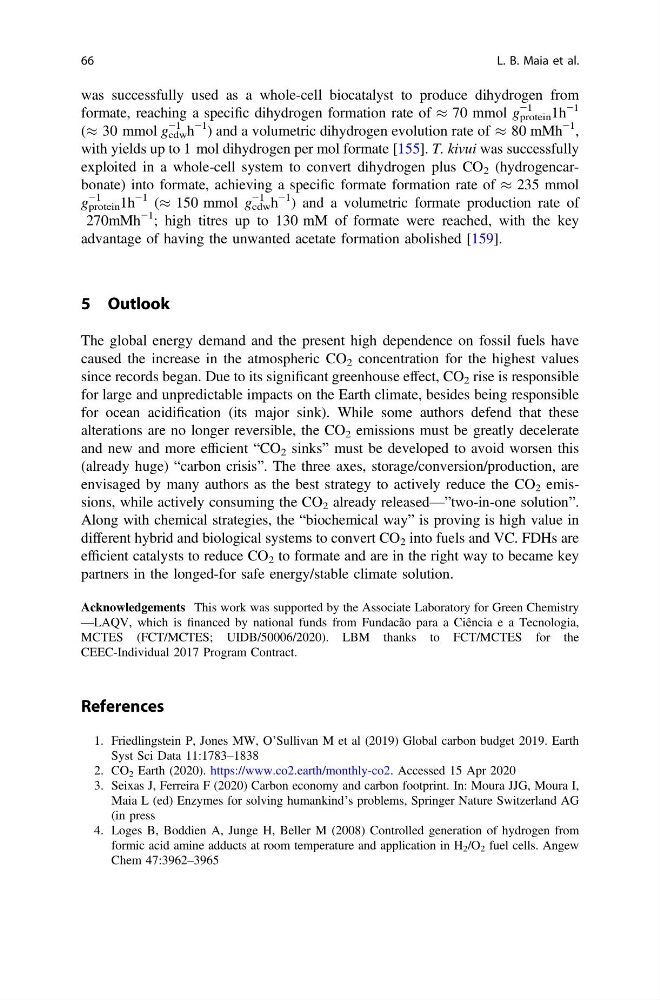
was successfully used as a whole-cell biocatalyst to produce dihydrogen from
formate, reaching a specific dihydrogen formation rate of % 70 mmol g protein
−1
1h
−1
(% 30 mmol g cdw
−1 h
−1 ) and a volumetric dihydrogen evolution rate of % 80 mMh
−1 ,
with yields up to 1 mol dihydrogen per mol formate [155]. T. kivui was successfully
exploited in a whole-cell system to convert dihydrogen plus CO 2 (hydrogencarbonate) into formate, achieving a specific formate formation rate of % 235 mmol
g protein
−1
1h
−1 (% 150 mmol g cdw
−1 h
−1 ) and a volumetric formate production rate of
270mMh
−1 ; high titres up to 130 mM of formate were reached, with the key
advantage of having the unwanted acetate formation abolished [159].
5 Outlook
The global energy demand and the present high dependence on fossil fuels have
caused the increase in the atmospheric CO 2 concentration for the highest values
since records began. Due to its significant greenhouse effect, CO 2 rise is responsible
for large and unpredictable impacts on the Earth climate, besides being responsible
for ocean acidification (its major sink). While some authors defend that these
alterations are no longer reversible, the CO 2 emissions must be greatly decelerate
and new and more efficient “CO 2 sinks” must be developed to avoid worsen this
(already huge) “carbon crisis”. The three axes, storage/conversion/production, are
envisaged by many authors as the best strategy to actively reduce the CO 2 emissions, while actively consuming the CO 2 already released—”two-in-one solution”.
Along with chemical strategies, the “biochemical way” is proving is high value in
different hybrid and biological systems to convert CO 2 into fuels and VC. FDHs are
efficient catalysts to reduce CO 2 to formate and are in the right way to became key
partners in the longed-for safe energy/stable climate solution.
Acknowledgements This work was supported by the Associate Laboratory for Green Chemistry
—LAQV, which is financed by national funds from Fundacão para a Ciência e a Tecnologia,
MCTES (FCT/MCTES; UIDB/50006/2020). LBM thanks to FCT/MCTES for the
CEEC-Individual 2017 Program Contract.
References
1. Friedlingstein P, Jones MW, O’Sullivan M et al (2019) Global carbon budget 2019. Earth
Syst Sci Data 11:1783–1838
2. CO 2 Earth (2020). https://www.co2.earth/monthly-co2. Accessed 15 Apr 2020
3. Seixas J, Ferreira F (2020) Carbon economy and carbon footprint. In: Moura JJG, Moura I,
Maia L (ed) Enzymes for solving humankind’s problems, Springer Nature Switzerland AG
(in press
4. Loges B, Boddien A, Junge H, Beller M (2008) Controlled generation of hydrogen from
formic acid amine adducts at room temperature and application in H 2 /O 2 fuel cells. Angew
Chem 47:3962–3965
66
L. B. Maia et al.
formate, reaching a specific dihydrogen formation rate of % 70 mmol g protein
−1
1h
−1
(% 30 mmol g cdw
−1 h
−1 ) and a volumetric dihydrogen evolution rate of % 80 mMh
−1 ,
with yields up to 1 mol dihydrogen per mol formate [155]. T. kivui was successfully
exploited in a whole-cell system to convert dihydrogen plus CO 2 (hydrogencarbonate) into formate, achieving a specific formate formation rate of % 235 mmol
g protein
−1
1h
−1 (% 150 mmol g cdw
−1 h
−1 ) and a volumetric formate production rate of
270mMh
−1 ; high titres up to 130 mM of formate were reached, with the key
advantage of having the unwanted acetate formation abolished [159].
5 Outlook
The global energy demand and the present high dependence on fossil fuels have
caused the increase in the atmospheric CO 2 concentration for the highest values
since records began. Due to its significant greenhouse effect, CO 2 rise is responsible
for large and unpredictable impacts on the Earth climate, besides being responsible
for ocean acidification (its major sink). While some authors defend that these
alterations are no longer reversible, the CO 2 emissions must be greatly decelerate
and new and more efficient “CO 2 sinks” must be developed to avoid worsen this
(already huge) “carbon crisis”. The three axes, storage/conversion/production, are
envisaged by many authors as the best strategy to actively reduce the CO 2 emissions, while actively consuming the CO 2 already released—”two-in-one solution”.
Along with chemical strategies, the “biochemical way” is proving is high value in
different hybrid and biological systems to convert CO 2 into fuels and VC. FDHs are
efficient catalysts to reduce CO 2 to formate and are in the right way to became key
partners in the longed-for safe energy/stable climate solution.
Acknowledgements This work was supported by the Associate Laboratory for Green Chemistry
—LAQV, which is financed by national funds from Fundacão para a Ciência e a Tecnologia,
MCTES (FCT/MCTES; UIDB/50006/2020). LBM thanks to FCT/MCTES for the
CEEC-Individual 2017 Program Contract.
References
1. Friedlingstein P, Jones MW, O’Sullivan M et al (2019) Global carbon budget 2019. Earth
Syst Sci Data 11:1783–1838
2. CO 2 Earth (2020). https://www.co2.earth/monthly-co2. Accessed 15 Apr 2020
3. Seixas J, Ferreira F (2020) Carbon economy and carbon footprint. In: Moura JJG, Moura I,
Maia L (ed) Enzymes for solving humankind’s problems, Springer Nature Switzerland AG
(in press
4. Loges B, Boddien A, Junge H, Beller M (2008) Controlled generation of hydrogen from
formic acid amine adducts at room temperature and application in H 2 /O 2 fuel cells. Angew
Chem 47:3962–3965
66
L. B. Maia et al.